
The Batman Effect: Why Your Kid Quits (And How to Build the Muscle That Fixes It)
Persistence isn't a personality trait. It's a muscle that grows under load.
- Kids who build this muscle handle frustration on their own, stick with boring tasks without melting down, and carry a quiet confidence that they can get through hard things.
- The move: stop rescuing them from discomfort and start giving them small, daily reps of pushing through it.
Researchers gave preschoolers a painfully boring task. Half the kids worked as themselves. The other half pretended to be a strong character -- a firefighter, a superhero, whatever they picked. The kids in costume stayed on task significantly longer. Same kids. Same boring job. The only difference was who they believed they were while doing it.
That finding cracks open something every parent senses but can't quite name: your child's ability to push through hard, boring, or frustrating things isn't fixed. It's a muscle. And like any muscle, it grows under load -- or atrophies without it.
The uncomfortable part? Most of us are accidentally weakening that muscle every day. Not through neglect. Through love. Through the instinct to rescue our kids from discomfort the moment we see it.
Why does my child always take the easy way out?
Children aren't lazy. They're following their biology. When something feels hard, their brain screams "stop" -- and if they've learned that fussing, whining, or melting down gets someone to rescue them, they'll use that strategy every time. Not because they're manipulative. Because it works.
The fix isn't punishment. It's gradually proving to them -- through small, stackable experiences -- that they can handle discomfort. Every time they push through something uncomfortable on their own, it deposits a coin in their "I can handle hard things" account.
Every rep of discomfort your child completes on their own deposits confidence in their "I can handle hard things" account.
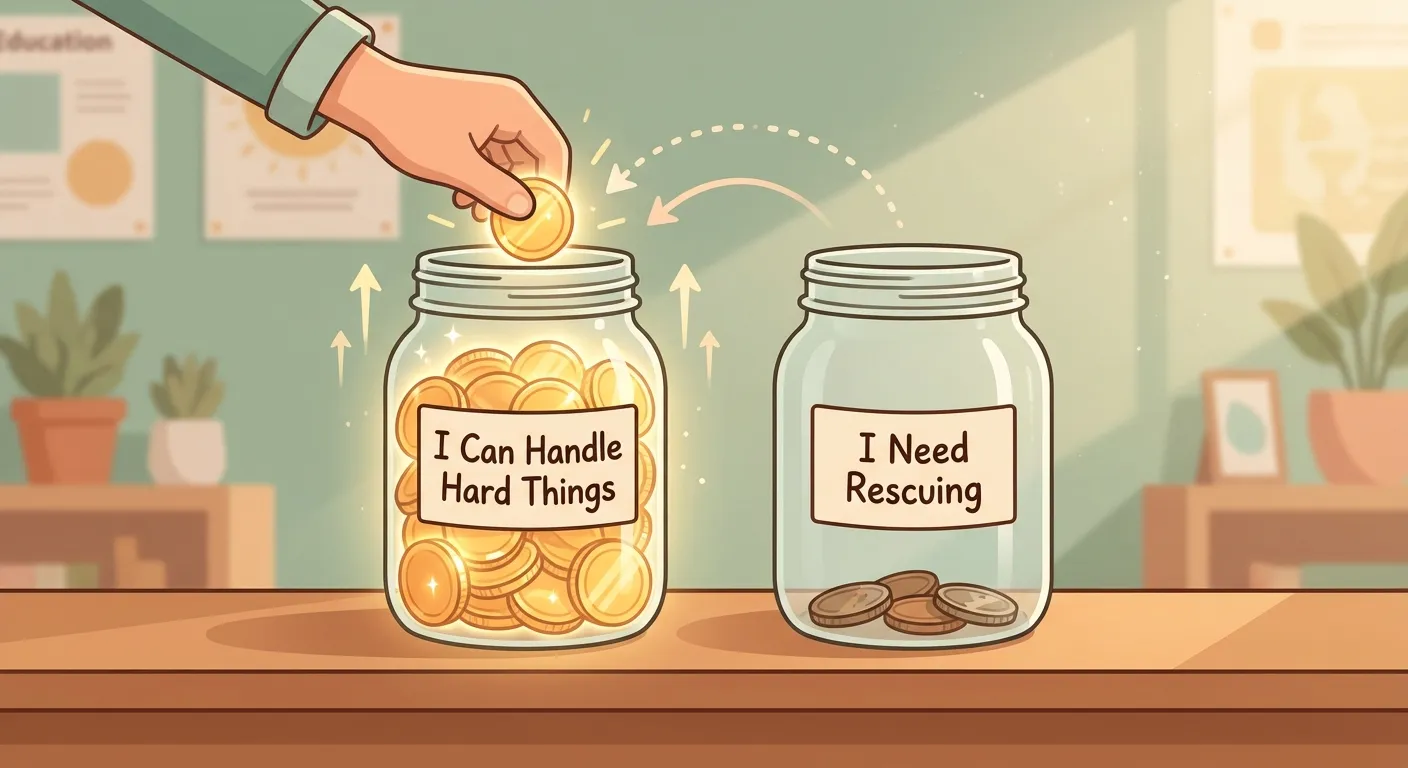
Persistence isn't born. It's built -- one small rep at a time.
The two traps that kill persistence
When your child hits a wall, you'll feel a powerful urge to do one of two things. Both feel like helping. Both teach your child the opposite of what you intend.
Trap 1: The Rescue
You solve the problem because watching them struggle is painful -- for you.
Trap 2: The Distraction
You dodge the discomfort entirely by changing the subject, offering a treat, or creating a diversion.
| Kills the muscle | Builds the muscle |
|---|---|
| Jumping in the moment they show discomfort | Letting them sit with frustration before stepping in |
| Doing their tasks because it's faster and quieter | Celebrating effort and strategy, not just results |
| Offering treats or screens to stop complaints | Asking "what could you try next?" instead of giving answers |
| Caving after they escalate (this trains them to escalate harder) | Holding the line calmly -- especially when you're tired |
| Modeling your own shortcuts when things get hard | Narrating your own push-throughs out loud |
That last row matters more than you'd think. "I really don't feel like going for a run, but I know I'll feel better after" -- said out loud, in front of your kid -- does more than any lecture about persistence.
Three techniques, matched to their age
The push-through muscle looks different at 4, 9, and 15. Here's what works at each stage -- with the exact words to use.
The Character Power-Up
This is the Batman Effect in action. Young children persist longer at tedious tasks when they pretend to be a strong, capable character. It works because stepping outside their own frustration gives them distance from the "I don't wanna" feeling. They're not quitting -- Batman wouldn't quit.
The "Prove It" Challenge
When school-age kids say "I can't," their brain is lying to them. They're confusing "this is uncomfortable" with "this is impossible." You break that pattern by giving them a small, timed challenge -- then showing them they went further than they predicted.
The Honest Trade-Off Talk
Teens see through "just say no" lectures instantly. What lands is acknowledging the appeal of the easy path and laying out the math of what it costs. Credibility comes from honesty, not prohibition.
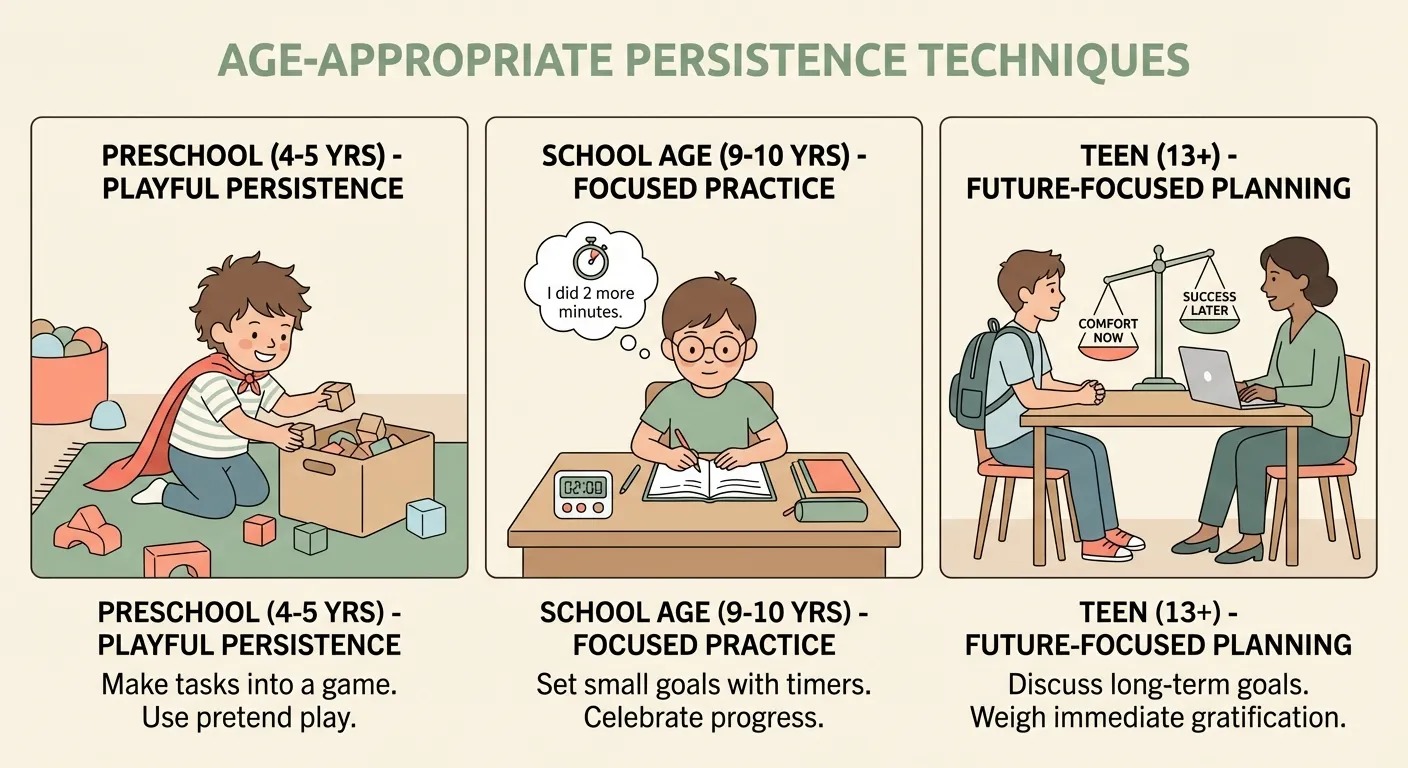
Same muscle. Different exercises. Matched to where their brain is.
Self-talk anchors: the phrases that hold
Help your child pick one short phrase they can grab when the urge to quit hits. The best anchors are physical and specific to the moment -- not inspirational posters, but handholds.
When the task feels endless. Shrink the horizon to the next single action.
When they want to quit. Reframes quitting as a choice they haven't made yet.
Connects present struggle to past evidence of capability.
For the final stretch when willpower is at its lowest.
Once they've picked their phrase, use it yourself when you see them struggling. Hearing "one more step!" from you activates the anchor without a lecture.
Daily reps: where the muscle actually grows
Don't wait for big moments. The persistence muscle gets its reps from everyday friction -- tiny, forgettable moments that add up.
Wait for dinner
Instead of snacking. Ten minutes of hunger won't hurt them -- but it builds the "I can wait" circuit.
Finish before screens
Complete the chore first. The delay between effort and reward is the entire exercise.
Walk past the candy aisle
Not every time. But enough that "no" becomes something they can tolerate, not a crisis.
Stick with the boring part
Every skill has a boring middle. Sitting through it -- not switching to something fun -- is the rep.
Most shortcut-taking happens when everyone is exhausted. If you're running on empty by 7 PM every night, the fix isn't more willpower -- it's restructuring the day so you have gas in the tank when it matters.
When they slip -- and they will
Your child pushes through on Tuesday. Caves on Wednesday. That's not failure. That's normal.
Persistence isn't a streak. It's a batting average. Highlight Tuesday. Let Wednesday go. Over time, the ratio shifts -- not because you forced it, but because they proved to themselves, enough times, that they could.
Stop rescuing. Start repping. The muscle only grows under load -- and every small push-through your child completes on their own is a deposit in the confidence account that lasts a lifetime.
Pick one technique from this page. Use it this week. Not all of them -- just one. The persistence muscle grows through reps, not overhauls.