
The Four Engines That Actually Make Kids Bilingual
Your child will speak a language when they genuinely need it to reach someone they love.
- Kids raised with real need -- a grandma who only speaks Spanish, a best friend who hasn't learned English yet -- don't resist the minority language. They use it because it connects them to people who matter.
- The shift: stop reminding your kid to 'speak Mandarin' and start building relationships that run on it -- a weekly call with abuela, a park playdate with new-arrival families.
The popular "one parent, one language" rule has a surprisingly mixed track record. Here's what research says matters more.
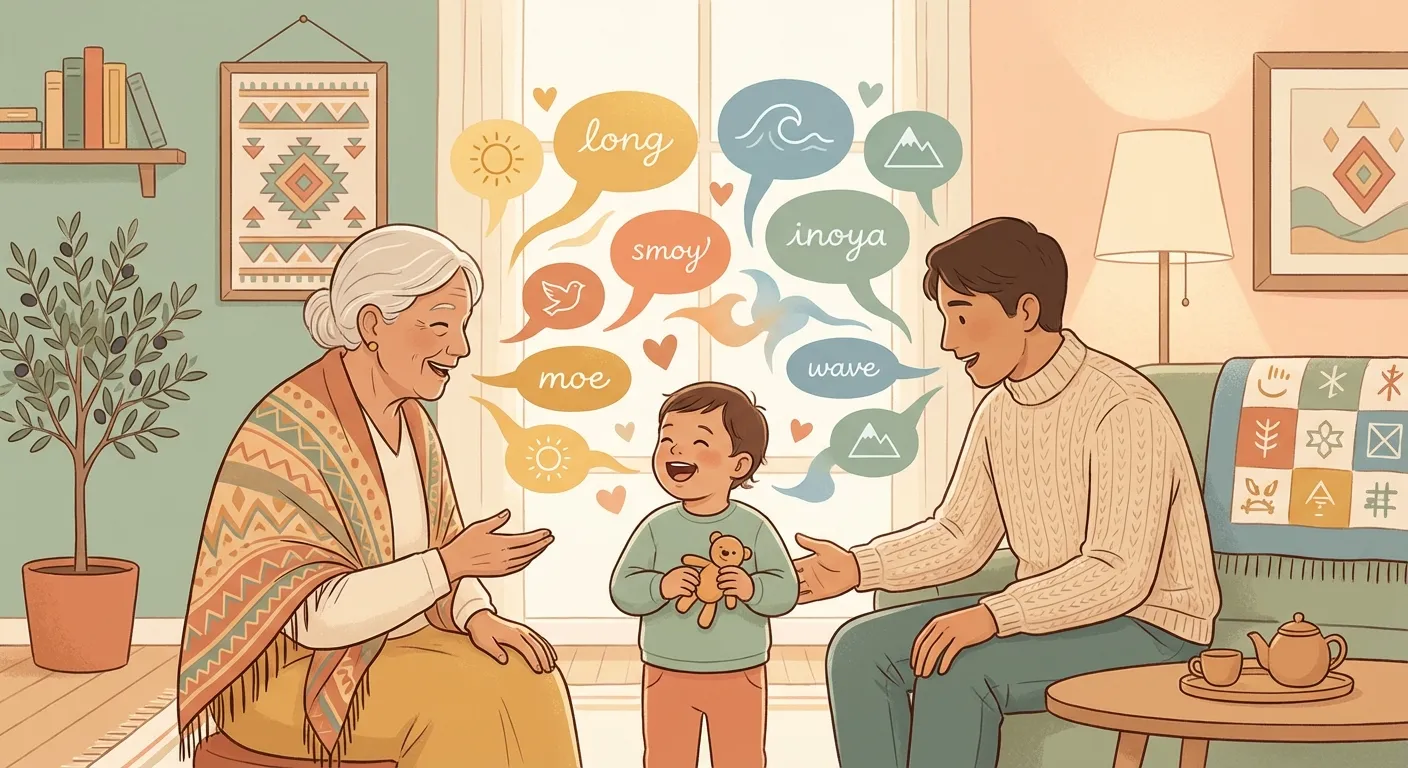
A three-year-old walks into preschool speaking Mandarin at home and hearing English all day from teachers and friends. Within six months, English starts winning. By kindergarten, Mandarin is fading. The parents did everything "right" -- each spoke their language, bought the apps, played the songs.
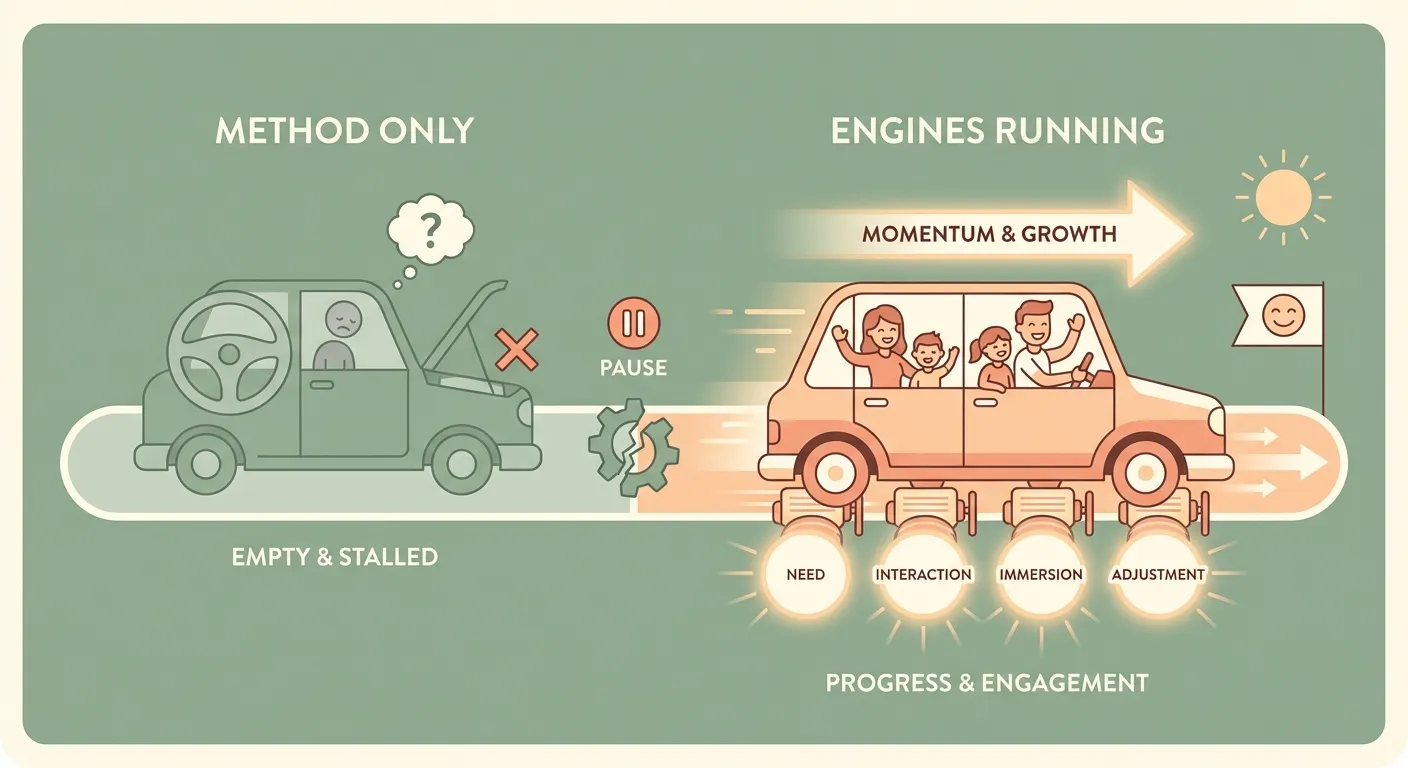
What happened? They had a method. They didn't have the engines running.
Decades of research on bilingual households across multiple countries keep landing on the same conclusion: the specific method you pick matters far less than whether you keep four forces running underneath it.
The Four Engines
Think of these as the power supply. Your method is just the wiring. Without current flowing through these four channels, no setup works. With them running, almost any setup can.
Real Need
A grandparent who only speaks Korean. A best friend from the park who hasn't learned English yet. A beloved babysitter. Your child needs a reason to speak the language -- someone they care about who can only be reached through it.
Live Interaction
Talking, playing, arguing, joking -- real back-and-forth with a real person. Background TV and language apps barely register compared to a conversation with someone who cares what your child is saying.
One-Language Moments
Time with people who speak only one of their languages. When everyone around is bilingual and switches freely, kids default to whatever is easier. Time with a monolingual speaker is gold.
Ongoing Adjustment
What works at 3 won't work at 8. As your child's world expands, the language balance shifts. Keep checking: where is input dropping off? What new sources can you add?
How the Engines Beat the Methods
Here's the difference in action. Same families, same languages -- different results based on whether the engines were running.
| Factor | Method Only | Engines Running |
|---|---|---|
| Who child talks to | Parents (who also speak English) | Grandma who only speaks Spanish, monolingual playmate from new immigrant family |
| Language input | Apps, TV shows, songs | Live conversation, bedtime reading, weekend playgroup |
| When child resists | Parent reminds: "Speak Mandarin!" -- child resents it | Child calls abuela on video -- has to use Spanish to communicate |
| At school age | Community language takes over, parents scramble | Parents add Saturday cultural school + adjust input quarterly |
| Outcome | Language fades by age 7-8 | Language grows alongside English |
Match Your Setup, Then Fire the Engines
Your family situation determines which wiring to use. The engines are what you plug in regardless.
Each Parent Speaks a Different Language
Each parent speaks their strongest language to the child. The community language gets plenty of exposure through school and friends. Pour extra energy into the language your child hears less.
- The less-common language parent can start to feel invisible once school starts
- This is the most common point where families lose the second language
- Engine fix: Build relationships with monolingual speakers of the minority language
Both Parents Share the Minority Language
Make home a zone for the minority language. Trust that school and friends will handle the rest. This approach shows the strongest results because the child gets dense, sustained input.
- Only works if both parents can hold a relaxed, natural conversation in that language
- Strained input in one language is worse than natural input in another
- Engine fix: Read together nightly; find a weekly playgroup in the minority language
Isolated -- No Local Community
You speak a language nobody else around you speaks. No immersion school, no extended family nearby. You're fighting gravity -- the community language is everywhere.
- Weekly video calls with grandparents who only speak that language
- Host visitors from abroad for extended stays -- even a few weeks shifts the balance
- Engine fix: Create situations where the language is genuinely needed, not forced as an exercise
The School Shift: Your Biggest Danger Zone
Nearly every bilingual family hits this wall. School starts, English becomes your child's entire social world, and the minority language starts losing ground fast.
Before You Plan
"We'll just keep speaking it at home."
"The apps and shows will help."
"They already know it -- it won't disappear."
Result: Minority language fades within 2 years of school starting.
After You Plan
After-school activity in the minority language locked in.
Saturday cultural school or playgroup on the calendar.
Quarterly check: How many hours of real input this week?
Result: Both languages grow -- just at different speeds.
Six Moves to Fuel the Weaker Language
These are specific, high-leverage actions. Pick two or three that fit your life.
Find New-Arrival Families
Their kids haven't learned English yet. Your child gets authentic peer practice. These windows are temporary -- use them.
Ritual Video Calls
Weekly call with grandma: story time, guessing games, show-and-tell. A relationship that runs on the language -- not a chore.
Long-Stay Visitors
A cousin or family friend who stays for weeks. Only speaks the minority language. Your child adapts fast when they need it to eat, play, and get through the day.
Bedtime Reading
15 minutes a night in the minority language. Books deliver vocabulary and sentence patterns no conversation provides. Compounds over years.
Build a Playgroup
Three or four families, same language, weekly park meetup. Kids play; language happens. Also tells your child: this language is normal, not weird.
Skip the Guilt Trips
Pressuring a child to speak a language they know you understand in English creates resentment. Create real need instead of artificial pressure.
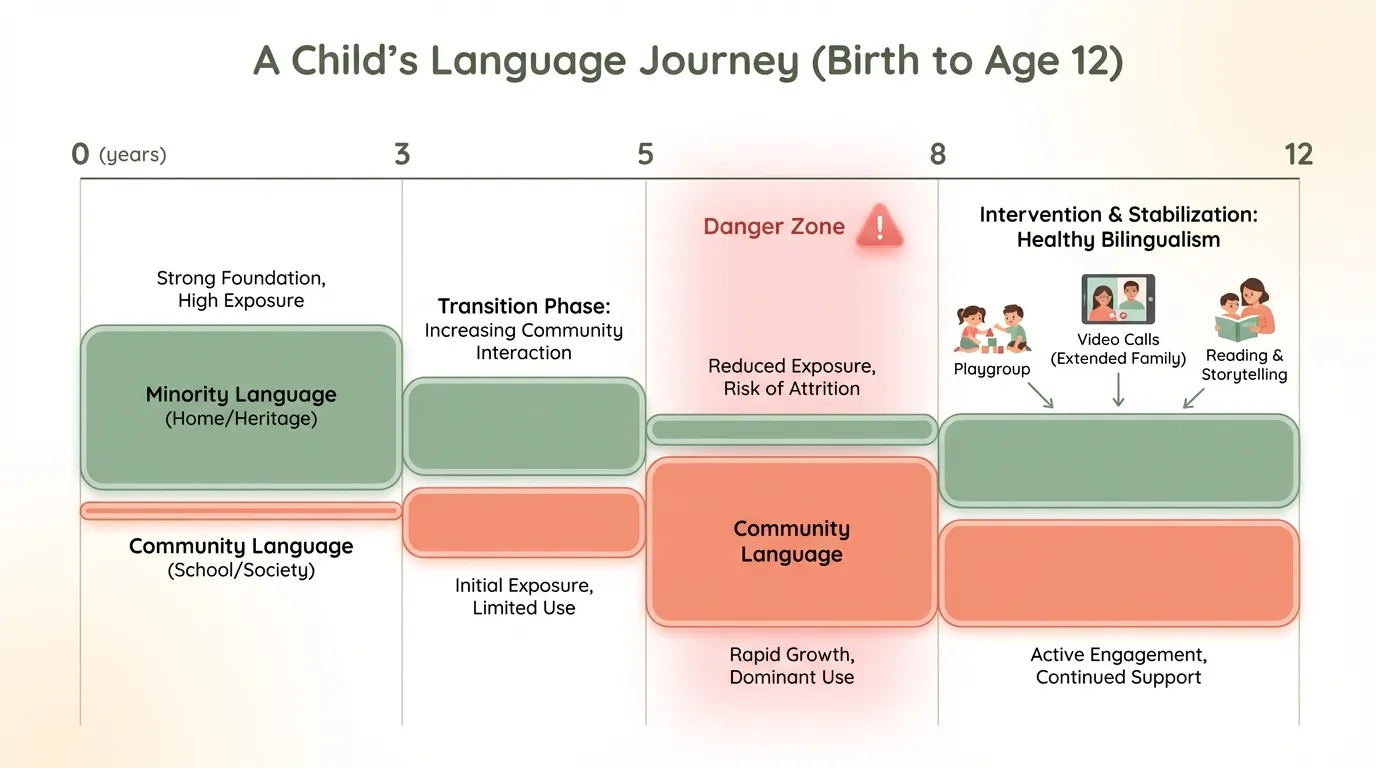
The Long Game: What to Expect Year by Year
Ages 0-3: The Foundation
Dense input in the minority language. This is when you have the most control. Use it. Grandparents, babysitters, and playgroups in the minority language are massive.
Ages 3-5: The Preschool Shift
Community language starts gaining ground. Normal. Keep minority language input high at home and through relationships.
Ages 5-8: The Danger Zone
School floods them with the community language. Expect resistance to the minority language. Don't panic -- add new sources. After-school programs, weekend activities, travel.
Ages 8-12: The Stabilization
If you've kept the engines running, both languages stabilize. Language mixing in sentences isn't confusion -- it's a sign their brain is managing two systems at once. Linguists call this a skill.
Ages 12+: Identity Kicks In
Teens who maintained the minority language often reconnect with it as part of their identity. The investment pays off when they choose to use it, not because you made them.
One Line to Remember
The perfect strategy you can't sustain loses to the imperfect one you stick with. Pick what fits your life. Then protect it fiercely.