

The HOLD
Method
Set limits and stay connected — in the same sentence
Kids who feel seen during a boundary stop fighting the boundary.
- They learn to handle no without melting down, hold their emotions without exploding, and trust you enough to come to you when it actually matters.
- The move: state the limit and name their feeling in the same sentence — then give them permission to be upset.
Wrong. That feeling — that you have to choose between your boundary and your child's feelings — is the trap. And it's the reason most discipline moments end in either a power struggle or a guilt spiral.
The truth is simpler than it feels in the moment: your decision can stand and their feelings about that decision can be real. These are not competing realities. They're parallel ones. And you can say both out loud, in one sentence, without weakening either.
Why does every boundary turn into a battle?
Because most of us were raised in either/or mode. We learned that when someone is upset about a rule, either the rule is wrong or the upset is wrong. Someone has to lose.
Children feel this instinctively. When a child senses that only one version of events is allowed — yours — they feel erased. And erased people fight back. Not because they're defiant, but because they need to prove they exist. That's why the screaming isn't really about the sleepover or the broccoli. It's about being seen.
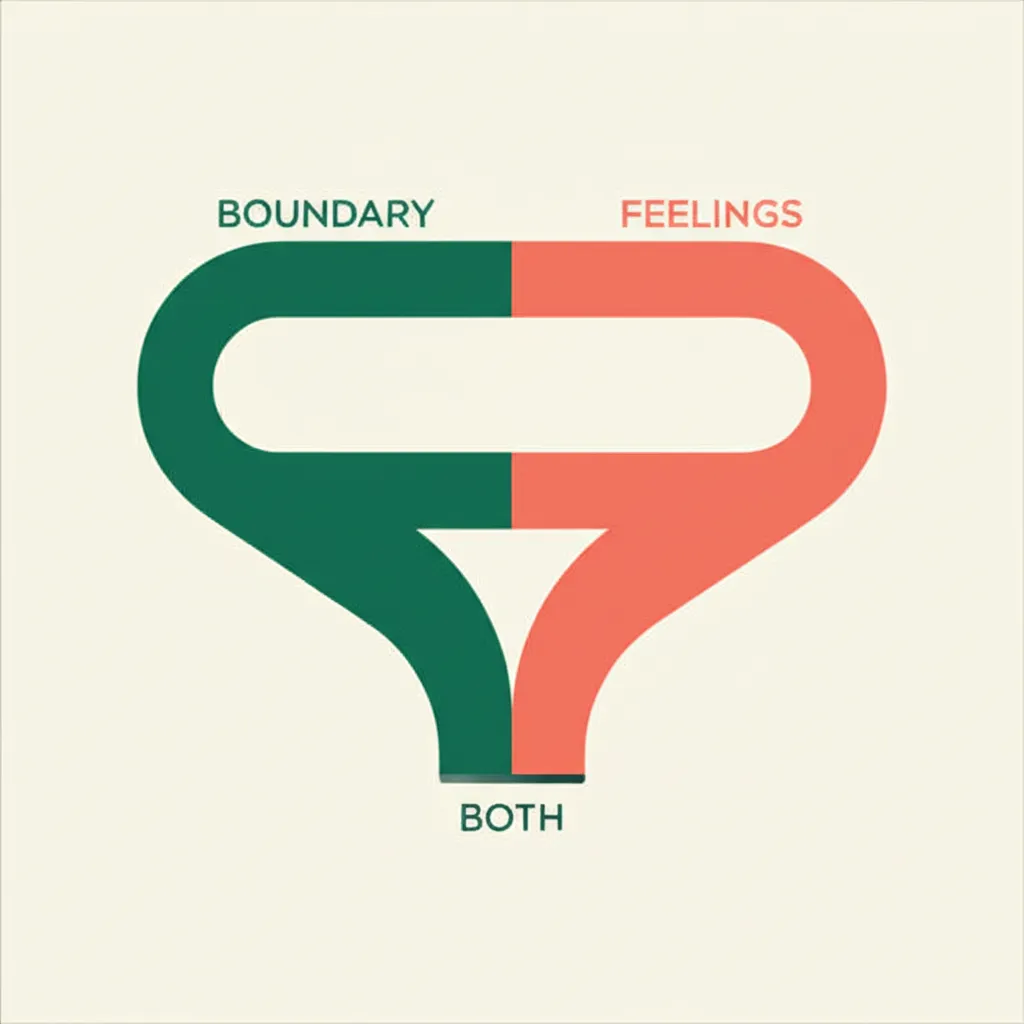
| Either/Or Thinking | Both-And Thinking |
|---|---|
| "If I acknowledge their upset, I'll undermine the rule" | "I can hold the rule and name what they feel" |
| "They need to learn that no means no — period" | "No still means no. They're also allowed to feel angry about it" |
| "If I'm warm right now, they'll think they can change my mind" | "Warmth isn't weakness. It's what makes the boundary land" |
| "I'm the parent. My feelings don't matter right now" | "I can be struggling and still be a good parent. Both are true" |
What is the HOLD method?
HOLD is a 4-step framework for setting a boundary without shutting down your child's experience. Each letter is one move. The whole thing takes about ten seconds once you've practiced it.
H — Hold Your Ground
Get clear on your decision before you speak. Remind yourself: "I've thought about this. I trust my judgment." This is one reality.
O — Open to Their Feelings
Notice what your child is experiencing — frustration, sadness, a sense of injustice. Name it to yourself. This is the other reality.
L — Link Both Truths
Say your boundary and their feeling in the same breath. Connect them with "and" or "at the same time."
D — Deliver Permission
Finish by giving them explicit permission to feel what they feel: "It's okay to be upset about this."
That last step matters more than it looks. When you say "you're allowed to feel upset," you're telling your child something crucial: your emotions won't break this relationship. That's the signal their nervous system needs to stand down.
What does this sound like in real life?
Below are four scenarios — expand any to see the full script. Notice the pattern: limit + feeling + permission. Same structure, different words.
1 Saying no to a sleepover ▶
Your 8-year-old desperately wants to sleep at a friend's house tonight. You don't know the family well enough yet.
2 The vegetable standoff at dinner ▶
Your 5-year-old takes one look at the broccoli and declares she's not eating. She wants mac and cheese. You're not making a second meal.
3 When they scream something hurtful ▶
You've just told your 6-year-old that screen time is over. He slams the tablet down and yells something that stings — words designed to hurt you.
4 When YOU feel like you're failing ▶
You just handled bedtime badly. You were short, impatient, and now guilt is flooding in. The voice in your head says you're terrible at this.
Guilt wants to convince you that one bad moment defines you. It doesn't. Self-blame locks you in place. Acknowledging both realities — the rough moment and the good intent — is what frees you to repair and do differently next time.
How do I make this a habit instead of a one-time trick?
The hardest part isn't learning the steps — it's remembering them when your child is screaming and you're exhausted. These four practices help the pattern stick.
- Catch the fork. The moment you feel yourself choosing between "hold the rule" and "care about their feelings" — that's your cue. You've hit the fork. Both paths are available.
- Practice when stakes are low. Use both-and language in calm moments: "You're tired AND you still got yourself dressed. Both are true." This builds the muscle before you need it.
- Model repair. If you slip into either/or mode — "Because I said so!" — come back later. "I held my rule, but I didn't listen to how you felt. Let me try that part again."
- Know your collapse triggers. Most parents fall into either/or when they're exhausted, rushed, or feeling judged by others. Notice those moments — they're where the old pattern pulls hardest.
Decades of relationship research — across couples, parent-child pairs, and workplace teams — converge on the same finding: when both perspectives are acknowledged, defenses drop and problem-solving opens up. Developmental psychologists call this capacity to hold multiple truths at once "multiplicity," and it's considered a marker of psychological health in both adults and children.
Remember
Seeing their feelings is not surrendering your boundary. The strongest limits come wrapped in understanding.
Explore more strategies at kungfu.family