
Behavior Strategy
The Relief Test
Time-outs have a hidden failure mode most parents never catch.
- Kids who get breaks done right stop needing them within weeks -- they self-regulate, rejoin activities on their own, and handle frustration without blowing up.
- The move: watch their face the instant you send them -- relief means you just rewarded the behavior, disappointment means the break is landing.
If your kid looks happy heading to time-out, you just rewarded the exact behavior you're trying to stop. Here's the one-second diagnostic that tells you whether your breaks are working -- and how to fix them if they're not.
Picture this: your kid shoves a sibling, you send them to the corner, and they... stroll over happily. Maybe even look relieved.
That pit in your stomach? Trust it. Something just went wrong.
Not wrong in a dramatic way. Wrong in a mechanical way. The break you just gave didn't function as a consequence. It functioned as a reward. Your kid wanted out of the situation, and you handed them exactly that.
That single sentence is the whole game. Everything else flows from it.
The One-Second Diagnostic
Next time you send your kid for a break, watch their face in the first second. That micro-expression tells you everything:
They look disappointed or mildly annoyed
The break is working. They valued being in the activity. Removing them from it has weight. Keep going.
They look relieved, happy, or unbothered
The break is backfiring. They didn't want to be there anyway. You just gave them an exit ticket -- and taught them that acting out is how you get one.
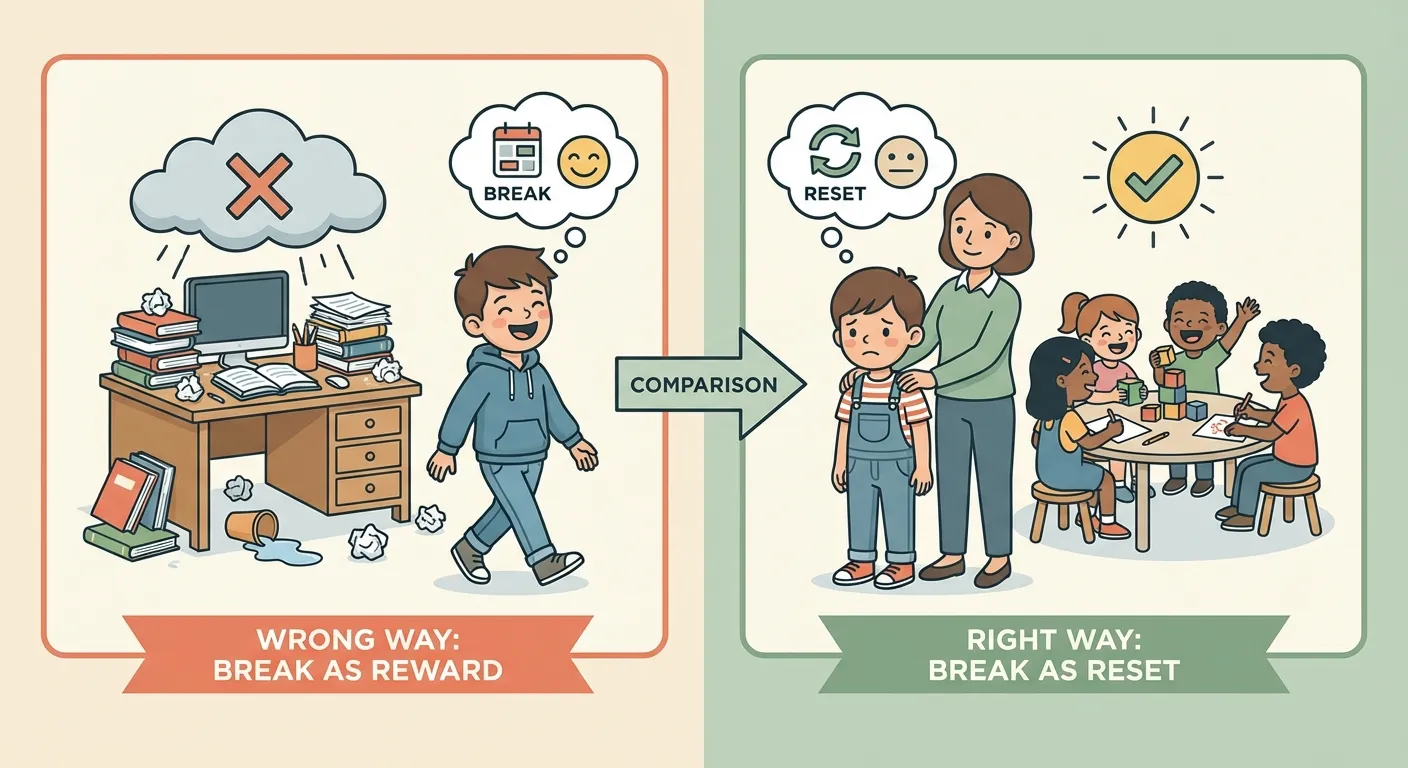
This is the Relief Test. It takes one second, no equipment, and it changes how you think about consequences forever.
Why Most Time-Outs Quietly Fail
The classic time-out was built on a solid idea: remove access to something rewarding, and the behavior that caused the removal decreases. Decades of research back this up -- when the conditions are right.
But the conditions are often not right. Here's what usually goes wrong:
| Break That Backfires | Break That Works |
|---|---|
| Kid is escaping a hard task | Kid is pulled from something fun |
| Activity feels boring or chaotic | Activity is genuinely engaging |
| Parent lectures during the break | Zero attention during the break |
| Break spot has toys, screens, books | Break spot is boring (not scary -- just dull) |
| Break lasts 15-20 minutes | Break lasts 1-5 minutes |
| Kid returns with no follow-up | First good behavior after return gets noticed |
Notice the pattern. The left column isn't about bad parenting. It's about misreading the situation. The break looks like a consequence, but under the hood it's reinforcing the exact behavior you want to stop.
The Five-Step Break That Actually Lands
Once you pass the Relief Test -- meaning they genuinely care about being in the activity -- here's how to run the break cleanly:
Name it. One sentence.
State the rule that was broken. No lecture. No "why did you do that." No negotiation.
Send them to the spot.
Minimal words. Point if needed. Do not engage in a debate about whether the break is fair. If they refuse to go, that's a different problem than this tool can solve.
Start timing when they're calm.
The break clock doesn't start during the tantrum. It starts when they're sitting quietly. You're measuring calm time, not scream time.
Go silent.
Zero attention. No eye contact, no talking, no explaining. Even negative attention is attention -- and attention is often the thing they were after. Stay nearby for safety, but become a wall.
End clean. Catch them fast.
When time's up and they're calm, brief words to close it out. Then watch like a hawk for the first good thing they do -- and notice it immediately.
When to Skip Breaks Entirely
- The behavior is escape-driven. They're acting out to get away from something hard. A break hands them exactly what they want.
- The activity isn't engaging. If they don't care about being there, removal has no weight.
- It's sensory or self-soothing. Removing them from the room doesn't change their internal state.
- You haven't taught the replacement yet. "Use your words" only works if they know which words. Teach first, consequence second.
Is It Working? The 2-Week Tracker
Don't guess. Count. Track how often you're using breaks per week. If it's working, the number drops over 2-3 weeks. If it's flat or rising, the strategy isn't landing.
Weekly Quick-Check
If you're seeing red signals, don't push harder on the same approach. The break isn't broken -- the conditions around it are.
The Real Endgame: No More Breaks
Breaks are a short-term tool, not a permanent system. The goal is to build self-regulation so your kid doesn't need to be removed. Here's how you get there:
The Relief Test takes one second. But it reframes every consequence interaction you'll ever have. Because once you see breaks through the lens of "what are they actually experiencing right now," you stop running the same play that isn't working -- and start designing situations where your kid genuinely wants to be in the game.
That's when the breaks start working. And that's when you start needing them less.