
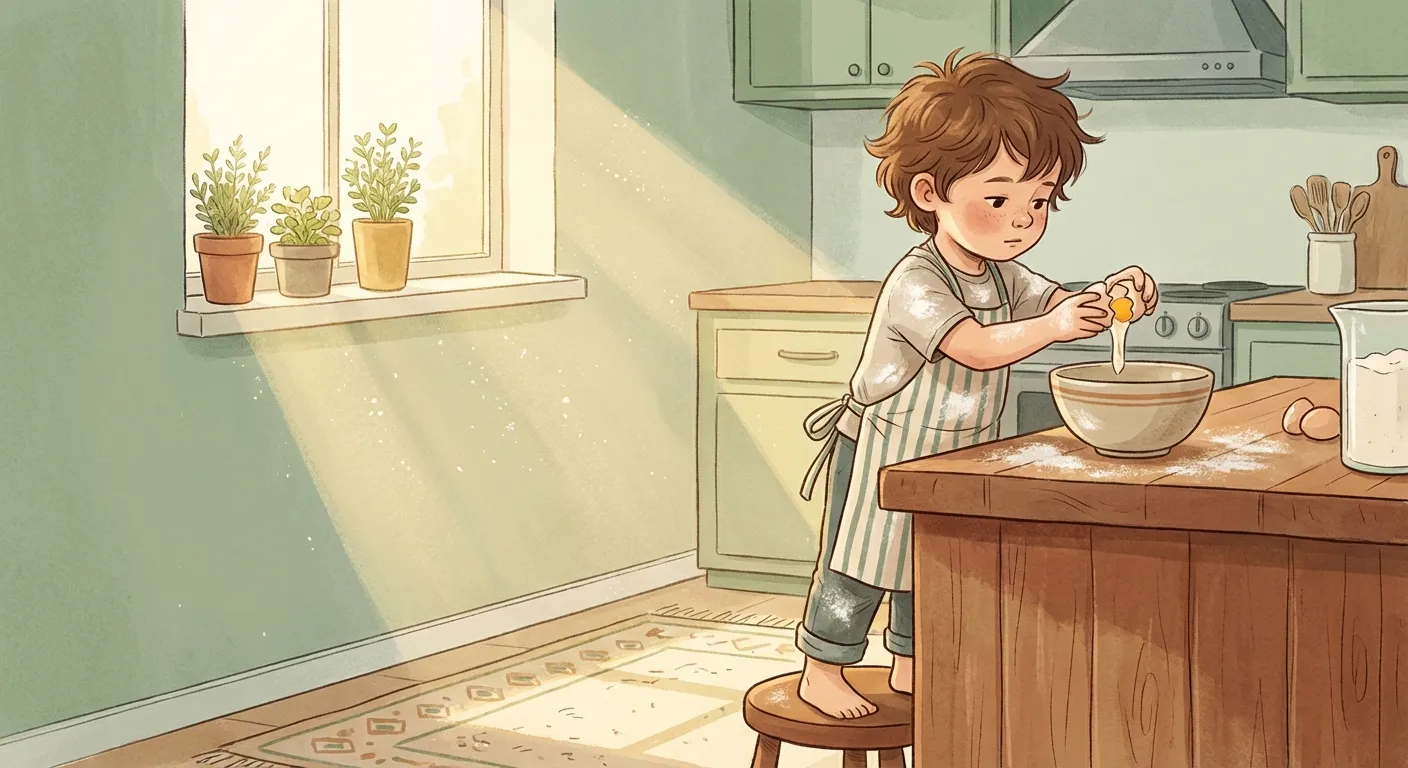
The Scary Part Is the Point
Confidence doesn't come from praise. It comes from doing hard things.
- Kids who cook, navigate, make phone calls, and travel without a parent hovering develop lower anxiety and stronger self-regulation — measurably, within weeks.
- The shift: replace 'Good job!' with 'How did that feel?' — let them own the win instead of borrowing yours.
That knot in your stomach when they ride off alone? Don't fight it. It means the confidence machine is working.
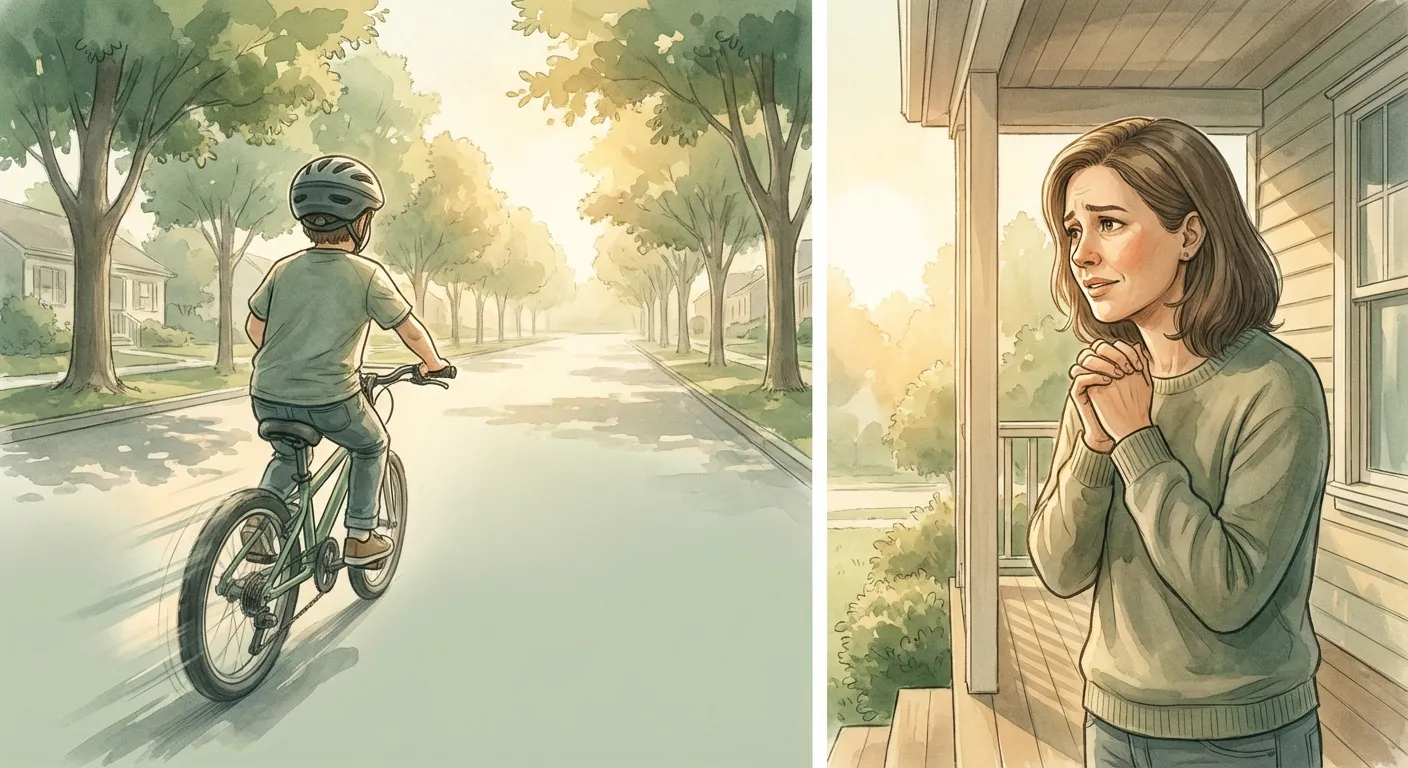
Your seven-year-old wants to bike to the park alone. Your stomach drops. You run the scenarios: the intersection, the stranger, the fall. Every cell in your body says not yet.
Here's the thing nobody tells you: that feeling isn't a warning sign. It's the exact sensation of confidence being built — theirs and yours.
Developmental research keeps landing on the same finding: children who regularly handle real-world tasks on their own — cooking, navigating, buying things, solving problems without a parent hovering — develop stronger self-regulation, lower anxiety, and greater resilience. Not because the tasks are hard. Because the tasks are real.
The Flip
Every parenting fear has a mirror image. The moment that scares you is the exact moment something clicks for your kid. Look at the flip:
| What scares you | What it builds in them |
|---|---|
| They miss the bus | They learn to problem-solve under pressure |
| The recipe fails spectacularly | They learn that failure isn't permanent |
| They get lost in the store | They learn to ask strangers for help |
| They call and say "I don't know what to do" | They learn to name the problem before solving it |
| Nobody sits with them at lunch | They learn they can survive discomfort |
| They spend their money on something stupid | They learn what "not worth it" actually feels like |
The pattern holds every time: struggle followed by success wires confidence. Struggle followed by rescue wires helplessness.
The Timeline of Letting Go
Most parents wait too long. If you're wondering whether they're ready, they probably were six months ago. Here's what the research-backed progression looks like — and what that scary-proud moment feels like at each stage:
Milk on the counter. Cheerios on the floor. They beam like they've conquered Everest. Set up kid-height shelves, smaller containers, accessible supplies — then step back.
Your fear: the mess. The growth: "I can feed myself."
Send them a few aisles away to find an item. Later, they handle the register while you hang back. Talking to cashiers, counting money — foundational social muscles.
Your fear: they'll freeze up. The growth: "I can talk to adults."
Start with routes you've done together. A watch or basic phone gives a check-in option without the distraction of a smartphone. Gradually extend the range.
Your fear: the intersection. The growth: "I can navigate the world."
Ordering takeout. Calling a relative. Making a reservation. Many young adults struggle with phone calls because they never practiced as kids. Start with low-stakes calls.
Your fear: awkwardness. The growth: "I can handle conversations."
Plan, shop for ingredients, cook, serve. Once or twice a week. Bonus: that's one night you don't have to think about dinner.
Your fear: the knife, the stove. The growth: "I can take care of other people."
Airlines offer unaccompanied minor programs starting around age 5. Navigating gates, handling delays, managing luggage — a massive confidence lever.
Your fear: everything. The growth: "I can go anywhere."
A hike, a camping trip, an afternoon at the beach — planned and executed by teens without you. This is where real judgment develops.
Your fear: the unknown. The growth: "I trust myself."

What to Say When They're Scared
They'll say "I can't" or "I'm scared." That's not a stop sign. It means the challenge is real — which means the growth will be too. Here's the script:
The Moment They Hesitate
Notice what's not on the list: praise. "Good job" makes it about you. "How did that feel?" makes it about them. That's the difference between borrowed confidence and the kind they keep.
But Is It Even Safe?
The fear feels modern, but the data says otherwise.
The perception of danger went up because media coverage went up — not because actual risk increased. By every major statistical measure, your child's physical environment is safer than the one you grew up in.
And the real risk? It's not the scraped knee or the missed bus. It's a kid who reaches 18 and has never called to make their own appointment, never cooked a meal, never navigated a new place alone — and now has to do all of it at once with nobody to practice on.
Every capable thing your child does without you is a deposit in a confidence account that will carry them through adolescence and beyond.
The Three Rules
When Doubt Creeps In, Remember
Start Tonight
Pick one thing your kid can do that you're currently doing for them. Hand it over. Feel the knot in your stomach. Watch them figure it out. That's the feeling of confidence being built — theirs and yours.