

Your Child's Perception Is Their Superpower. Five Phrases Are Quietly Disabling It.
The tiny rewrites that build a kid who trusts what they see, feel, and know
You're not just responding to your child's world. You're building the lens they see it through.
- Kids whose reality gets honored develop emotional clarity, resist gaslighting, and maintain stable self-worth through adolescence and beyond.
- The move: trade 'you're fine' and 'stop crying' for scripts that tell your child their eyes and gut are working correctly.
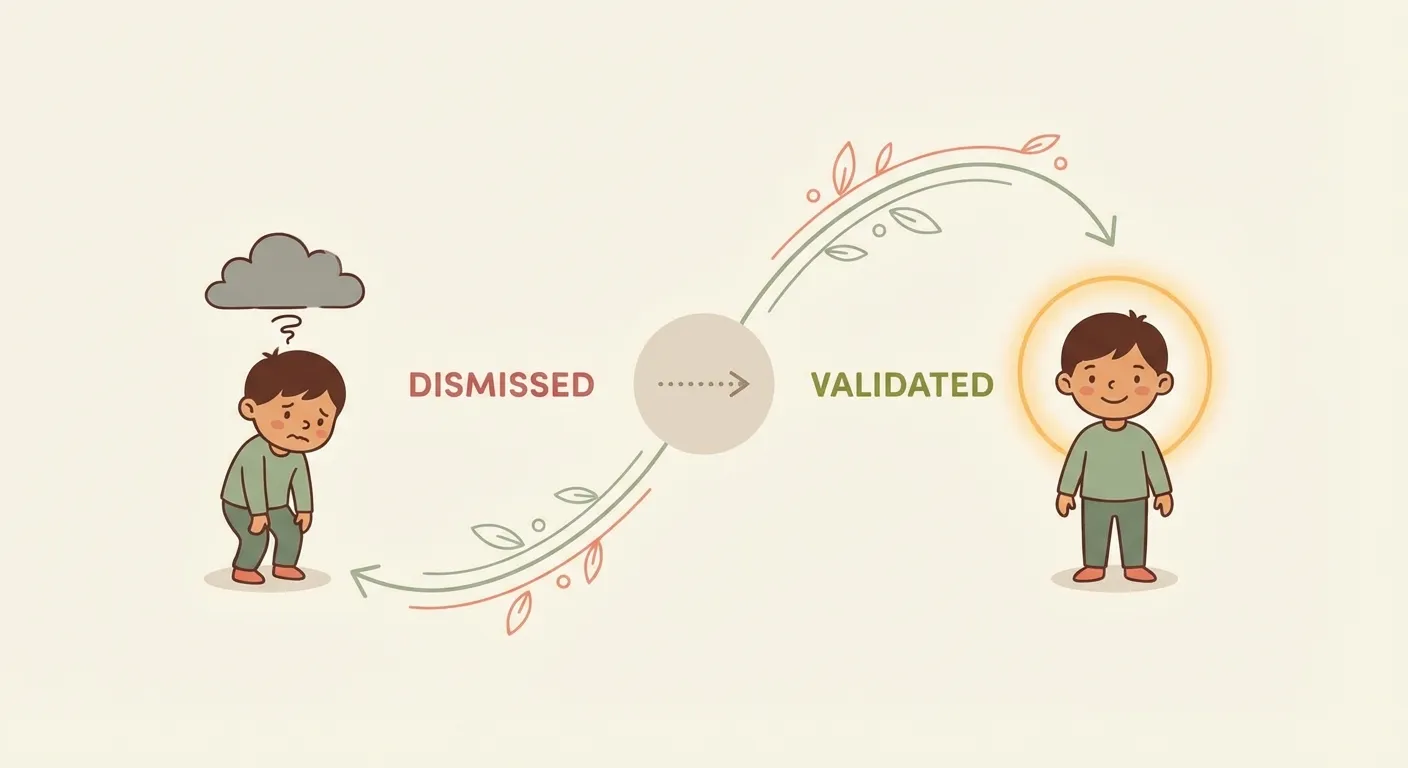
Your kid walks into the kitchen and says, "Mommy, you look sad." You weren't expecting that. You paste on a smile: "I'm fine, sweetie! Go play."
Totally normal. Totally harmless. Except your child just demonstrated something remarkable -- they read a room, identified an emotion, and named it accurately. And you just told them they were wrong.
This happens dozens of times a week in most homes. Not because parents are cruel, but because we're running on autopilot. And here's the thing developmental research keeps showing: every time a child's accurate perception gets waved away, their internal compass loses a degree of calibration.
Experiences that get pushed out of a child's awareness don't disappear. They keep shaping thoughts, feelings, and behavior -- often for decades -- while the person has no conscious understanding of why.
The good news? This is one of the easiest parenting upgrades you can make. No special training. No new routines. Just swapping five reflexive phrases for five better ones.
The Five Phrases (And What to Say Instead)
These aren't rare slips. They're the phrases most of us grew up hearing. They feel completely natural -- which is exactly why they're worth examining.
Instead of
"You're fine."
Try
"That sounds really scary to you. Tell me more about what you're feeling."
Dismissing fear teaches kids their internal warning system is broken. Taking it seriously -- even when the fear seems irrational -- tells them their feelings are real data, worth investigating.
Instead of
"Stop crying."
Try
"It's okay to cry. You're missing them. I miss them too."
"Chin up" and "don't cry" are among the most quietly destructive things a parent can say. When you let your child see that sadness is allowed -- and share your own -- they learn painful feelings are survivable, not something to flee from.
Instead of
"That didn't happen."
Try
"Yes, that happened. It was upsetting. You're safe now, and I'm here if you want to talk about it."
Children can handle age-appropriate honesty. What they cannot handle is being told their eyes lied to them. Chronic distrust of their own senses starts here.
Instead of
"Don't be angry at me."
Try
"You're really mad at me right now. That's allowed. I'm not going anywhere."
A child who can't be angry at a parent has two options: turn it inward (depression, self-blame) or redirect it destructively. Simply naming the feeling as allowed -- without caving on boundaries -- is enough.
Instead of
"I never said that." / "I didn't yell."
Try
"I'm sorry I yelled. That wasn't okay. You didn't deserve that."
Children who watch parents deny obvious mistakes learn that reality is negotiable -- and that power determines what's true. Owning your errors teaches them the world is stable and trustworthy.
What's Actually Happening Under the Hood
This isn't about hurt feelings in the moment. It's about something structural. When a child's perception gets repeatedly overridden, three things break down:
| The Pattern | What It Costs Them Long-Term |
|---|---|
| Told they imagined or dreamed it | Chronic distrust of their own senses. Difficulty telling what's real. A persistent feeling something is "off" they can never name. |
| Family events treated as secrets | The secret becomes a cage. They can't process what happened because they can't talk about it. Isolation deepens the impact. |
| Sadness or fear shut down | The targeted emotion goes offline -- but so does their broader emotional range. Adults who feel strangely numb, unable to identify what's wrong. |
| Parent presented as always right | The child holds two contradictory realities: the parent they're required to see (flawless) and the parent they actually experience. They learn their perception of people can't be trusted. |
| Expected to manage parent's emotions | They bury their own needs and build a performance persona -- capable, agreeable, never asking -- while their actual self stays hidden. |
The thread connecting all of these: the child's experience doesn't vanish. It goes underground. It keeps operating. And decades later, they're in a therapist's office trying to figure out why they can't trust their own judgment.
Four Habits That Protect the Superpower
Beyond swapping phrases, you can build a home where perception stays sharp. These aren't big interventions. They're small, daily recalibrations.
-
1
Catch your reflexive dismissals. "You're fine," "it's nothing," "stop making a big deal out of it" -- these phrases slip out because most of us heard them growing up. Start noticing them. Each one is a small signal that your child's experience doesn't count.
-
2
Name emotions out loud. "You look sad." "That seems frustrating." "I think you might be scared." This teaches kids that feelings are identifiable, nameable, and normal -- not mysterious forces to suppress.
-
3
Let your own imperfection show. When you admit to being wrong, tired, frustrated, or unsure, you model that inner experience is worth acknowledging. A parent who never shows vulnerability teaches the child to hide theirs.
-
4
Know your triggers. If certain topics -- your marriage, your own parents, money -- make you want to shut down questions, that's information. Those are the exact areas where your child most needs honest (if age-appropriate) engagement.

Why This Matters More Than You Think Before Age 12
Before adolescence, children's perceptions are heavily shaped by how parents frame the world. What you openly acknowledge, they learn to perceive clearly. What you refuse to discuss, they may struggle to register at all.
Read that again. You are not just responding to your child's world. You are literally building the lens through which they see it.
Every time you confirm what they observed -- "Yes, Dad was upset at dinner. That was real." -- you strengthen the lens. Every time you deny it -- "Everything's fine, stop worrying" -- you put a smudge on it. Enough smudges and they stop trusting what they see entirely.
Your child can handle the truth, told simply and with warmth.
What they cannot handle is being told that what they saw, heard, or felt isn't real.
Protect the superpower. It's the foundation for everything else they'll build.