
The Four Hardest Words in Parenting Aren't "I Love You"
Most kids stop talking about feelings because of what happens when they try.
- Kids who grow up with this ritual tell you when something's wrong — before it becomes a crisis. They learn to name their emotions, ask for space, and trust that honesty won't be punished.
- The move: give your family a weather metaphor for feelings, and when someone shares, say only "Thanks for telling me."
Your kid tells you they had a terrible day. Every instinct screams: Ask what happened. Find the problem. Fix it. But the single most powerful response is one that will feel completely wrong the first time you say it.
"Thanks for telling me."
That's it. No follow-up. No detective work. No "Was it that kid again?" Just acknowledgment that they trusted you enough to say something honest, and you didn't turn it into a project.
Virginia Satir, a family therapist, spent decades watching families talk past each other. She noticed something specific: most people -- adults and kids -- can't talk about how they actually feel. Not because they lack vocabulary. Because every time they try, the other person does something with it. Gives advice. Minimizes it. Turns it into a conversation about themselves. So people stop trying.
Her fix was deceptively simple. She gave families a metaphor.
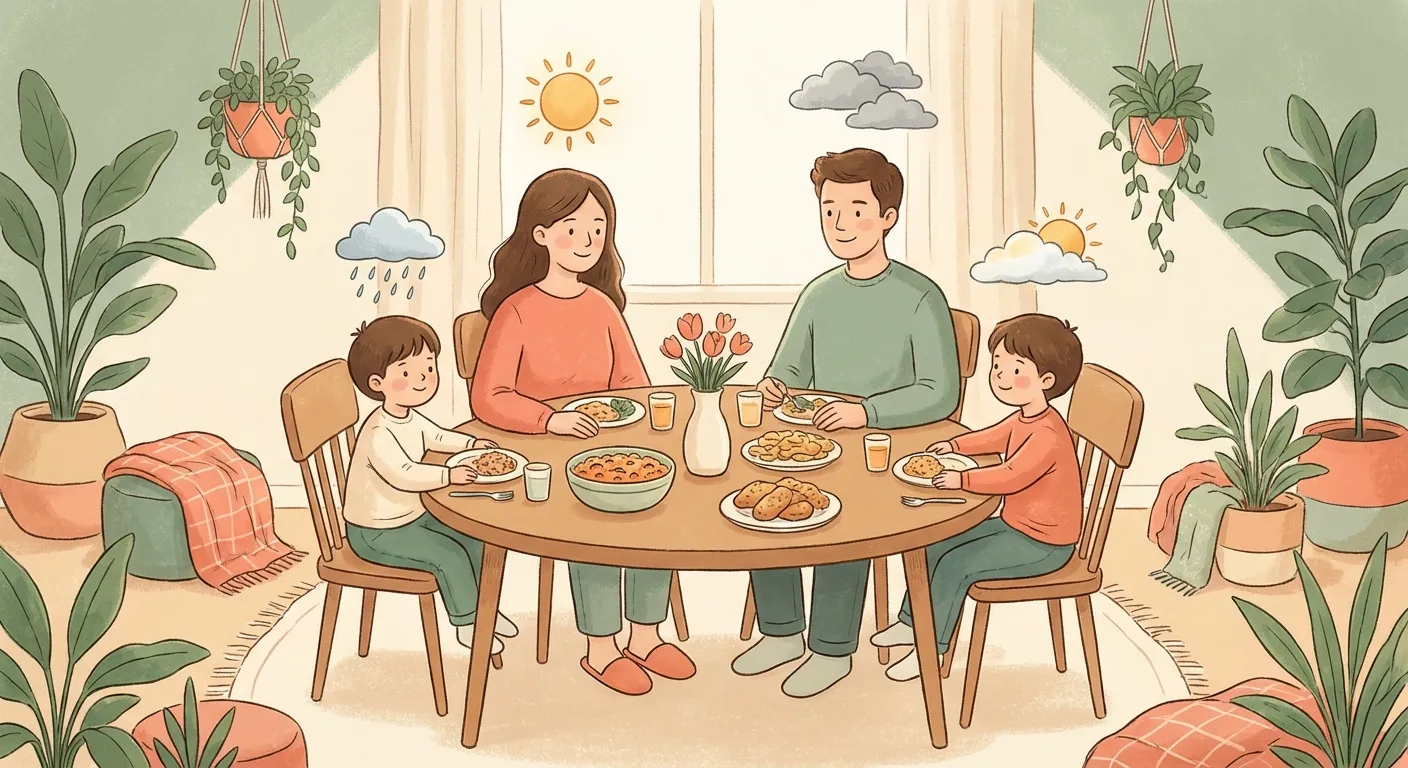
Everyone carries different weather. The family that can say it out loud weathers everything better.
The Metaphor That Removes the Pressure
Imagine your inner world has weather. Some days are clear and warm. Other days are overcast, rainy, freezing. There's no wrong weather -- the only problem is pretending the sun is out when you're actually in a storm.
"What's your weather today?" is a different question than "How are you feeling?" It's lighter. Less clinical. A six-year-old can answer it. A teenager can answer it without feeling interrogated. And it comes with a built-in escape hatch: weather changes. Saying "I'm stormy" doesn't mean you're broken -- it means right now is rough.
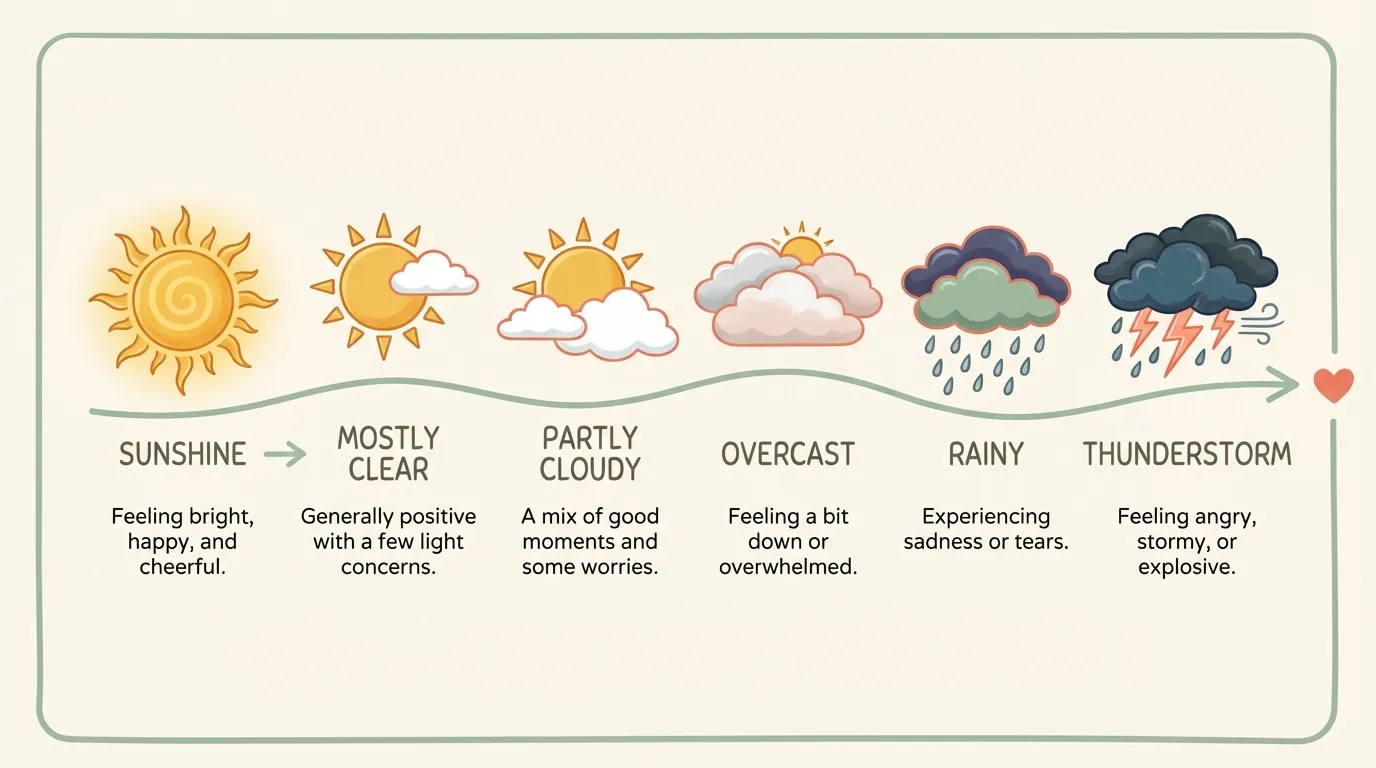
The scale isn't about precision -- it's about giving people a fast, low-pressure way to signal where they are.
The scale doesn't need to be complicated. Most families land on something like this:
| Weather | What It Feels Like |
|---|---|
| Sunshine | Good energy. Open. Ready for anything. |
| Partly Cloudy | Fine overall, but something's sitting in the back of my mind. |
| Overcast | Low energy. Everything feels heavier than usual. |
| Rainy | Sad, drained, or just want to be left alone. |
| Thunderstorm | Angry, overwhelmed, or falling apart inside. |
Kids don't have to explain why they're rainy. They just have to say the word. That alone is a massive shift. It turns "I can't articulate this complicated feeling" into "I can point to a cloud."
Why the "Fix It" Instinct Kills the Whole Thing
Here's where most parents -- most people, honestly -- break the ritual without realizing it.
A child says, "My weather is stormy." And the parent, because they love this child, immediately responds with some version of:
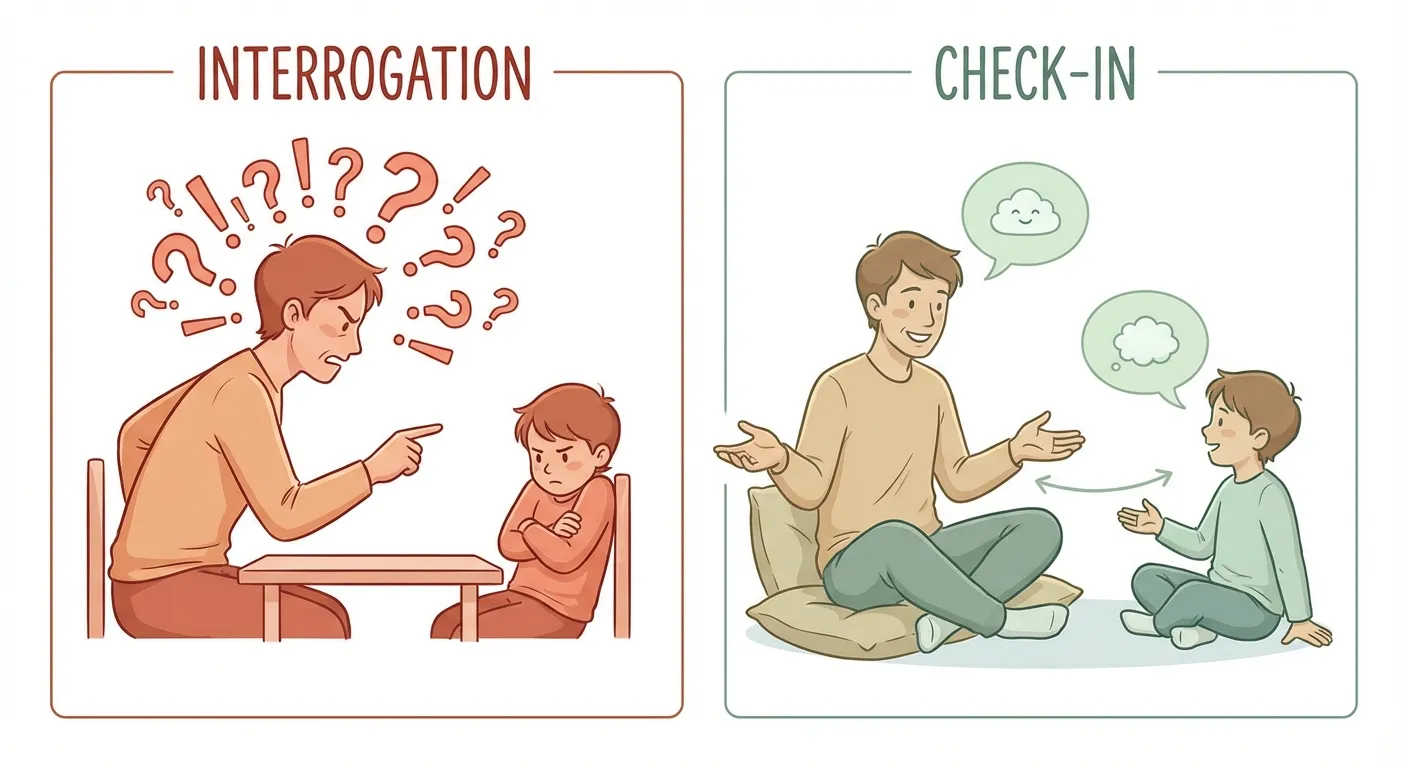
Same kid, same bad day. The difference is what happens in the next five seconds.
| What feels natural | What actually works |
|---|---|
| "Why? What happened?" | "Thanks for telling me." |
| "Was it something at school?" | (Silence. Warmth.) |
| "Well, at least you have the weekend." | "I'm glad you told me." |
| "Do you want to talk about it?" | "I'm here if you want to say more. No pressure." |
The left column isn't bad parenting. It's loving parenting with the wrong timing. Every one of those responses sends the same unintentional message: Your feeling is a problem to be solved.
The right column sends a different message: Your feeling is information I'm grateful to have.
When someone shares their weather, you say:
"Thanks for telling me."
No judging. No fixing. No interrogating.
This is genuinely hard. It will feel insufficient. You'll worry you're doing nothing. But think about it from the child's perspective: every other adult in their life responds to feelings with action. You're the one person who responds with presence. That's rare. And they'll come back to it.
How to Start (Without It Feeling Forced)
The ritual has four steps. The first three take about a week. The fourth takes care of itself.
Pick a casual moment -- dinner, a car ride, bedtime. Don't make it a big announcement. Just introduce the idea that people carry invisible weather.
Use the language yourself for several days before you ever ask your kid about theirs. Let them hear you be honest -- including on the cloudy days. If you only ever report sunshine, they'll learn this is performative.
"I'm pretty overcast right now. Long day. I just need a few quiet minutes."
After a few days of modeling, ask casually. If they share, thank them. If they shrug or say "I don't know" -- let it go. The moment this becomes mandatory, it stops being safe.
When the metaphor sticks, something shifts. Family members start using it unprompted to communicate needs -- without justifying or explaining.
"Leave me alone for a bit -- my weather is rough."
"Can we talk later? I need my skies to clear first."
If you ask about their weather and then probe with "Why? What happened?" -- you've just turned a check-in into an interrogation. They won't make that mistake twice. The rule is: they share, you thank them. That's the whole move.
Adjusting for Age
The metaphor works across a surprisingly wide range. How you use it just shifts.
Skip words. Use their bodies: arms spread wide overhead for "sunshine," arms hanging low for "rainy." You can also draw suns, clouds, and storms on a whiteboard by the door.
Add a number. "My weather's about a 6 out of 10 -- partly cloudy." Ask what made it go up or down. They'll start connecting events to feelings on their own.
Introduce the real distinction: having a rough day is normal. Pretending you're fine when you're not is what's dangerous. Teens need permission to drop the mask.

The danger isn't having stormy weather. It's the gap between what they show and what they feel.
Making It Stick (Without Making It a Chore)
- Anchor it to one moment. Dinner, bedtime, the car ride home. One consistent touchpoint is enough. Don't try to do it all day.
- Let it breathe. Some days nobody wants to check in. That's fine. An invitation that becomes an obligation stops working immediately.
- Repair when you slip. You'll accidentally jump into fix-it mode. When you catch it: "Sorry -- I just started problem-solving. What you said matters. Thanks for telling me." Modeling the repair teaches more than doing it perfectly ever could.
- Watch the "always sunny" person. The family member who never reports clouds might need the ritual most. Don't push, but notice. Sometimes just saying "I've noticed you always say sunny -- I want you to know it's okay to say cloudy" opens everything up.
Give your family a metaphor that makes feelings speakable, and respond to honesty with the only words that keep people coming back:
"Thanks for telling me."