
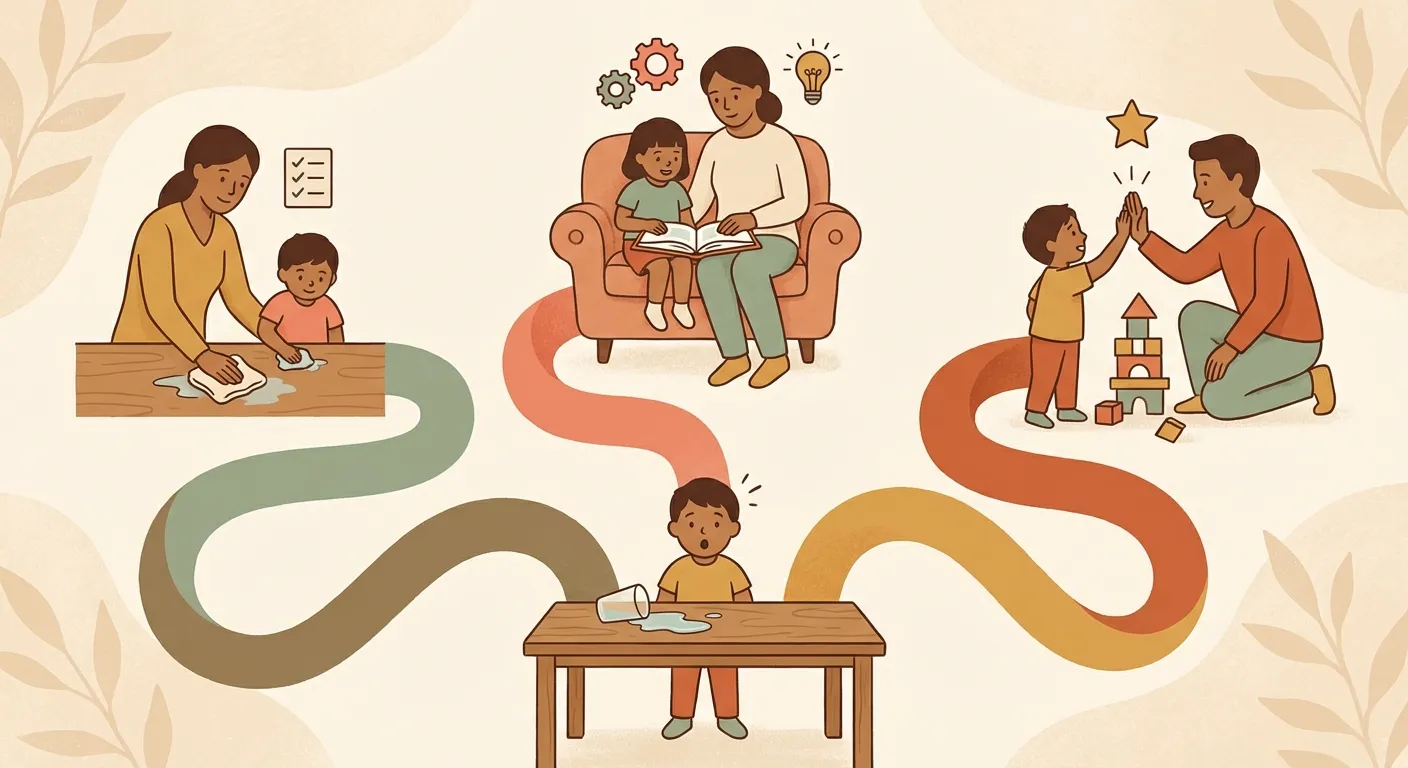
The growth mindset trick nobody talks about: match the mistake type.
- Kids raised this way don't crumble after a bad grade or a rejection -- they know how to diagnose what happened, extract the lesson, and move forward with a plan.
- The shift: celebrate risk-taking mistakes, normalize knowledge gaps, and build systems for careless ones -- instead of lumping them all together.
Your kid comes home with a failed math test. Your other kid didn't make the soccer team. Your youngest spilled juice all over the couch because she was doing cartwheels in the living room.
Three mistakes. And if you respond to all three the same way -- a lecture, a sigh, a "we'll do better next time" -- you're missing the single most useful insight in the whole growth mindset playbook.
These aren't the same kind of mistake. They came from different places. And the conversation that helps one will actually backfire on another.
The Three Types
Once you see this framework, you can't unsee it. Every mistake your child makes falls into one of three buckets -- and each one has a different job for you as a parent.
Careless Mistakes
Rushing, not paying attention, skipping steps. The mistake didn't need to happen -- they just weren't being careful.
Forgetting their name on a test. Spilling milk because they were goofing around. Leaving their jacket at school for the third time this week.
Your job: help them build systems. Checklists, routines, slow-down habits.
Knowledge-Gap Mistakes
They didn't know something yet. This isn't a failure -- this is literally how learning works.
Getting a math problem wrong because they haven't mastered the concept. A social misstep they couldn't have predicted.
Your job: normalize it completely.
Risk-Taking Mistakes
They tried something hard, something new, something uncertain -- and it didn't work out. These are the most valuable mistakes a child can make.
Trying out for the school play and not getting a part. Starting a lemonade stand that flopped. Raising their hand in class and getting it wrong.
Your job: celebrate the courage.
Quick Reference
Tape this to your fridge. When your child makes a mistake, identify the type first -- then match your move.
| Type | What Caused It | Your Move | The Script |
|---|---|---|---|
| Careless | Rushing, inattention | Build a system | "Let's figure out a way to catch this next time." |
| Knowledge Gap | Didn't know yet | Normalize | "Now we know what to learn next." |
| Risk-Taking | Tried something hard | Celebrate | "That took guts. I'm glad you went for it." |
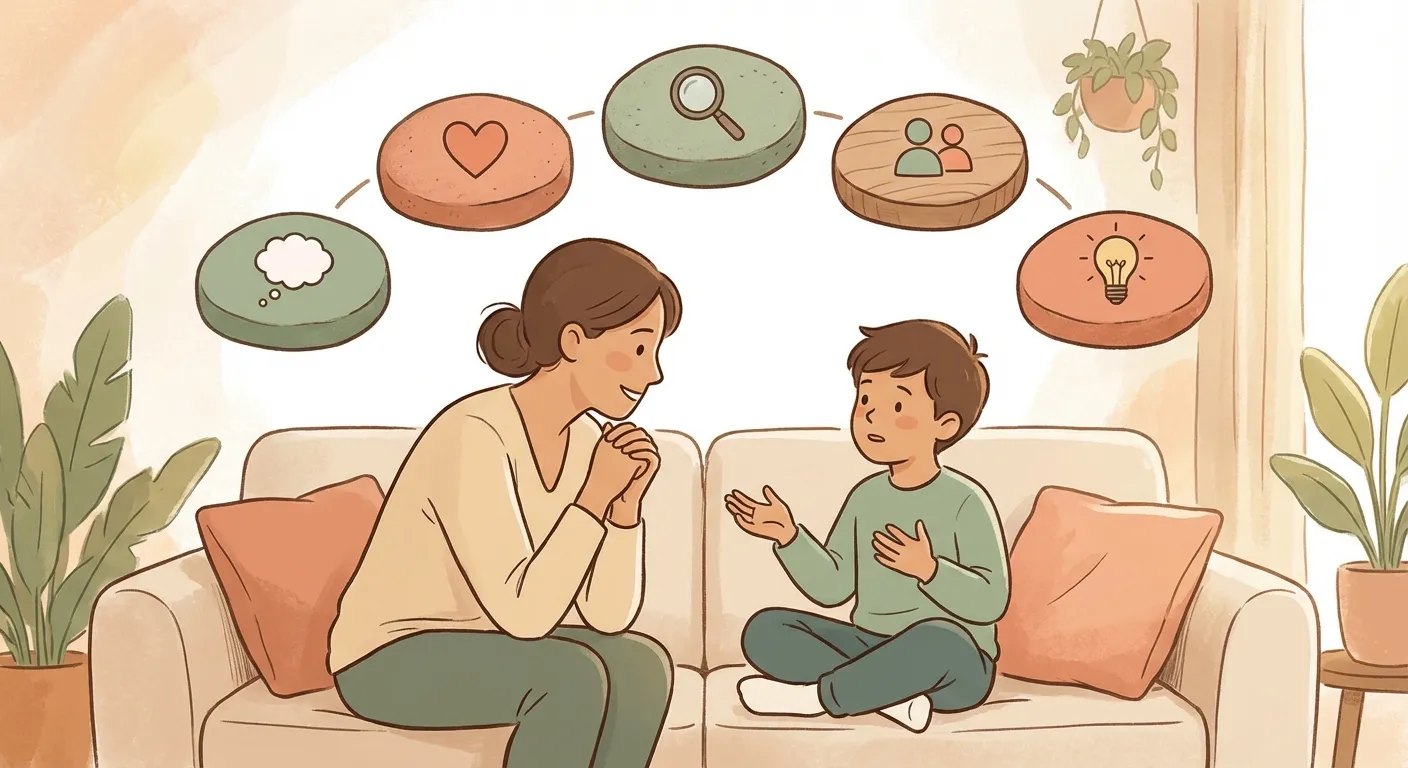
The 5-Question Debrief
After you've identified the type, wait until the emotion passes -- ten minutes, an hour, sometimes a full day. Then walk through these five questions.
"What happened?"
Let them tell it in their own words. No corrections, no jumping ahead. Just listen.
"What were you thinking at the time?"
Most kids have never been asked to trace their own reasoning. This single question builds more self-awareness than a hundred lectures.
"What did you learn?"
There's always something. If they say "nothing," try this:
"What would you do differently?"
This is where regret turns into a plan. Push past vague answers.
"Is there anything you need to do to make it right?"
If someone was affected, help them take responsibility. An apology, a fix, a gesture. This teaches that mistakes carry social weight -- and that repair is always possible.
What Helps vs. What Backfires
The instinct to protect your child from failure is natural. But the research is clear: children who never face the sting of a mistake never build the muscle to recover from one.
Builds Resilience
- Running the 5-question debrief after emotions settle
- Sharing your own recent mistakes out loud
- Letting consequences teach instead of lectures
- Asking "What did you learn?" not "Why did you do that?"
- Debriefing wins too, not just failures
- Celebrating the comeback, not the clean record
Backfires Every Time
- Swooping in before they even stumble
- Finishing their work so it comes out "right"
- Fighting their battles with teachers or coaches
- Hovering over every decision
- "I told you so" or "I knew that would happen"
- Only caring about the grade, the score, or the win
The Hidden Variable
Stanford research found something that surprises most parents: what predicts whether your child develops a growth mindset isn't whether you believe intelligence is flexible. It's how you react to their failure.
Your child reads your face before they process their own feelings. If they see panic or disappointment flash across your expression when they confess a mistake, they file a mental note: mistakes are dangerous. Hide the next one.
If they see curiosity -- maybe even something that looks like calm interest -- a different file opens: this is something we figure out together.
You don't need to fake happiness about a broken window. You just need two seconds of neutral face before you respond. Feel your feelings later. What they need in that first moment is safety.