

The Sentence Running Your Parenting
It takes less than a second to form. It feels like absolute truth. And it's almost never accurate.
Words like 'always,' 'never,' and 'every time' are the tell that you've left observation.
- Kids raised with accurate thinking instead of reactive thinking develop stronger self-regulation and fewer anxiety patterns.
- The move: replace the distortion with something accurate -- not positive, just true. The version you'd tell a friend.
Picture this: your kid spills juice on the couch for the third time this week. Before the liquid even hits the cushion, a sentence fires in your brain.
"He doesn't care about anything in this house."
That sentence isn't an observation. It's a triggered thought -- automatic, emotionally charged, and wearing a very convincing disguise as a fact. And in the two seconds before you open your mouth, that thought has already decided what kind of parent you're about to be.
Here's the thing nobody tells you: you're not reacting to your child. You're reacting to a thought about your child. And when you learn to catch the thought, something remarkable happens -- you get a choice.
You're reacting to a thought about your child --
and that thought is almost never the full picture. Cognitive behavioral research confirms: our reactions are driven by interpretation, not events.
The Usual Suspects
Triggered thoughts come in flavors. Once you know the menu, you start recognizing what you're being served.
These all share one thing: they feel urgent, true, and final. They're none of those things. They're reflexes -- old stress patterns firing because your brain detected a threat. The threat isn't real. But the reaction it produces absolutely is.
Why This Happens
Neuroscience has found that parents who experienced difficult childhoods can have competing neural circuits fire at the same time when their own child is distressed. One system says "move toward your child." The other says "protect yourself." The collision produces a reaction that often surprises you as much as it does your kid.
When stress activates your brain's threat-detection system, thinking becomes rigid and extreme. Words like "always," "never," and "every time" start showing up in your inner monologue. Those words are the tell. They mean you've crossed from observation into distortion.
The good news: these patterns can be interrupted. Every single time.
The SCAN Method: 60 Seconds, Four Moves
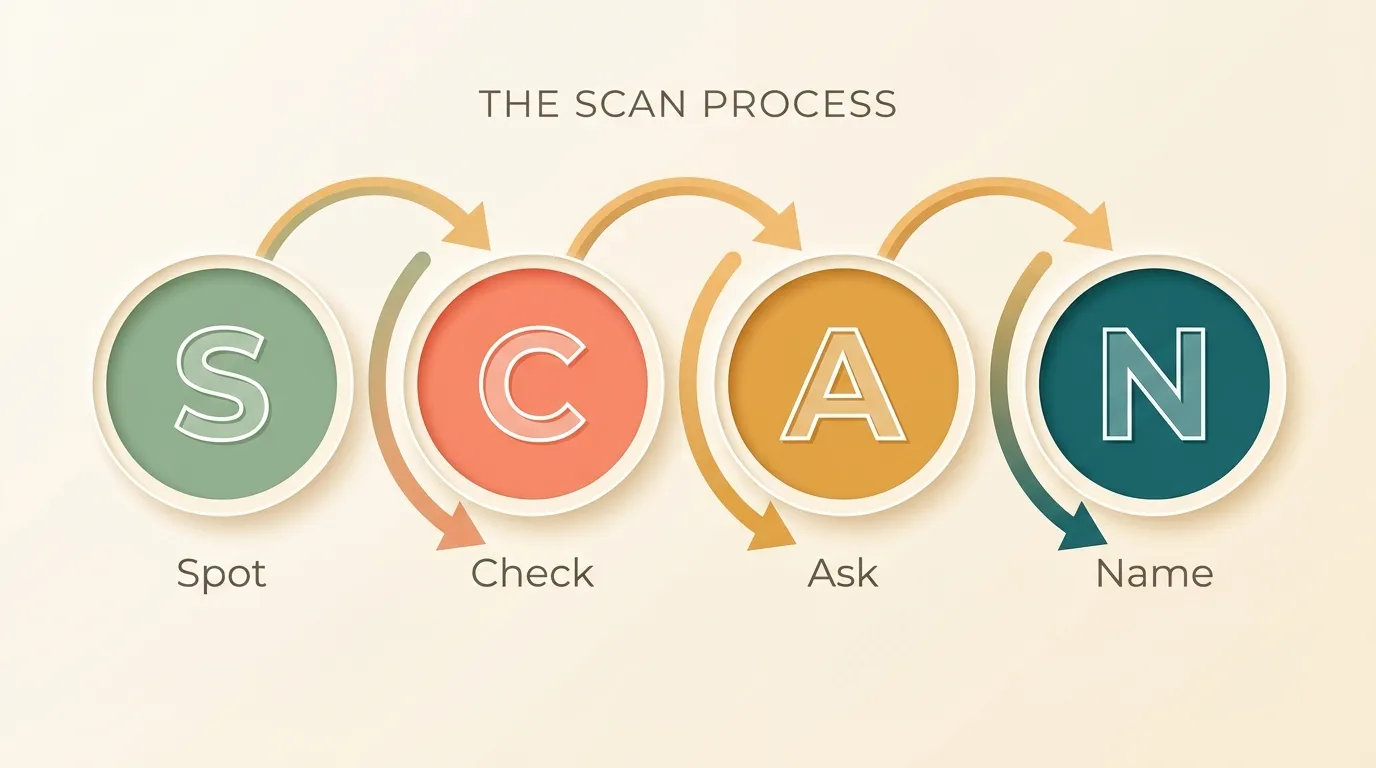
Spot the Thought
Not the feeling -- the sentence. "I'm angry" isn't a thought. "They never listen to me" is. Pin the exact words running through your head.
Check the Evidence
Test it like a claim, not a feeling. Look for absolute words -- "always," "never," "nothing." What would a camera have actually recorded?
Ask What It Costs
When you act from this thought, what kind of parent does it make you? What do you say, do, or shut down? Now imagine dropping it entirely.
Name What's Actually True
Replace the distortion with something accurate. Not positive thinking -- accurate thinking. The version that would feel calmer in your body. The thing you'd tell a friend who described this same situation.
Watch It Work
End of a long week. Your seven-year-old has been asked three times to put her shoes on. Instead, she's drawn marker all over her arm and is now crying because she doesn't want to wash it off.
Reactive vs. Clear-Eyed
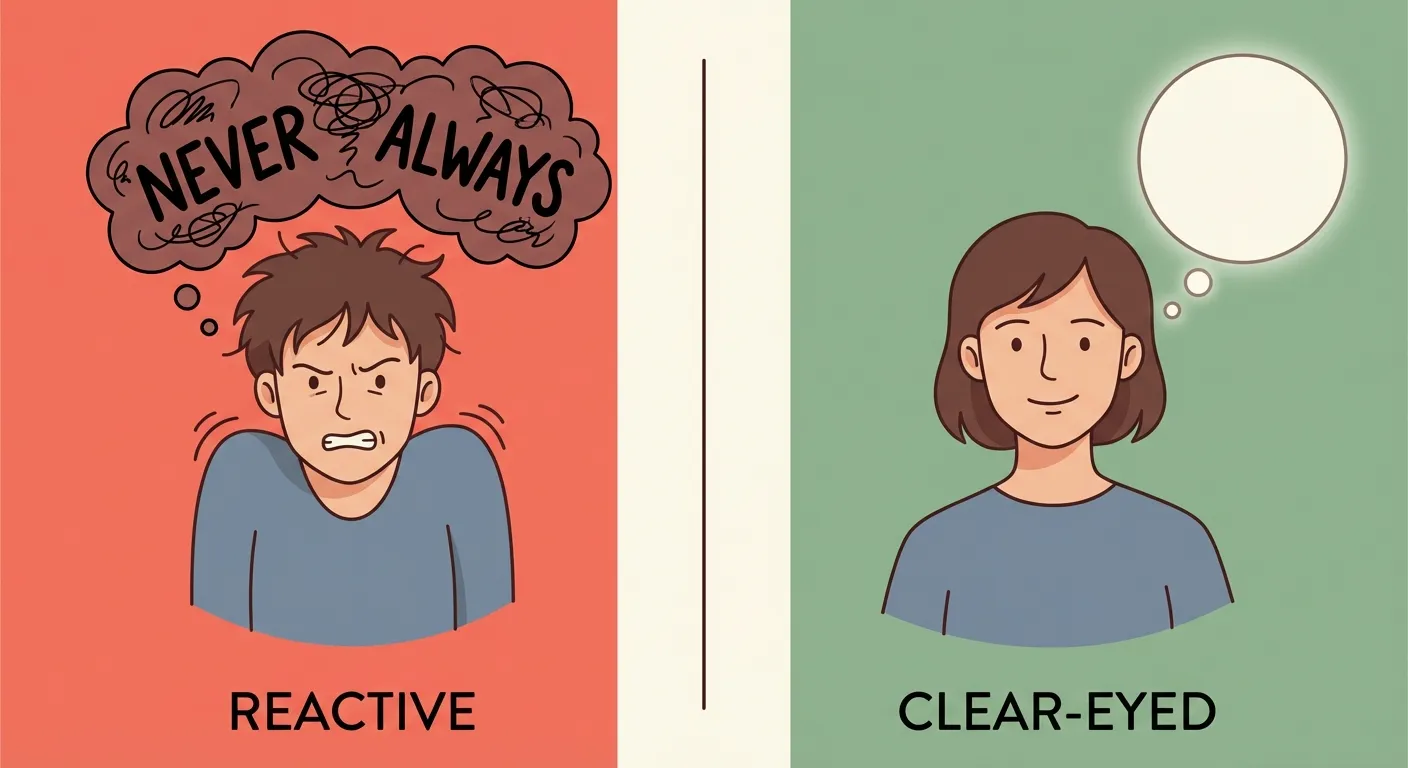
| Reactive Mode | Clear-Eyed Mode |
|---|---|
| "They never listen." | "This specific moment is hard." |
| "I'm failing at this." | "I'm tired and this is a tough stretch." |
| "They're doing this on purpose." | "They're dysregulated, not scheming." |
| "Nothing I do works." | "What I tried yesterday didn't fit today." |
| "This will never get better." | "This is a phase, and I have tools." |
Notice: the right column isn't optimistic. It's just accurate. That's the shift. You don't need to feel great -- you just need to see clearly.
Three-Second Gut Check
When you feel the heat rising, ask:
- Am I reacting to what my child just did, or to a story I'm telling myself about what it means?
- Would I respond this way if I'd slept well and had a calm day?
- Is the intensity of my reaction matching the size of this actual moment?
How This Muscle Grows
You won't catch every thought in real time on day one. That's fine. The skill builds in layers.
- Start after, not during. Run the SCAN after things settle. Reviewing past triggers builds the muscle for catching them live.
- Learn your rotation. Most of us have two or three signature thoughts that keep cycling. Once you know your greatest hits, they lose their power.
- Let your body be the alarm. The thought fires before you notice it, but your body responds instantly -- jaw tightening, chest heat, shallow breathing. Those physical signals are your early warning system.
- Repair out loud. When you catch yourself mid-reaction, say so: "I just snapped and that wasn't fair. Let me try again." This teaches your child that thoughts can be examined and course-corrected.
- Shrink the gap. The goal isn't perfection. It's reducing the time between reaction and awareness. That gap gets smaller with practice -- and even a small gap changes everything.