
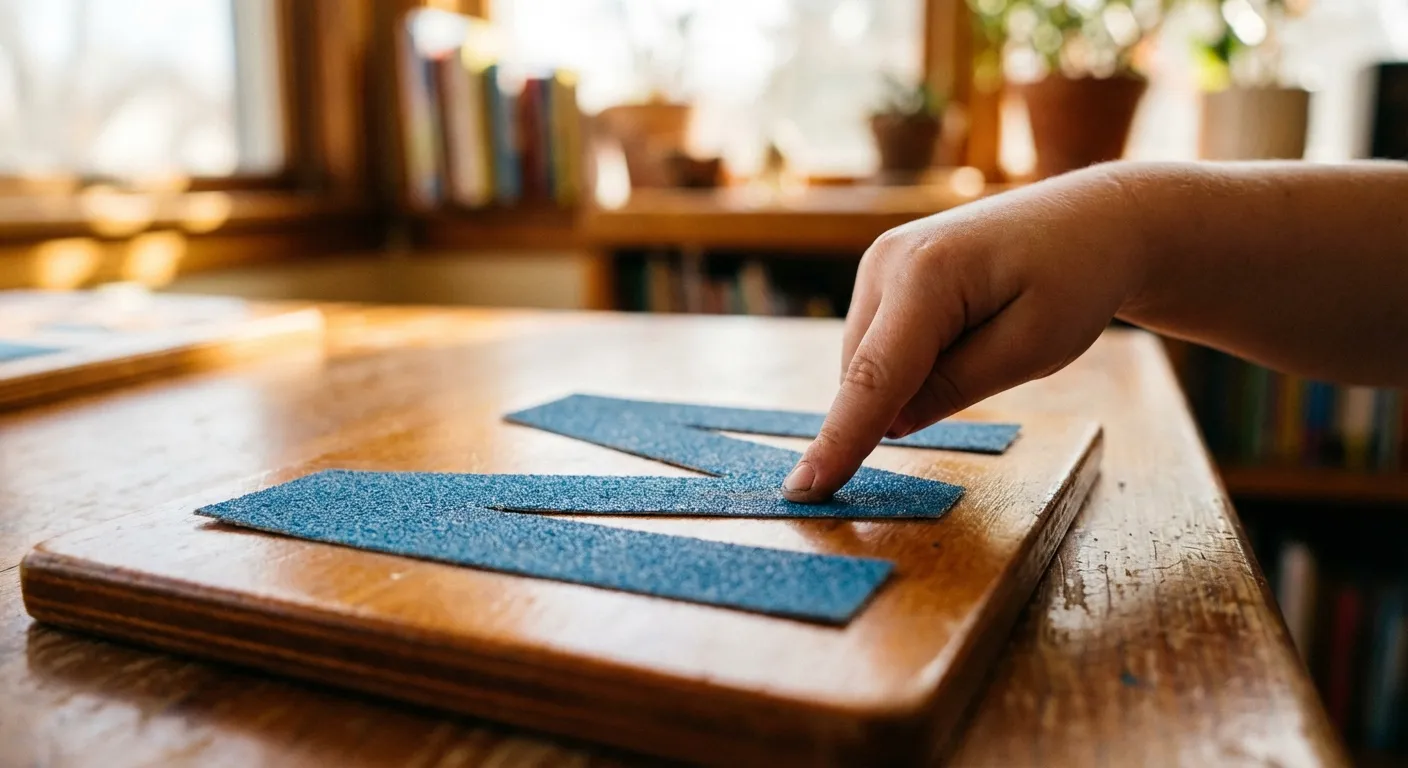
Touch teaches letter shapes faster than sight alone.
- Kids trained this way hit third-grade handwriting at age four — and they think they are playing, not practicing.
- The shift: replace visual drills with tactile tracing. Sandpaper gives instant feedback — the child feels every curve and straight line.
Here is a weekend project that takes less time than assembling IKEA furniture and produces a better outcome than most preschool curricula: cut 26 letters out of sandpaper, glue them to cardboard, and hand them to your kid.
That is the entire Montessori sandpaper letters method. Maria Montessori figured it out in 1907, watched four-year-olds produce handwriting that matched third-graders, and the approach has been quietly outperforming traditional methods ever since.
The wild part? The children never actually practice "writing." They trace rough letters with their fingertips until the shapes live in their muscles. Then one day -- Montessori called it "the explosion into writing" -- they pick up a pencil and just... write. Full words. On the first try.
The Secret: Writing is Two Skills, Not One
Most people think writing is one thing. Montessori realized it is two completely separate mechanisms that can be trained independently -- and should be.
Letter Form Memory
The shape in your musclesWhat: Knowing how each letter moves -- the curves, the lines, the direction.
How to train: Trace sandpaper letters with fingertips. The rough texture gives instant feedback -- you can feel when you go off course.
Result: The hand knows the movement before it ever touches a pen.
Instrument Control
The grip and the glideWhat: The physical ability to hold a pencil and move it with precision.
How to train: Fill in metal inset shapes with colored pencils. Just coloring inside lines -- no letters involved.
Result: Rock-steady pencil control, trained completely separately from letter shapes.
This is the breakthrough: When both mechanisms are ready, they snap together. The child already knows the shapes (from tracing) and already controls the pencil (from inset filling). Writing appears -- fully formed, seemingly from nowhere.
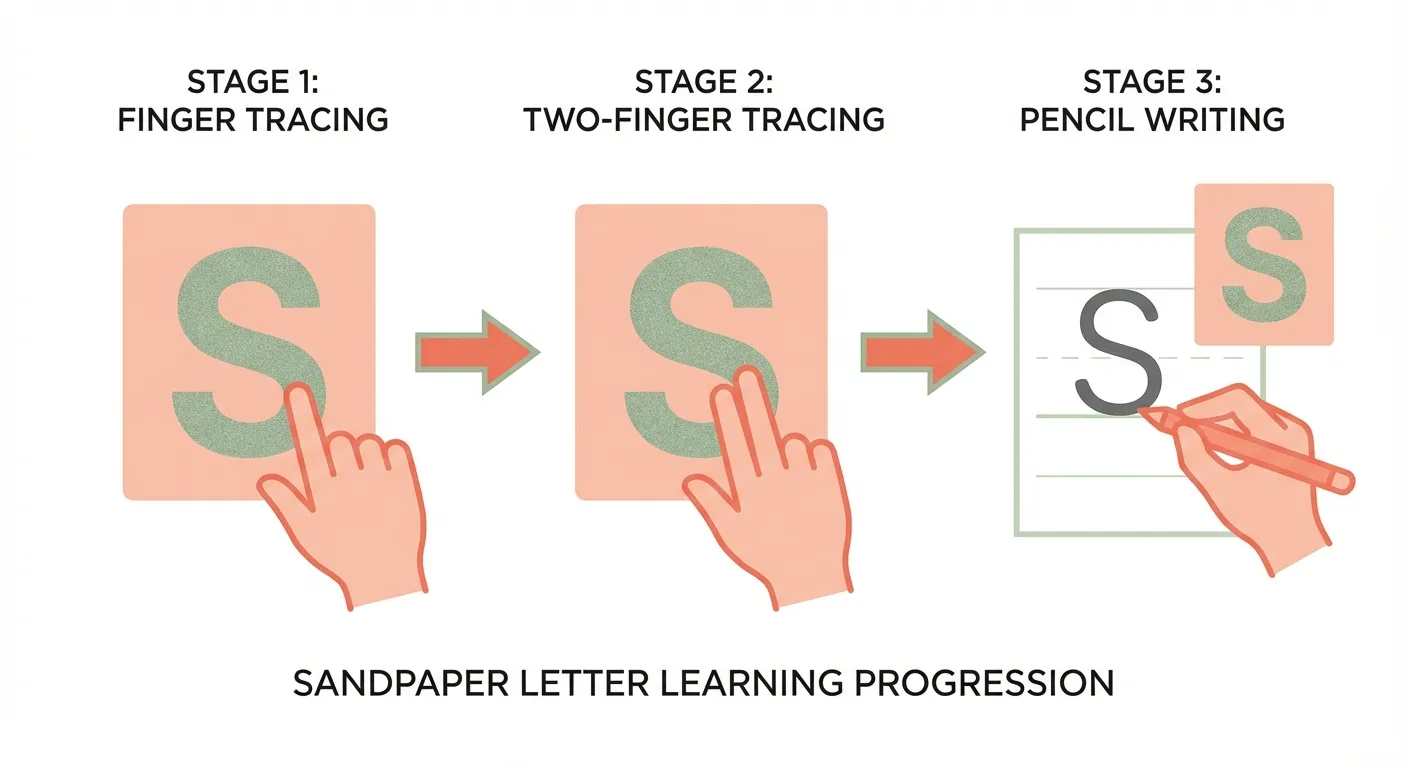
The three-stage bridge: finger tracing, two-finger tracing, then pencil -- each building on the last.
The 5-Step Protocol
Once you have your sandpaper letters (DIY instructions below), here is exactly how to use them:
Present the Letter
Pick one letter. Hold up the card. Say the sound, not the name.
Demonstrate the Trace
Run your index finger over the sandpaper letter, following the exact stroke direction you would use when writing. Slowly. Let them watch.
Child Traces -- One Finger
Their turn. Index finger on the rough surface, following the same path. The sandpaper does the teaching -- they feel every curve and straight line. Repeat until the movement is smooth and confident.
Graduate to Two Fingers
Index and middle finger together now. This subtly prepares the hand for a pencil grip without the child realizing it.
Bridge to a Writing Tool
A small wooden stick or thick crayon, held like a pen. Same tracing motion, same letter, but now with an instrument in hand. The gap between "tracing" and "writing" shrinks to nothing.
"Touching the letters and looking at them at the same time, fixes the image more quickly through the co-operation of the senses. Later, the two facts separate: looking becomes reading; touching becomes writing."
Why This Beats Worksheets
Sandpaper Letters
- Prepare movements indirectly
- Two skills trained separately
- Starts with curves (natural to the alphabet)
- Feels like play, not practice
- Results in weeks
Traditional Worksheets
- Jump straight to writing
- Everything at once
- Starts with straight lines (unnatural)
- Tedious repetition
- Takes months or years
Montessori had a sharp observation about the traditional approach: the alphabet is made up almost entirely of curves. So why does conventional instruction start children with straight-line drills? She called it "incredible" -- and then proved it was unnecessary.
Make Your Own -- Tonight
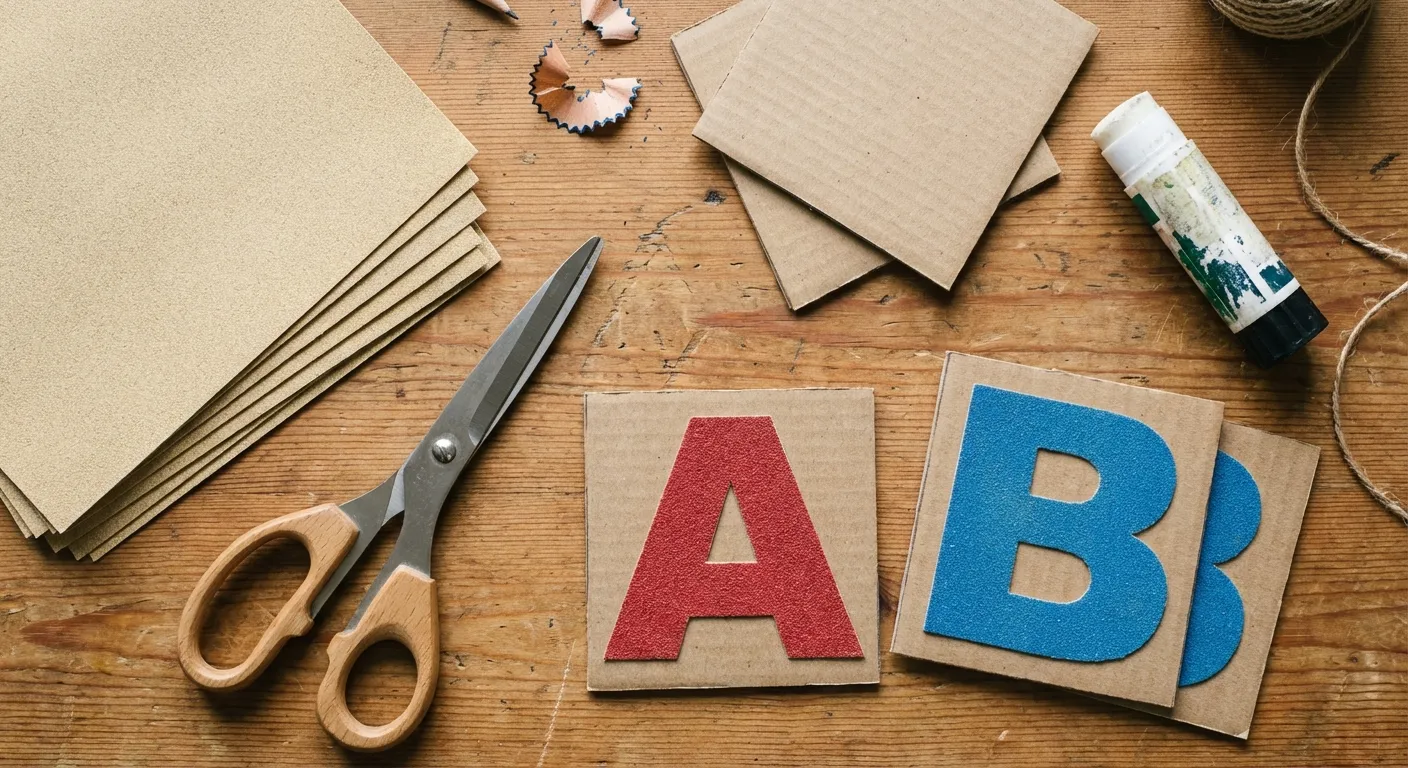
Everything you need: sandpaper, cardboard, scissors, glue. That is it.
| Supply | Details | Cost |
|---|---|---|
| Fine sandpaper | 150-220 grit, 3-4 sheets | ~$5 |
| Cardboard or wood boards | Sturdy, smooth surface, ~6x8 inches each | ~$3-8 |
| Scissors | Sharp enough to cut sandpaper cleanly | You have these |
| Strong glue | Craft glue or hot glue gun | ~$3 |
Assembly in 6 Steps
- Print or draw lowercase letter templates at 8+ cm tall (use cursive/script forms if you can)
- Trace templates onto the back of your sandpaper and cut them out
- Glue letters onto cardboard -- one letter per card
- Use one color sandpaper for vowels (A, E, I, O, U) and another for consonants -- or mark the cards with red/blue borders
- Let glue dry completely before use
- Start with 3-4 letters your child encounters most (their name is a good starting set)
The beauty of DIY: imperfect is fine. The sandpaper does the heavy lifting. As long as the texture is there and the letter shape is recognizable, you are giving your child the same multi-sensory advantage Montessori classrooms charge thousands for.
Montessori herself noted that her simplest homemade versions outperformed the elaborate materials she had used in earlier work. The magic is in the rough texture meeting small fingertips -- not in production quality.
One More Thing: Writing Comes Before Reading
This surprises most parents. We assume reading comes first. Montessori discovered the opposite.
Writing = Easier
Motor translation of sounds into signsWriting is a natural extension of speech. The child already knows the sounds -- they just need a physical way to produce them. Sandpaper letters give them exactly that.
Reading = Harder
Abstract interpretation of graphic symbolsReading requires the child to decode symbols back into meaning -- a more abstract intellectual operation. It follows writing, not the other way around.
So if your three- or four-year-old is not reading yet, skip the phonics apps. Hand them a sandpaper letter instead. Writing comes first. Reading follows.
Twenty minutes of cutting sandpaper. A stack of tactile letter cards. And you have just built the same tool that produced Montessori's famous "explosion into writing" -- four-year-olds writing words no one taught them, grinning because they did not know it was supposed to be hard.