
The Armor They Don't Know They're Wearing
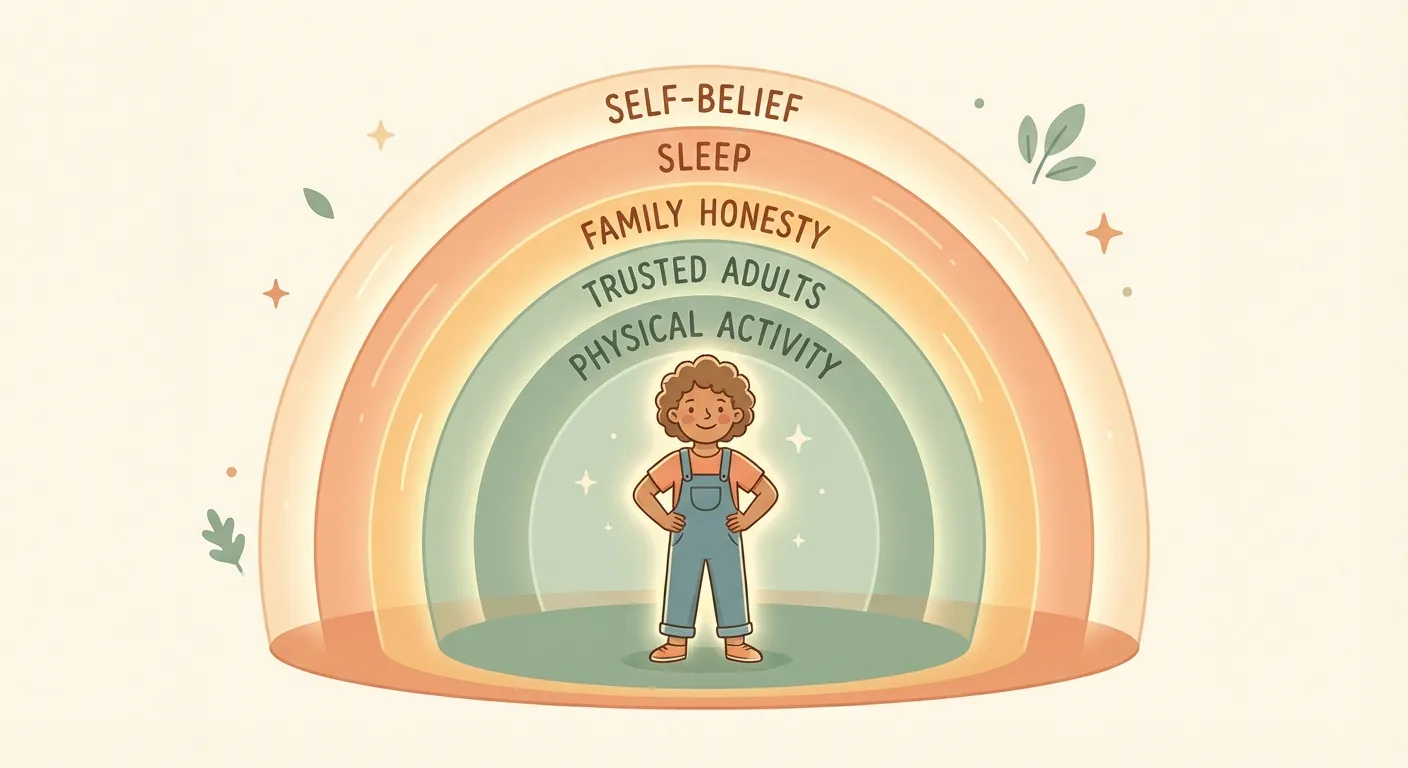
Self-belief is the single strongest defense a kid can carry.
- Kids raised with real challenges -- not just encouragement -- develop the kind of confidence that holds up under peer pressure, rejection, and stress.
- The move: replace hollow praise with stretch goals, honest feedback, and tasks that actually matter.
How to build invisible defenses years before your kid needs them
Your three-year-old is folding napkins. Your ten-year-old is planning the family hike. Your teenager just booked their own dentist appointment. None of them realize they're putting on armor.
Every real challenge a kid handles builds something researchers call a "protective factor" -- a measurable trait that makes risky decisions less likely down the road. Stack enough of these factors and you shift the entire equation. Not by lecturing. Not by hovering. By giving them things to do, things to master, and a home where hard truths are welcome.
The research on this is decades deep. And the most powerful finding? You don't build these defenses at 15, when substances show up. You build them at 3, at 7, at 11 -- one small challenge at a time.
Self-Belief Is the Lead Layer
Of every protective factor researchers have measured, one stands above the rest: a child's belief in their own ability to handle hard things. Not confidence in the motivational-poster sense. Real, earned confidence -- the kind you get from attempting something difficult and surviving it.
This is where stretch goals come in.
| Age | The Stretch | What It Builds |
|---|---|---|
| 3-5 | Fold napkins, pour their own drink, set the table | "I can do real things" |
| 6-9 | Cook a full meal, plan a family outing, manage a small budget | "I can handle complexity" |
| 10-13 | Navigate public transit, teach a younger kid a skill, organize a project | "People rely on me" |
| 14+ | Navigate an airport solo, handle a car repair appointment, budget a weekend trip | "I can operate in the adult world" |
Notice the pattern: each stage is a genuine upgrade in responsibility, not a simulated one. Kids know the difference between a real task and a made-up exercise. They build self-belief from the real ones.
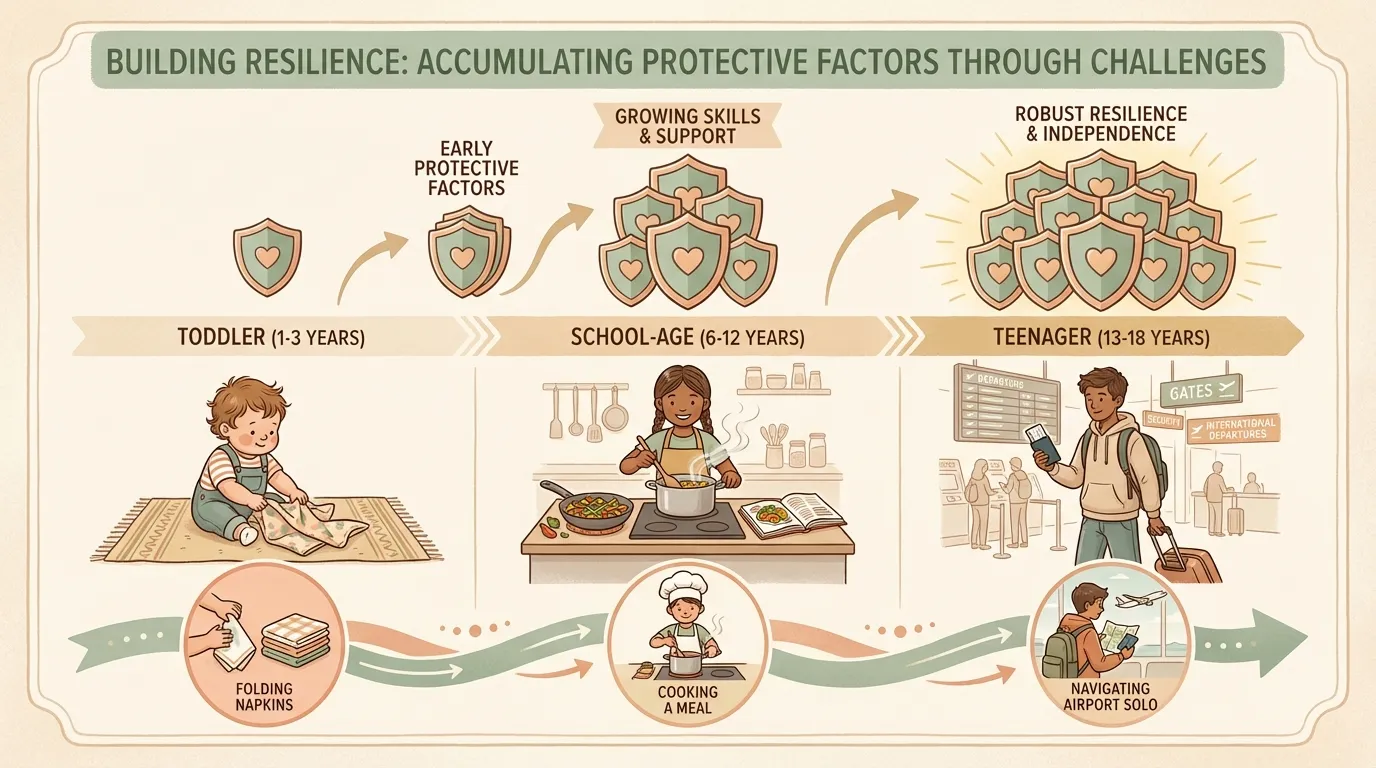
Each stage of real responsibility adds another layer of protection
The Words That Wire the Mindset
A growth mindset isn't something you teach in one conversation. It's a phrase you use so often it becomes your child's inner voice.
That second line does double duty. "I trust you" builds self-belief. "I'm right here" keeps the safety net visible. Kids who know the net is there take bigger, healthier risks.
Praise That Actually Works
Builds real confidence
"You stuck with that project even when you wanted to quit -- that's real persistence."
Name the specific action. Be honest about strengths and areas to grow.
Sounds good, does nothing
"Good job!" (so common it becomes white noise)
Telling a child with no rhythm they're a natural dancer. Kids know when you're overselling it -- and it erodes trust in all your feedback.
When Things Go Wrong: The Three-Part Reframe
Kids who interpret setbacks as permanent, total, and personal are at higher risk for everything -- including substance use. You can rewire that pattern, one conversation at a time.
It's not forever
"Your coach was tough on you today -- that doesn't mean she'll always be like that. Remember last week when she high-fived you after the drill?"
It's not everything
"This one assignment went badly. Your other subjects are fine, and you've got friends who think you're great."
It's about what happened, not who you are
Guide them from "I'm a failure" toward "That didn't go the way I wanted." From "Nobody likes me" to "That group wasn't a great fit today."
The Home Fortress
Self-belief is the strongest layer. But the home environment is where all the other layers either hold or fall apart.
Name the elephants
Most families carry a few unspoken secrets. Those secrets create shame, and shame creates cracks where risky behavior takes root. Age-appropriate honesty about family challenges -- addiction history, mental health, difficult relationships -- removes the power of the secret.
Talk about genetic risk openly
Adolescents who know about their family's genetic predisposition often find it easier to decline substances. It gives them a straightforward, personal reason that doesn't require social acrobatics. That knowledge becomes a shield.
Secure the medicine cabinet
Roughly half of teens who misuse prescription medications access them from a family medicine cabinet. Lock addictive prescriptions. Track alcohol supply. This isn't distrust -- it's removing easy opportunity during a developmental period when impulse control is still under construction.
Move together
Physical activity is linked to lower substance use across multiple studies. It relieves stress, supports brain development, and channels the novelty-seeking drive that puts teens at risk into healthy outlets. Learning a new sport together adds connection time on top.
Sleep: The Unsung Protector
Adolescents need 8-10 hours. The vast majority fall short.
- Build the schedule around bedtime, not the other way around. If something has to give, it's not sleep.
- Screens off, lights low, house quiet at least an hour before bed.
- Stay consistent. Weekend sleep marathons don't compensate for weeknight deficits and can make the cycle worse.
- Know the biology. The adolescent brain doesn't release sleep-onset hormones until around 11 PM. Your teenager isn't being defiant -- their circadian clock has physically shifted.
Sleep loss and substance misuse reinforce each other: poor sleep drives self-medication, and substances disrupt sleep quality. One more hour of sleep often does more for a teenager than one more hour of studying.
Calm Under Pressure
Mindfulness strengthens the connection between the emotional centers of the brain and the prefrontal cortex -- exactly the wiring adolescents need for better decision-making. Brain imaging studies show structural changes from regular practice.
For younger kids: imagine a favorite place, pick one thing to focus on -- a tree, a wave, a cloud -- breathe in while looking at it, breathe out letting tension go. Then name what your body feels.
If they resist, propose a short experiment: ten minutes a day for one week. Offer to do it together. Most kids who try it for a week want to continue.
Your Early Warning System
Three people can catch problems when they're small -- before they become crises:
School nurse
Often the first to notice emerging issues in day-to-day behavior.
School counselor
Can provide in-school support and referrals before things escalate.
Pediatrician
Ask if they use screening tools at well-child visits for behavioral health and substance risk. If they don't, consider finding one who does.
Don't wait for a crisis to meet these people. Build the relationships now.
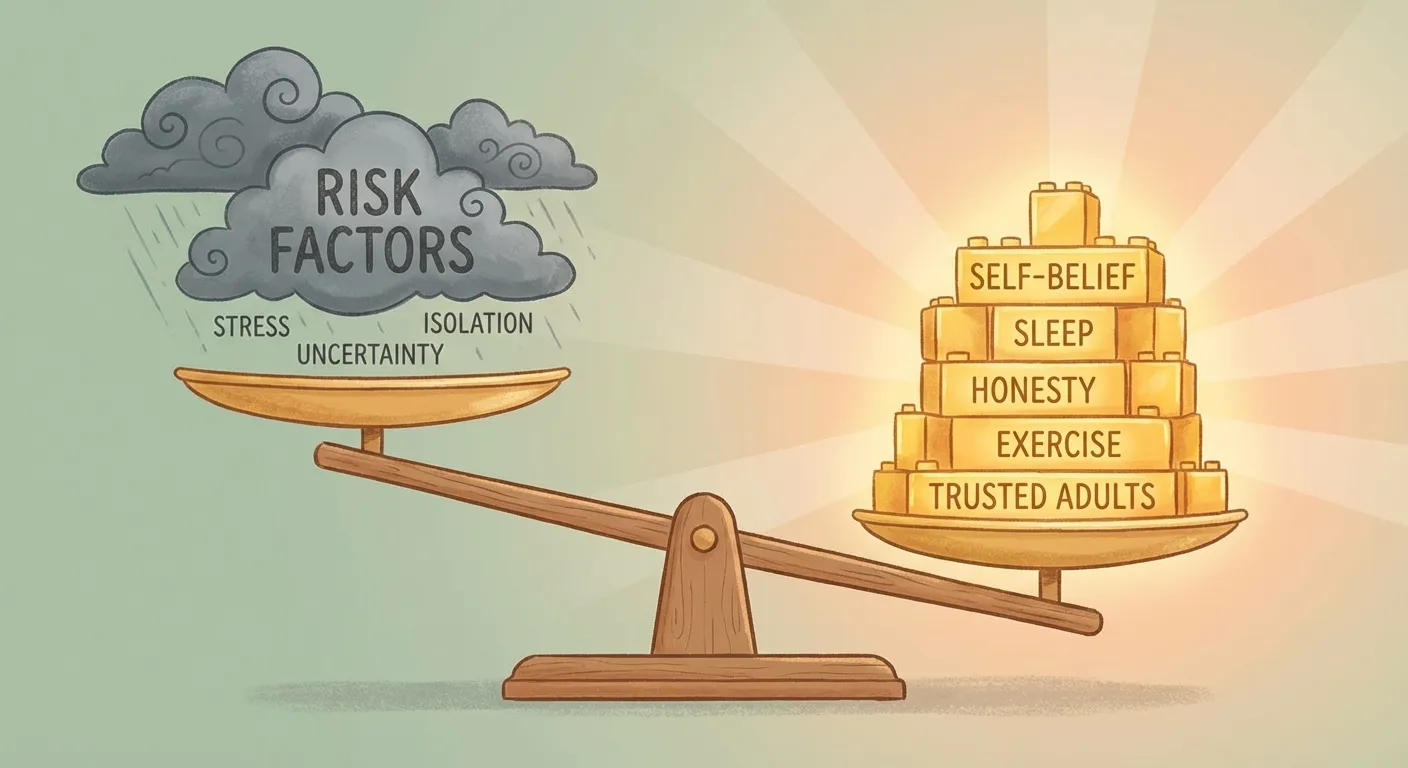
You can't eliminate every risk factor -- but you can tip the scale decisively
Keeping the Armor Strong
Protective factors aren't a one-time setup. They need maintenance.
| Signal | What It Means | What to Do |
|---|---|---|
| Sleep slipping | A key protective layer is thinning | Restructure the schedule. Sleep wins over activities. |
| Activities dropping | Loss of healthy outlets and peer connections | Explore what changed. Don't force the old activity -- find the next one. |
| Withdrawal from family | Communication channels closing | Invest in connection during calm times. Don't wait for crises to talk. |
| Avoiding challenges | Self-belief eroding | Offer a stretch goal that's achievable. Rebuild from a win. |
The Whole Strategy in One Line
You can't eliminate every risk factor. But you can stack your child's defenses so thick that the balance tips decisively their way -- self-belief, honest communication, real sleep, trusted adults, and a home where hard truths are welcome.