
Your Three-Year-Old Is a Better Judge Than You
A three-year-old will police a visible line before any adult notices the violation.
- Kids raised this way manage playground turns solo, welcome newcomers into the queue, invent rules for situations you never thought of, and self-regulate when you're not watching.
- The move: name a family queue, make the order visible, set a timer, and let them run it.
Give a kid a system they can see, and they'll run fairness like they were born for it
A three-year-old spots a line-cutter at the slide before any adult does. She marches over, plants herself, and announces: "It's not your turn. You go after me." No hesitation. No negotiation. Pure procedural justice.
Adults stand there impressed, maybe a little embarrassed. Because here's the truth nobody talks about: young children are extraordinarily good at running fair systems. Better than most boardroom adults, honestly. They just need one thing we almost never give them.
A system they can see.
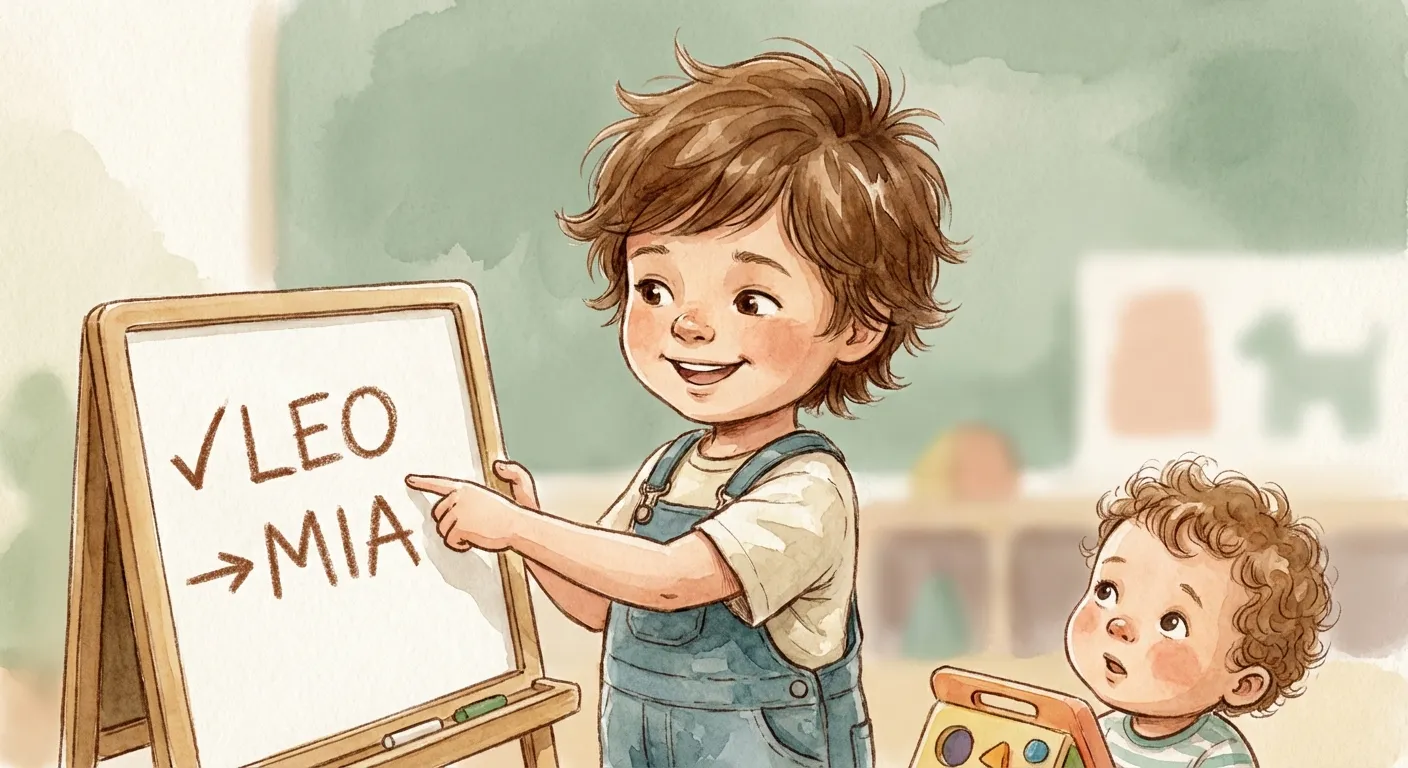
Give them a visible queue and watch what happens
The Problem with "Share"
Every parent says it. "Share." Fifty times a day. Nothing happens.
Because "share" is an abstract moral concept. You're asking a small human to voluntarily give up something they want right now, for someone else's benefit, based on a principle they haven't fully developed yet. Most adults can barely do that at a buffet.
But watch what happens when you replace the moral appeal with a visible procedure. A whiteboard. A list of names. A sand timer. Suddenly the same kid who screamed "MINE" five minutes ago is calmly pointing to the board and saying, "You're after Liam."
It's not magic. It's design.
| Telling Them to "Share" | Giving Them a Turn Queue |
|---|---|
| Asks for emotional generosity | Gives them a rule they can follow |
| Child loses what they have now | Child sees their turn is guaranteed |
| You referee every single conflict | They monitor and enforce it themselves |
| Feels like punishment to the giver | Feels like fairness to everybody |
| "Why do I always have to give in?" | "Same rules for all of us" |
Kids don't need a lecture on generosity.
They need a system they can see and run.
What Kids Actually Do With a Queue
This is the part that blows parents' minds. Give children a visible turn system and step back. Within days:
Age when kids start policing violations on their own
Adult interventions needed once the queue is running
Age when they start inventing new rules for new situations
They remind each other. They call out line-cutters. They invite new kids to join the queue. They negotiate modifications. They create rules for situations you never thought of. You go from exhausted referee to spectator with coffee.
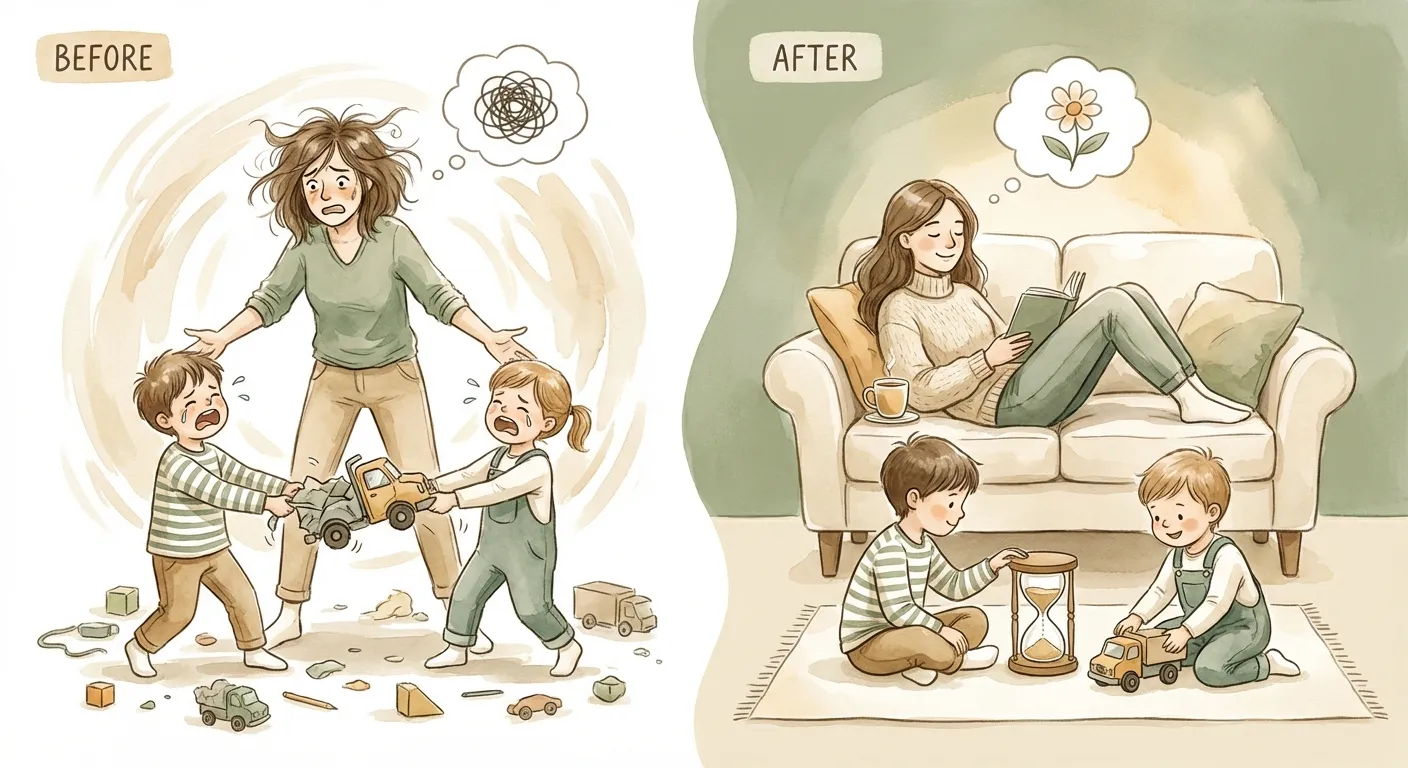
The transformation: from constant refereeing to watching them run it
How to Set It Up (Tonight)
This takes about ten minutes to introduce. Here's the full setup:
Name It
Give the system a family name your kids can invoke: "the queue," "the turn list," "the lineup." The name matters because it becomes a tool your child reaches for. When conflict erupts, they say "we need the queue" instead of screaming. That's the goal.
Make It Visible
Names on a whiteboard. Clothespins on a strip of cardboard. A physical line. The order has to be something kids can see. Visibility is what makes the system self-enforcing. Nobody can claim they didn't know whose turn it was.
Set a Timer
Every turn needs a clear endpoint -- kitchen timer, sand timer, a set number of rounds, or a task ("until you go down the slide three times"). Without a defined end, the first person monopolizes everything and the whole thing falls apart.
Everyone Follows It
Including adults. The moment a child sees you wave their sibling to the front, the system is dead. If the rule isn't universal, it's not a rule -- it's a suggestion. Kids see through suggestions instantly.
Step Back
Once it's running, your job is done. Children who manage the system themselves develop stronger fairness instincts and social skills than children managed by adults. Let them call out violations, negotiate adjustments, welcome newcomers.
The Scripts That Make It Click
Theory is nice. These are the exact words that work:
"We have a new system for stuff we all want to use. It's called the Turn List. Your name goes on the board. When the timer goes off, the next person goes. Everyone gets the same time. Sound fair?"
"Sounds like you both want it. Let's check the Turn List -- who's next?"
"You're waiting so well. See your name? You're right after Kai."
"You two figured out the turns all by yourselves. That's how teams work."
"Waiting is really hard. Your turn is coming -- look, you're next on the board. Want to watch the sand timer with me?"
Where to Deploy It
Screen Time
Each child gets a defined turn with the tablet. Timer runs. When it beeps, the next child goes. Post the rotation on the fridge so everyone can check.
Coveted Toys
New LEGO set, ride-on car, art supplies -- the queue determines who plays first, second, third. No negotiation needed.
Family Privileges
Front seat. Movie pick. Who gets to help cook. Rotate on a queue schedule. Your kids will remember and keep you honest.
Playground and Playdates
Multiple kids want the same swing? Queue up, count to 30, rotate. Other parents will look at you like you have a superpower.
What to Expect at Each Age
Kids grow into the system. Here's what each stage looks like:
They can't wait yet -- but they're absorbing everything
You physically manage every handoff. Name it each time: "Now it's your turn." The concept is sinking in even if they can't act on it.
Can wait 30-60 seconds. Starting to remind others about rules.
Set the order, run the timer, narrate: "You're waiting so well." Step in when patience runs out. They still need backup.
This is where it gets incredible.
They form their own lines. They vigorously police violations. They protest loudly when rules break -- that's a feature, not a bug. Set it up, then step back. Intervene only when someone's being excluded.
Full autonomy. They're better at this than most offices.
They negotiate turn order, set their own time limits, create new rules for new situations, and welcome newcomers. Your job: occasional check-in. Mostly just enjoy watching.
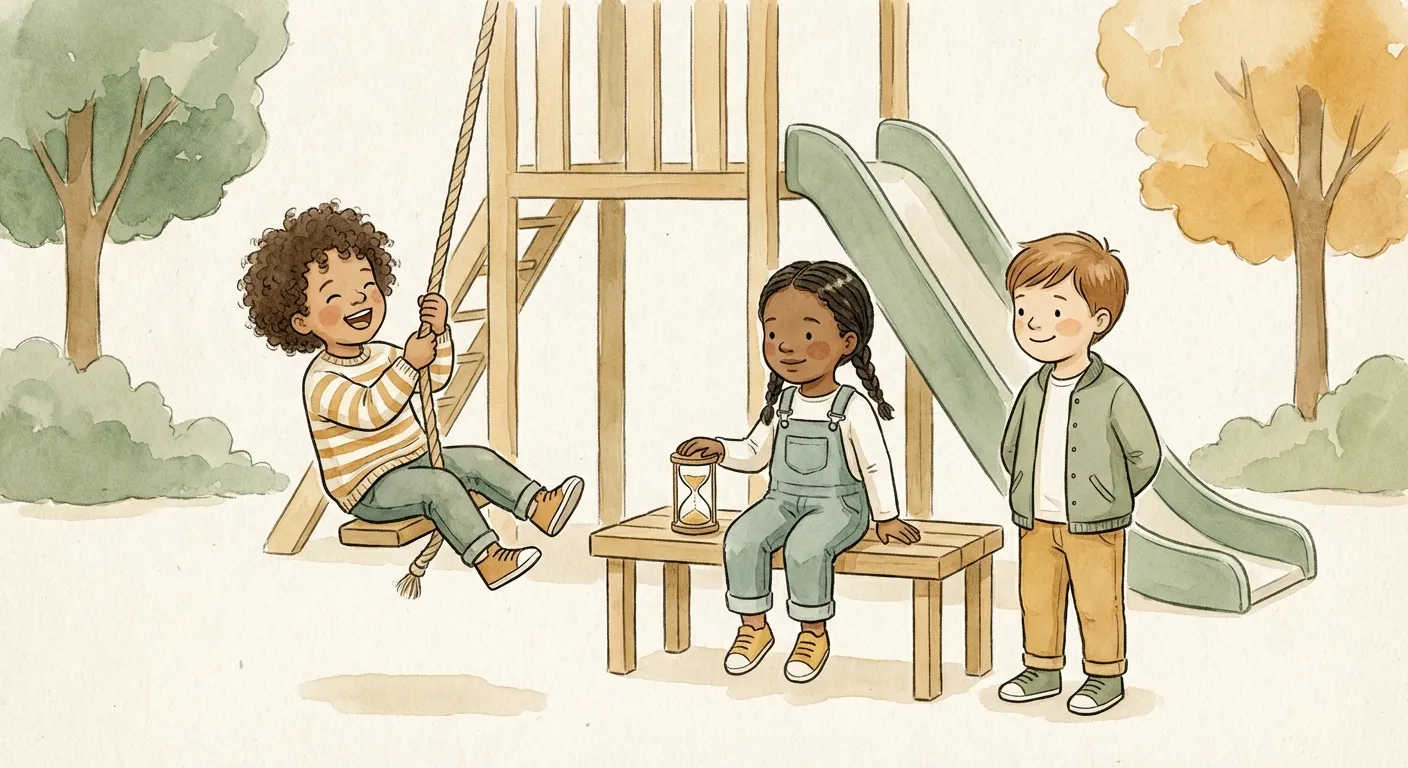
By age 5, they'll run the system better than you ever could
Three things to keep in mind
- Shared resources only. The queue is for things everyone has equal claim to -- shared toys, family privileges, playground equipment. Forcing turns on a child's personal things ("let your brother use YOUR bike") feels like a violation, and they're right.
- Power dynamics don't disappear. A bigger or older child can still intimidate a younger one into surrendering a turn. In mixed-age groups, stay closer -- not farther away.
- Big feelings will still happen. The queue doesn't prevent frustration -- it channels it. A child who melts down while waiting is learning something valuable. They still need your empathy in the moment.
The Real Payoff
Start with something low-stakes during a calm moment. Once the concept clicks, bring it to the high-conflict situations -- tablet time, the new toy, who picks the movie.
When you hear the first rumble of "that's MINE," get ahead of it: "Sounds like we need the queue." Early intervention is ten times easier than late intervention.
And model it yourself. When you and your partner disagree about what to watch or whose music plays in the car, use the queue. Kids learn systems from watching, not from lectures.
As they grow, they'll modify the system -- adding exceptions, negotiating trades, inventing rules for new situations. That's not gaming the system. That's learning to build systems. Cooperative negotiation, fairness instincts, conflict resolution -- the skills that transfer to group projects, team sports, roommates, workplaces, everything.
Ten minutes to set up. A kid who runs fairness like she was born to.