
Your Child's Inner Voice Is Copying You Right Now
Your child's self-talk during setbacks is a recording of how you handle yours.
- Kids with resilient thinking patterns hold their own socially, push through academic frustration, and regulate without needing you in the room.
- The move: audit your own out-loud reactions, then teach three age-specific exercises that build flexible thinking as a default.
That thing you muttered about the traffic? It just became their self-talk script.
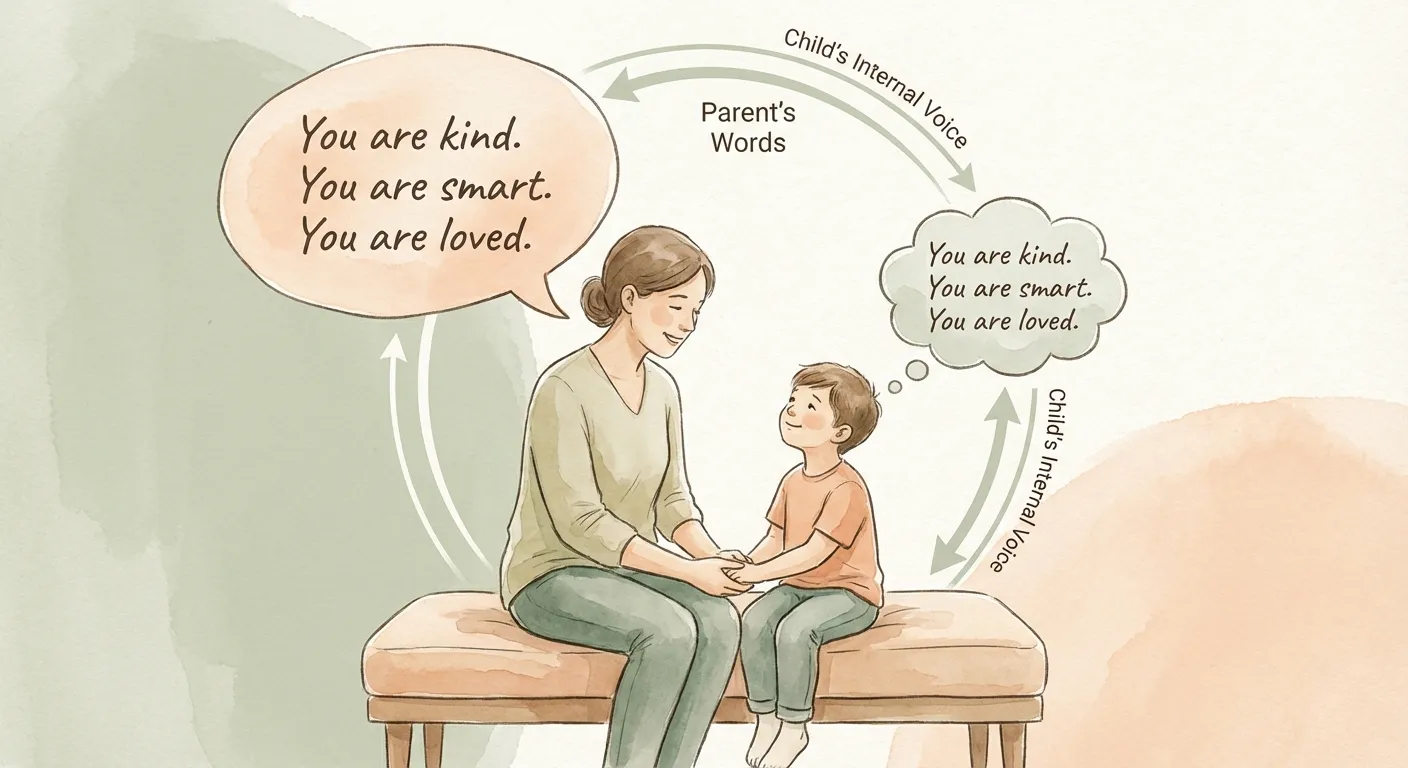
You spill coffee on your shirt. What do you say out loud?
If it's "Ugh, I'm such a disaster" — your kid just filed that away. Next time they drop their juice box, their brain will replay your voice: I'm such a disaster.
If it's "Whoops, let me grab a towel" — they filed that instead. Setback acknowledged, solution found, no identity crisis required.
This is the single most powerful leverage point in your child's emotional development: your out-loud narration of everyday frustrations is literally programming their internal voice. Before you teach them a single resilience exercise, your running commentary is already teaching them how to interpret every setback they'll face.
Two Paths From Every Setback
When something goes wrong, a child's brain does a split-second calculation across three dimensions. Their default answer on each one determines whether they spiral or bounce.
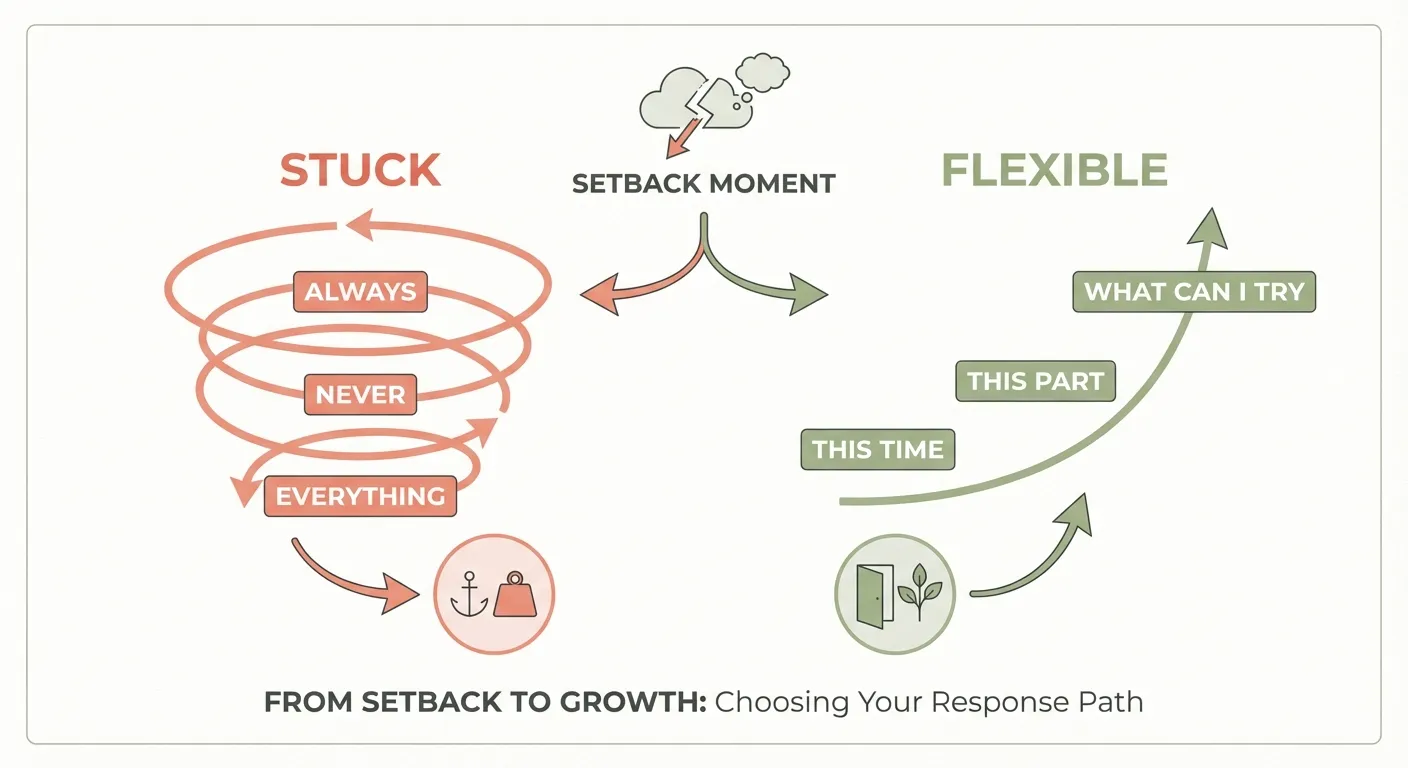
- "My whole day is ruined."Scope: everything is affected
- "Things never work out for me."Duration: this is permanent
- "I'm just bad at this."Control: nothing I can do
- "That part didn't work, but other things are fine."Scope: just this one thing
- "This is hard right now, but it won't stay this way."Duration: temporary
- "I need more practice or a different approach."Control: I can try something
Here's what's wild: kids who default to the left column have significantly higher rates of depression and anxiety. Kids who default to the right column? They handle the same setbacks without the emotional freefall. Same situation, totally different outcome — based purely on how they've learned to talk to themselves about it.
The SPACE Method: Five Questions That Rewire the Default
When your child hits a wall — didn't get invited, failed the test, got cut from the team — walk them through these five questions. Over time, they'll start running through them on their own.
Critical: don't skip the first step. If you jump straight to reframing ("But you have so many other friends!"), your child feels dismissed. Acknowledge the feeling first. Then — and only then — help them examine it from different angles.
Age-Matched Exercises (Pick One Tonight)
The Cup Activity
- Fill a clear cup halfway with water (or a jar halfway with small treats)
- Ask: "Is this cup half empty or half full?"
- Explore together: "When you focus on what's gone, how does that feel? What about what's still there?"
- Apply it live next time something goes sideways:
Repeat with different scenarios until they start catching the pattern themselves.
Character Detective
- While watching a show or reading together, pause when a character faces a setback
- Ask: "Is this character thinking flexibly or getting stuck? How can you tell?"
- Brainstorm: "What could they say to themselves to feel less stuck?"
- Make it a running game: "Let's count stuck thoughts vs. flexible thoughts today!"
Spotting patterns in fictional characters is way less threatening than examining their own thinking. Once the radar is on, they'll start noticing it in themselves.
The "What Else Is True?" Pivot
- Let them express the stuck thought fully: "I'm terrible at basketball. I never make shots."
- Don't say "but." Say: "What else is true?"
- Guide gently: "You're improving at dribbling. You love being on the team. You made two baskets last week."
- Land it:
This teaches something profound: one true negative doesn't erase all the positives. Both can coexist.
The Number That Changes Everything
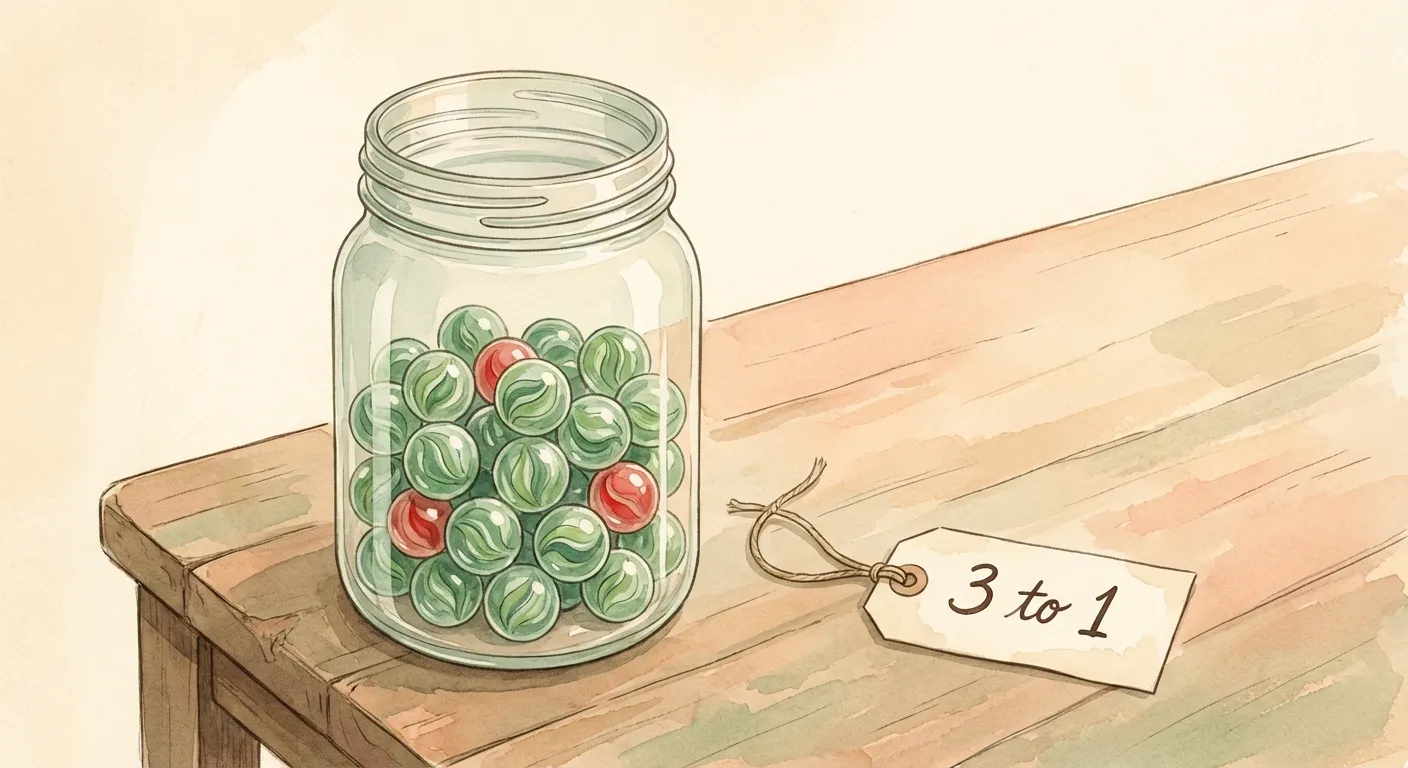
Research on emotional well-being found a tipping point: when positive experiences outnumber negative ones by roughly 3 to 1, people cross into what researchers call "flourishing" — more engagement, deeper connection, higher life satisfaction. Below that ratio, things start to feel heavy even if nothing is technically wrong.
The trick is that good experiences give you two rounds of positive emotion: once when they happen, and again when you remember them. So you don't need to manufacture positivity. You need to make sure the real good moments get counted.
Scroll through recent pictures together. Relive the good moments out loud.
Each person names one good thing from today. Can be tiny: "The bus driver smiled at me."
"What are the three best parts of this weekend you want to remember?"
Retell family favorites — that camping trip, the snow day, the time the dog jumped in the pool.
Making It Stick
Your Cheat Sheet
- Start with you. Audit your own out-loud reactions for a day. Every "I always" and "I'm so bad at" is being recorded.
- Give them vocabulary. "I notice you're in 'always' thinking. Let's try 'this time' thinking instead."
- Celebrate the catch. "You just noticed your own stuck thinking and shifted it. That's the skill right there."
- Practice when calm. Meltdowns are the worst time to learn. Do these exercises when everyone's regulated.
- Narrate your own process. "I got frustrated at the store. I noticed I was thinking 'nothing ever works out' — which isn't true. Most errands do work out."
Here's the thing that makes all of this feel less like "one more parenting task" and more like a superpower: these thinking patterns, once installed, run automatically. Your kid won't need to consciously walk through SPACE forever. Eventually, flexible thinking becomes the default — the voice in their head that says "this is hard right now, but I can handle it" without any prompting from you.
That voice started as yours. Make it a good one.