
The Snowball Your Kid Doesn't See Rolling
None of the world-class performers studied looked exceptional before adolescence.
- Kids who hit this cycle practice because they want to, feel genuinely skilled at something peers can't do, and build an identity around achievement — not because they were pushed, but because momentum carried them.
- The move: create a head start through family routine, then let recognition and competence feed each other.
Researchers spent years studying concert pianists, Olympic swimmers, and world-class mathematicians. None of them were "discovered." Every single one was built — by a flywheel their parents quietly set in motion.
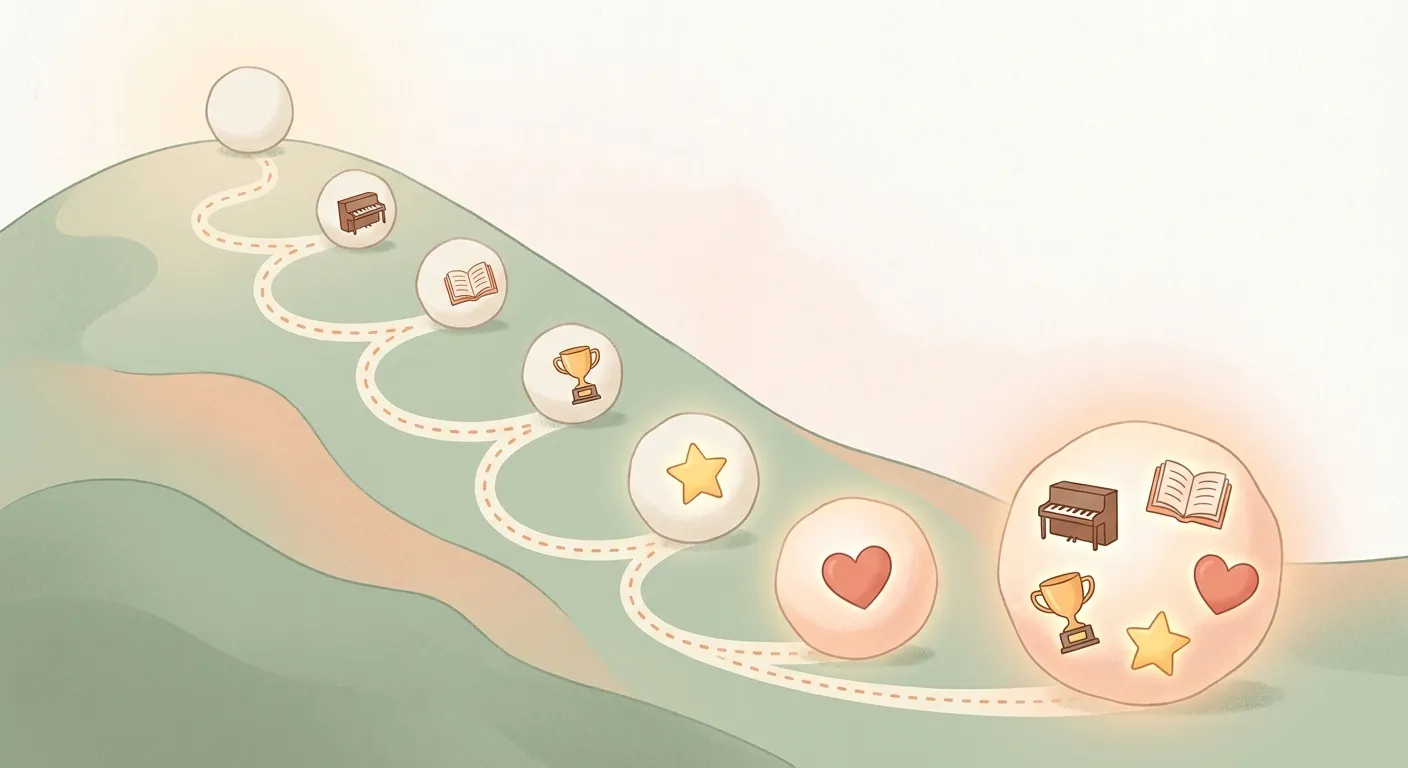
Here's what's wild about the research on world-class performers: almost none of them looked exceptional before adolescence. Their teachers didn't gasp at their first lesson. Their parents didn't sense genius in the crib.
What happened instead was quieter and more powerful. A series of five linked stages, each one feeding the next, until the commitment was so deep and the skill so real that everyone — including the kid — assumed it had always been there.
The parents built a snowball. And by the time it was enormous, nobody remembered pushing it.
The Five Stages — One Table
| Stage | What Happens | What It Creates |
|---|---|---|
| 1 | Parents weave the activity into family life. Daily practice is a household expectation — like brushing teeth. | A head start. The kid walks into first lessons already familiar. Teachers notice them as "fast learners." |
| 2 | Family, teachers, and relatives start calling the child "special." Applause at recitals. Featured at school events. Extra attention from instructors. | An identity. By 11 or 12, some kids got excused from chores because of their "thing." The activity became who they were — before they chose it. |
| 3 | Real competence develops. The kid can do something most people around them cannot. | A motivation shift. Practice stops being about approval and starts being about the private thrill of getting better. |
| 4 | Success opens doors: better teachers, selective programs, summer intensives, professional networks. | Compounding advantages. Each win unlocks the next opportunity. The "rich get richer" dynamic kicks in. |
| 5 | After years of investment, stopping feels harder than continuing. The identity is fused to the activity. | Psychological lock-in. The commitment is enormous, but it feels natural — because it grew one small step at a time. |
↓
Each stage is quiet on its own. Together, they're a machine. The parents who produced world-class performers didn't find talent — they manufactured the conditions for it.
The Part Nobody Talks About: Stage 1
Stage 1 is where parents have the most control — and where most people misunderstand what's happening.
The kids in the research didn't choose their activity. Their parents did. And practice wasn't optional. It was expected the same way homework was expected. Some of these children didn't enjoy it at first. Their parents kept them in it anyway — not with cruelty, but with the same calm insistence you'd use for anything that matters.
"I don't want to force it. If they're not into it, we'll try something else."
"Practice is just what we do. Like dinner, like school. We stay with it long enough for the good part to kick in."
That "good part" is Stage 2 — the moment other people start noticing. And it doesn't require national-level skill. It just requires being a little ahead of the kids in their immediate world.
The "Special" Label Is Local, Not Global
This is the key insight most parents miss. The recognition that fuels the flywheel isn't based on objective excellence. It's based on local comparison.
- 1 Best pianist at the school recital — not best in the state
- 2 Fastest swimmer on the neighborhood team — not fastest in the region
- 3 The one Grandma always asks to perform at holidays
- 4 Teacher gives them five extra minutes of attention each lesson
That's all it takes. The child doesn't need to be extraordinary. They need to feel extraordinary in the circles that matter to them — family, classroom, neighborhood. That feeling is rocket fuel.
Spotting the Motivation Shift (Stage 3)
There's a moment — and if you're watching for it, you'll see it — where your kid stops practicing because you told them to, and starts practicing because they want to. This is Stage 3. Competence becomes its own fuel.
"Can I stay ten more minutes?"
"Watch this — I almost have it."
"I want to try the hard one."
When you hear those words, something has shifted inside your kid. External pressure can start loosening. Internal drive is taking over. The snowball is rolling on its own now.
The parents in the research did something smart at this stage: they made sure their child both developed genuine skill and recognized it in themselves. Competitions, performances, and measurable progress gave concrete proof. The kid could point to evidence: I'm actually good at this.
How to Start the Snowball Tonight
Pick one activity and make it non-negotiable
You don't need to find the "right" one. You need one that sticks long enough for Stages 2 and 3 to kick in. Treat practice like any other household expectation. Calm, consistent, not up for debate.
Celebrate locally and loudly
Ask your kid to perform for grandparents. Mention their progress at dinner. Make sure their teacher knows you value their effort. The "special" label is built from dozens of small moments of recognition — not one big achievement.
Watch for the shift — then lean back
When your kid starts asking for more time, wanting harder challenges, or practicing without being told — that's your signal. Start loosening the external pressure. Their own motivation is becoming the engine now.
Open doors, don't shove them through
Better teachers. Stronger programs. Summer intensives. Your job is to create access to the next level. But the child walks through on their own growing motivation. The cycle works because each stage builds on genuine engagement, not just parental ambition.
The families who raised world-class performers consistently said the same thing: they had no idea what they were getting into at the start. The commitment grew so gradually that each step felt manageable. That's the snowball. It doesn't feel heavy while it's rolling.