
Stop Hiring the Best Teacher. Start Hiring the Right One.
The best first teacher is rarely the most skilled one.
- Kids whose first teacher makes them love the activity practice willingly, beg to go back each week, and build the internal drive that carries them through harder phases later.
- The move: hire for warmth and kid-friendliness first — technical skill can wait until Phase 2.
Your seven-year-old doesn't need a world-class instructor. They need someone who'll make them beg to go back next week. Here's why that matters more than you think.
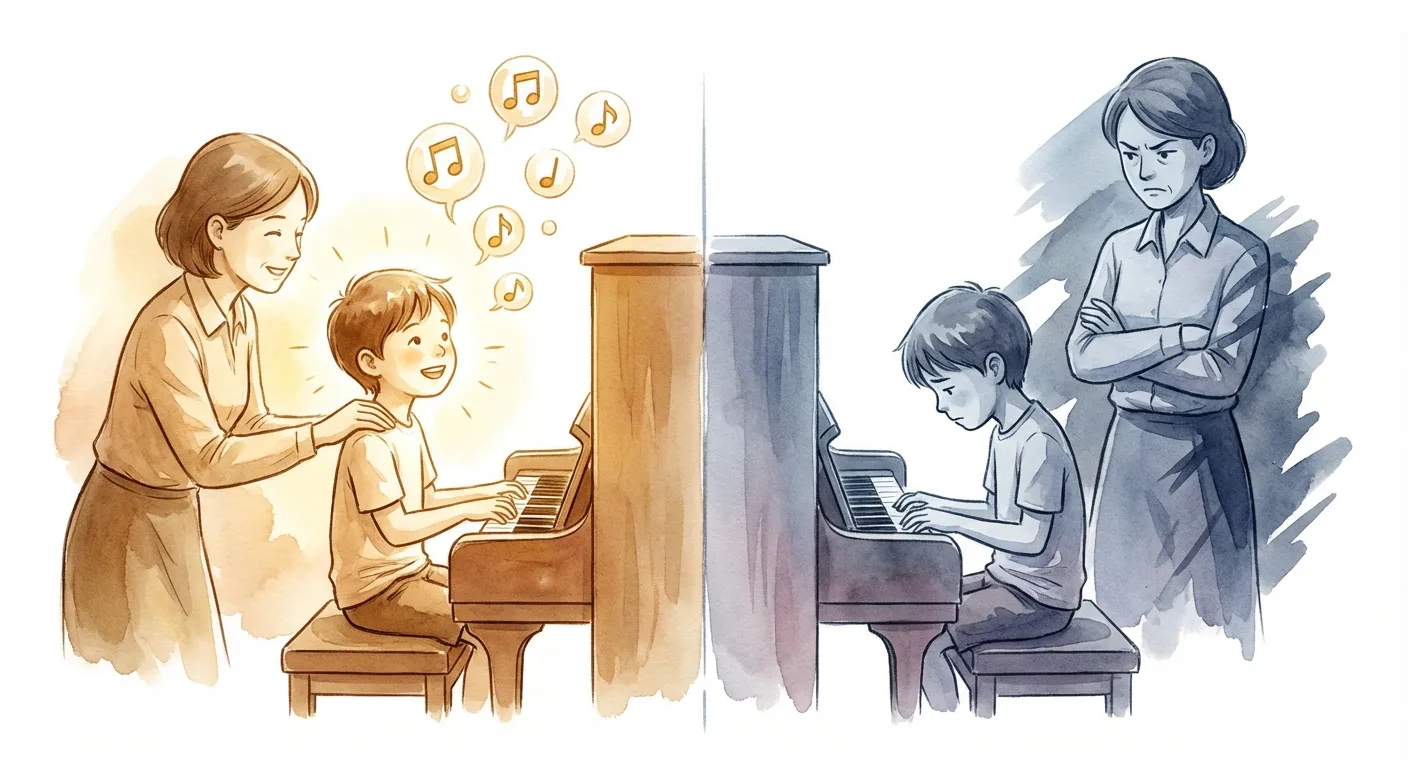
Picture this: you find a piano teacher with a master's from Juilliard. She's technically brilliant, exacting, no-nonsense. Your six-year-old sits at the bench and gets corrected on hand position fourteen times in thirty minutes.
By month two, your kid "hates piano."
You didn't hire a bad teacher. You hired the wrong teacher for the phase your child is in.
The most common mistake in choosing a teacher: optimizing for the teacher's skill level instead of their fit with your child's current developmental stage.
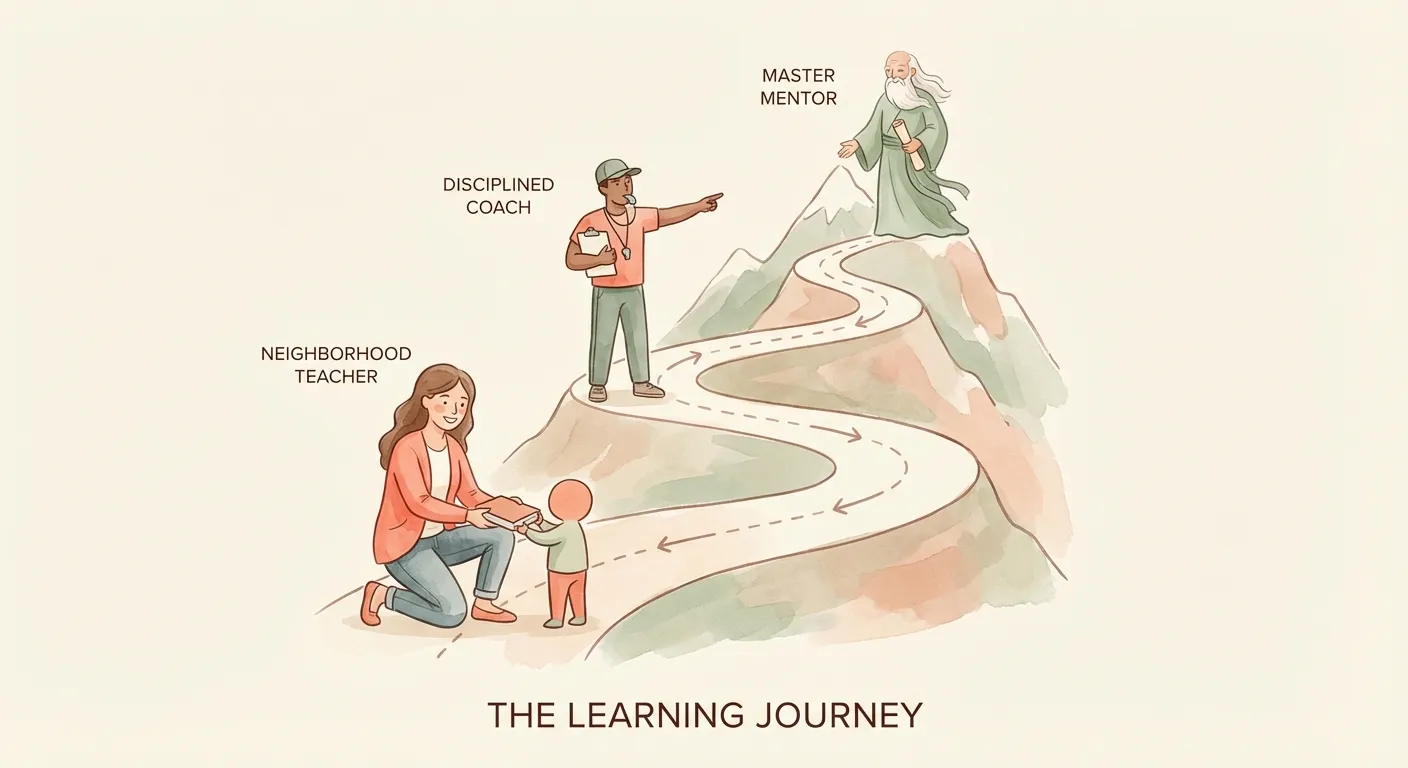
Decades of talent development research found the same pattern over and over: world-class performers didn't have one great teacher. They had a sequence of very different teachers, each matched to where they were.
Three Phases. Three Different Teachers.
Every kid who develops real ability in anything -- piano, swimming, math, chess, painting -- passes through three distinct phases. Each phase needs a fundamentally different kind of instructor.

Phase 1: The Spark Lighter
Ages ~5-10Their only job? Make your child fall in love with the activity. That's it. Technical perfection is irrelevant here.
| Hire for this | Ignore this (for now) |
|---|---|
| Patient, genuinely enjoys kids | High-level technical ability |
| Makes lessons feel like the best part of the week | Impressive resume or reputation |
| Creates chances to perform (recitals, shows) | Their own performance career |
| Honest enough to say "your child is ready for more" | A long-term development plan |
Here's the thing most parents don't expect: the vast majority of top performers started with an average-skilled neighborhood teacher who happened to be extraordinary with kids. Convenience is fine. Warmth is non-negotiable.
Time to move on when...
- The teacher says your child needs someone more advanced
- Your kid is clearly the best in the studio and coasting
- Progress has flattened despite regular practice
- Assignments get completed easily with no real stretch
Phase 2: The Skill Builder
Ages ~10-17Now casual interest becomes real ability. This teacher turns playful engagement into structured discipline. They demand precision. They introduce competitions, summer intensives, serious peers.
| Hire for this | Ignore this (for now) |
|---|---|
| Deep knowledge of technique and fundamentals | Celebrity or fame |
| High standards, attention to detail | A soft, easygoing personality |
| Teaches how to practice, not just what | Close to home |
| Connected to the wider network (programs, competitions) | A nurturing emotional bond |
The shift from Phase 1 to Phase 2 can feel jarring. Your kid went from a teacher who made everything fun to one who makes everything precise. Some turbulence is normal. Sustained misery is not.
Time to move on when...
- Technical foundation is solid -- they need creative development
- The teacher recommends a specific master-level instructor
- Succeeding at regional level, needs national-level mentorship
- Discipline is internalized -- they no longer need it enforced
Phase 3: The Master
Ages ~15-22The master isn't really a teacher anymore. They're a model. Your child learns technique, yes -- but mostly they absorb attitudes, work habits, and ways of seeing the field by proximity. Students at this level describe their teacher's words carrying extraordinary weight.
| Hire for this | Ignore this (for now) |
|---|---|
| Active or recently retired from elite-level work | Patience or hand-holding |
| Part of the professional inner circle | Focus on fundamentals |
| Teaches style, interpretation, creative voice | Easy availability |
| Lives the life the student aspires to | Constant encouragement |
Access usually requires a referral through the network. You don't just apply cold. This is where a skilled performer becomes an artist with a distinct voice.
The Quick Diagnostic
Not sure which phase your kid is in? Ask yourself these three questions:
Which teacher does your child need right now?
If the answer to the first question is "not really" -- your child needs a Spark Lighter, regardless of how skilled they seem. Enthusiasm has to come before discipline. Skip that and you get burnout.
If they love it and practice willingly but lack technical precision -- Skill Builder time. Find someone demanding.
If the technique is there but they sound like every other trained performer -- they need a Master. Someone who'll help them find what makes them different.
The One Rule That Never Changes
At every phase -- even the most advanced -- chemistry matters. A brilliant instructor who crushes your child's enthusiasm will set them back further than a slightly less expert one who keeps the fire lit.
Watch for this: does your child come home energized or deflated? Do they practice more after lessons or avoid the instrument? The right teacher makes your kid want to think about the activity between sessions, bring new ideas, push themselves voluntarily.
If that energy disappears, something is off. Trust your gut and find a better match. Talent development is a marathon. Motivation is the fuel.
There's no single perfect teacher for the whole journey. Match the teacher to where your child is -- not where you want them to go.
The warm coach who sparks the love. The demanding technician who builds the skill. The master who shapes the artist. Your child needs all three, in that order.