
The Second Opinion Trap
Why more doctors don't always mean better answers for your late-talking child
Diagnostic labels stick. Getting it right the first time matters more than getting it fast.
- Kids whose early evaluations are accurate avoid being tracked into the wrong services, misread by teachers who saw the file first, and boxed in by a label that doesn't fit.
- The shift: treat the evaluation like an investigation — rule out physical causes, verify credentials, and demand true independence.
Your toddler barely talks. One professional says developmental disorder. Another says give it time. A third says something in between. You came in looking for clarity and left with three different stories.
So you do what any smart parent does: you seek another opinion. And another. Surely more data points will converge on the truth.
Here's the problem nobody tells you: most second opinions aren't actually independent.
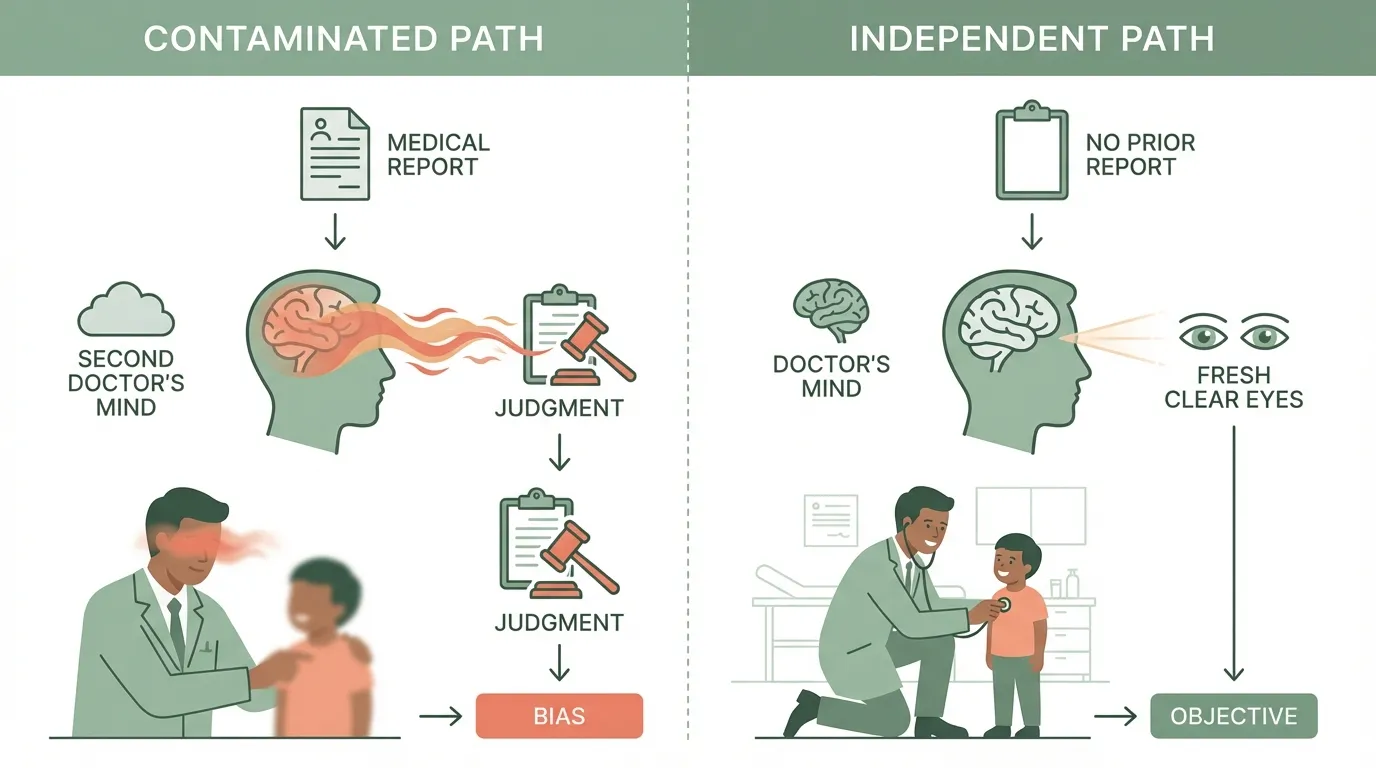
A "second opinion" that starts with someone else's conclusion isn't a second opinion at all.
When the new evaluator reads the first report before meeting your child, they aren't forming a fresh judgment. They're reacting to someone else's conclusion. Confirmation bias kicks in. They see what they've been primed to see.
That isn't a second opinion. That's the first opinion twice.
Four Traps That Lead Parents Astray
Before you can get good answers, you need to spot the bad ones. These four patterns show up again and again in evaluations of late-talking children.
A provider spends five minutes with your toddler, hears limited speech, and writes down a diagnosis that could follow your child for years. Later they claim it wasn't "formal." But it's already in the file.
Some professionals default to the most serious label as self-protection. Nobody gets sued for over-diagnosing. Your child gets a broad disorder label when "isolated speech delay" would be more accurate.
The new evaluator demands the prior report before they'll see your child. Now they're not evaluating your kid -- they're auditing someone else's work through a biased lens.
A hearing specialist mentions autism because your two-year-old won't sit still. A preschool teacher says "spectrum." Well-intentioned observations, but these are not diagnoses from qualified diagnosticians.
To be clear: This isn't anti-diagnosis. Some late-talking children do have autism, hearing conditions, or other issues that benefit enormously from early intervention. The goal is an accurate diagnosis -- not avoiding evaluation altogether.
The CLEAR Method
Five steps to getting an evaluation you can actually trust. Do these in order.

The CLEAR method: a systematic approach to getting answers that hold up.
Hearing, tongue mobility, palate structure, vision. Physical issues are concrete, diagnosable, and sometimes explain the entire picture.
If speech is the only delay -- and your child is meeting or exceeding milestones in reasoning, problem-solving, memory, motor skills -- a broad developmental label may not fit. Ask the evaluator to explain how the diagnosis accounts for your child's strengths, not just the gap.
A real second opinion means the evaluator has not seen the first report, has no professional ties to the first evaluator, and doesn't work at the same institution. If a clinic won't see your child without prior notes, find a different clinic.
Only professionals with specific training in the condition being discussed should be making that diagnosis. Ask directly:
Video your child doing things the evaluator didn't see. Keep written logs with dates. Your observations are data -- not denial. Evidence turns a "you're in denial" conversation into opinion versus documentation.
Spotting the Good Evaluators
Not all evaluations are created equal. Here's what to look for -- and what should make you pause.
When experts disagree, the quality of each opinion matters more than the number of opinions. One thorough, independent evaluation outweighs three rushed ones.

Your instincts plus documentation equals a conversation no one can dismiss.
The Long Game
Getting the evaluation right isn't just about today. Labels stick.
Once a diagnostic label enters your child's educational file, it tends to persist. Teachers read the file before they meet the child. Their expectations adjust accordingly. Early accuracy prevents years of mismatched expectations.
Keep building your case
Maintain a running timeline: evaluations, diagnoses given, qualifications of each evaluator, your own observations. This becomes your most powerful tool if you ever need to challenge a label.
Reassess as your child grows
Development isn't a straight line. A diagnosis that seemed plausible at two may be clearly wrong by four. Build re-evaluation into your plan from the start.
Separate the label from the help
Sometimes parents accept an inaccurate label because it unlocks services. If your child needs speech therapy, pursue it. But push back on a label that doesn't fit, even when it's the easiest path to getting help.
Your gut feeling about your own child is information. It's not the whole picture, but it's not nothing. Pair your instincts with documentation, qualified independent evaluators, and the CLEAR method -- and you'll get answers you can actually stand behind.