

There's a trainable skill that separates tight competitors from loose ones.
- Kids who build this habit recover from errors mid-game, breathe easy under scrutiny, and react before they think about it.
- The shift: teach your kid to notice a thought, place it on a leaf, and watch it drift downstream — daily, five minutes, thirty days.
Your kid already has the skills. The footwork, the reflexes, the muscle memory from hundreds of practice hours. The problem isn't ability. The problem is what's happening between their ears during the game.
Watch them closely next time they compete. Are they playing — or are they thinking? Because those are two very different things. When a kid is stuck in their head, their body can't do what it already knows how to do. They hesitate. They second-guess. They look tight.
There's a fix. It takes five minutes a day, costs nothing, and produces noticeable results within weeks. Sports psychologists have been prescribing it for decades. The most dominant professional athletes across basketball, tennis, and football have credited it as a core part of their training.
It's a focus practice called the Thought Relay.
The Noise Inside Your Athlete's Head
During competition, a young athlete's brain is running a parallel broadcast that has nothing to do with the game:
Live mental chatter during a game
That's six separate worry-threads competing for bandwidth while your kid is supposed to be reacting on instinct. It's like trying to drive while reading a textbook. Everything slows down. Nothing flows.
Quiet the noise, and flow arrives on its own.
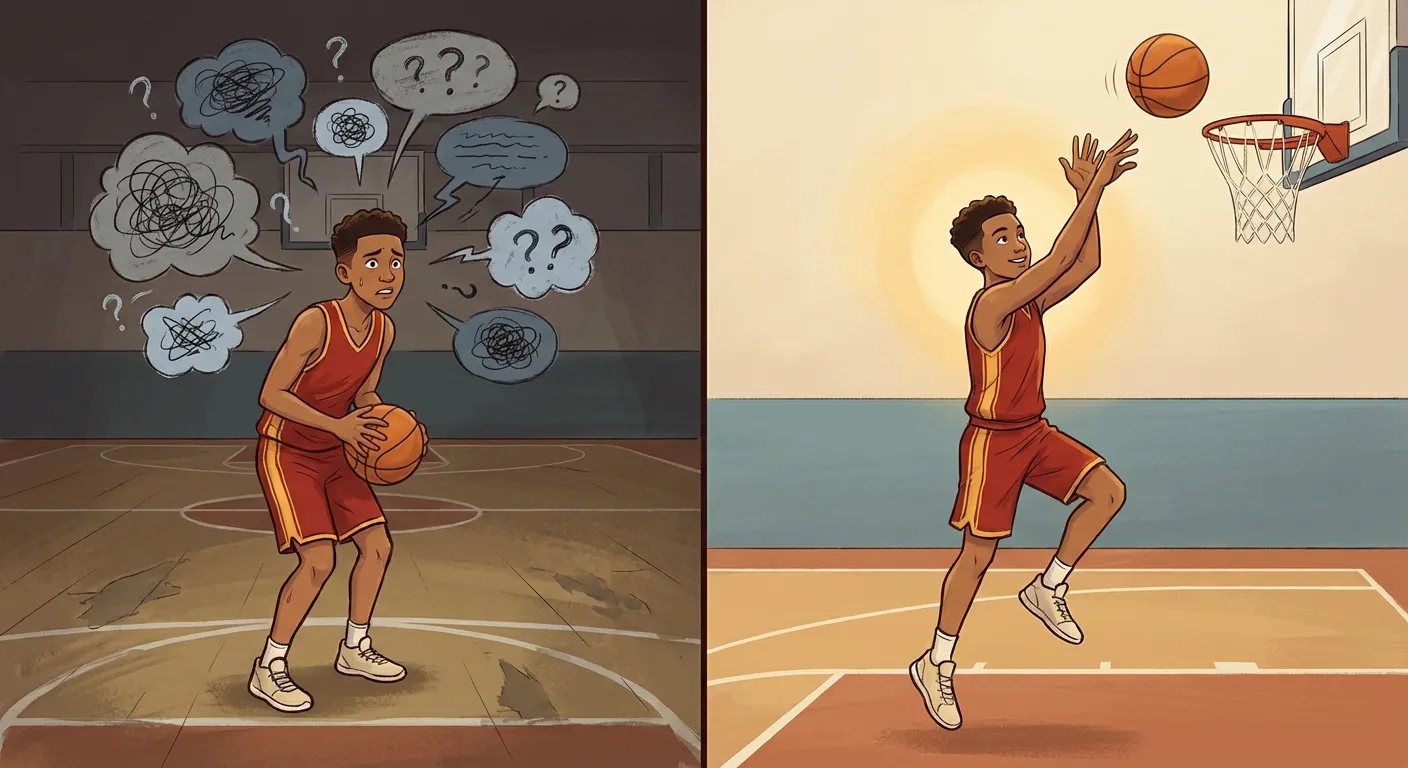
Stuck in their head
- Replaying last mistake
- Scanning the sideline for reactions
- Muscles tight, breathing shallow
- Half a second late on every decision
In the zone
- Mistake forgotten in 2 seconds
- Eyes on the ball, the play, the moment
- Loose, quick, breathing easy
- Reacting before they think about it
The difference between those two columns isn't talent. It isn't coaching. It's the ability to release a thought instead of getting stuck on it. And that's a trainable skill.
The DRIFT Method
Detach. Release. Imagine. Float. Trust. Five minutes, every morning.
Detach from Distractions
Quiet spot. Phone off. Eyes closed. The one moment today where there's literally nothing they need to do.
Release Each Thought
Picture a gentle stream. When a thought appears — and it will — imagine placing it on a leaf and watching it drift downstream. Don't fight it. Don't chase it. Don't judge it. Just notice, place, release.
Imagine the Stream
Build the scene: What does the water sound like? Is there sunlight on it? Trees on the banks? The more vivid the image, the easier the mind settles into it. Some kids prefer a sky with passing clouds, or waves on a beach — any flowing image works.
Float in the Gaps
Between thoughts, there are moments of quiet. That's the good stuff. At first they last a second or two. Over weeks, they stretch. Those gaps are what the zone feels like: total presence, zero noise.
Trust the Timer
Set a timer so "how much longer?" doesn't become another thought to release. Five minutes is the minimum — that's how long the brain's relaxation response needs to fully engage. Aim for 30 straight days.

This is what the practice looks like from the inside: thoughts arriving, being noticed, and floating away. The stream keeps moving. The bank stays still. Your kid learns to be the bank.
What Progress Actually Looks Like
Parents expect silence from day one. That's not how it works. Here's the real timeline:
Making It Stick
| Move | Why It Works |
|---|---|
| Stack it with teeth-brushing | Pairing with an existing habit removes the decision of when to do it |
| Quick 2-min version before games | Same technique, shorter duration — settles pre-game jitters in the car or on the bench |
| Don't ask "how was meditation?" | Turns it into a test. Just ask: "Did you do your five minutes?" That's all that matters. |
| Do it yourself | Kids stick with it when they see a parent doing it too. Even sitting quietly together counts. |
| Name the transfer | When they bounce back from a mistake in a game, connect the dots: "That's your training showing up." |
What This Actually Unlocks
Psychologist Mihaly Csikszentmihalyi spent decades studying peak performance — what athletes call "the zone." He found the same markers every time: the task matches their skill, movement happens without thinking, time distorts, the inner critic vanishes, and the activity itself becomes the reward.
Daily meditation is the most reliable on-ramp to that state. It trains the exact skill flow requires: letting go of conscious interference and trusting trained instincts. Five minutes a day, and your kid starts finding the zone on purpose instead of by accident.
The bottom line
The goal isn't an empty mind.
It's a mind that knows how to let go.