
Your Kid's Brain Has Four Predictable Glitches. Here's How to Fix Them.
The BLUE framework turns emotional meltdowns into a 60-second thinking reset.
A thought that arrives with a big emotion feels like evidence. It isn't.
- Kids raised to check their thinking handle friend drama, school setbacks, and unfairness without collapsing into learned helplessness.
- The shift: separate the feeling from the story. One is real. The other needs editing.
"I never get picked for anything. Nobody wants me on their team."
That was after one kickball game. One. Not a pattern of exclusion. Not a social crisis. A single round of not getting picked first.
But inside a kid's head, that moment didn't stay a moment. It became a verdict: I'm the kid nobody wants.
Here's what's actually happening. When something goes wrong, your child's brain doesn't just report events. It adds a story on top -- whose fault it is, how permanent the damage is, what terrible thing comes next. And the story feels completely, unshakably true. Because it arrived with the emotion, it feels like evidence.
It isn't. It's a rough draft.
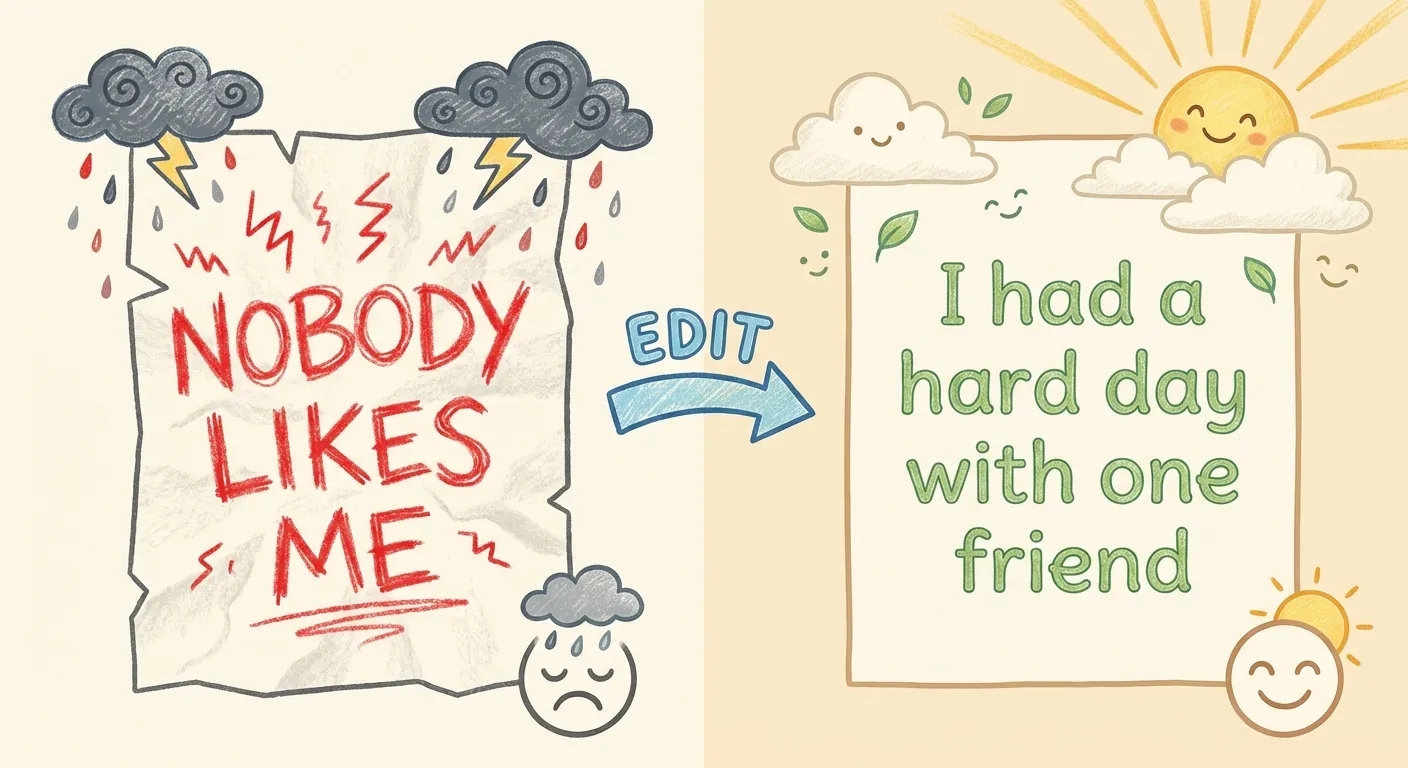
A thought that shows up when your child is upset is not evidence. It's a rough draft. Teach them to edit before they believe it.
Research on learned helplessness -- decades of it -- shows that children who habitually believe they have no control over outcomes stop trying to change their situation. Not because they're lazy. Because their own thinking has convinced them there's no point.
The fix isn't positive thinking. It's accurate thinking. And it starts with knowing exactly which glitch is running.
The Four Glitches (BLUE)
Cognitive behavioral therapy identified four predictable patterns kids fall into when upset. The BLUE acronym, widely used in child therapy, gives them something kids can actually remember:
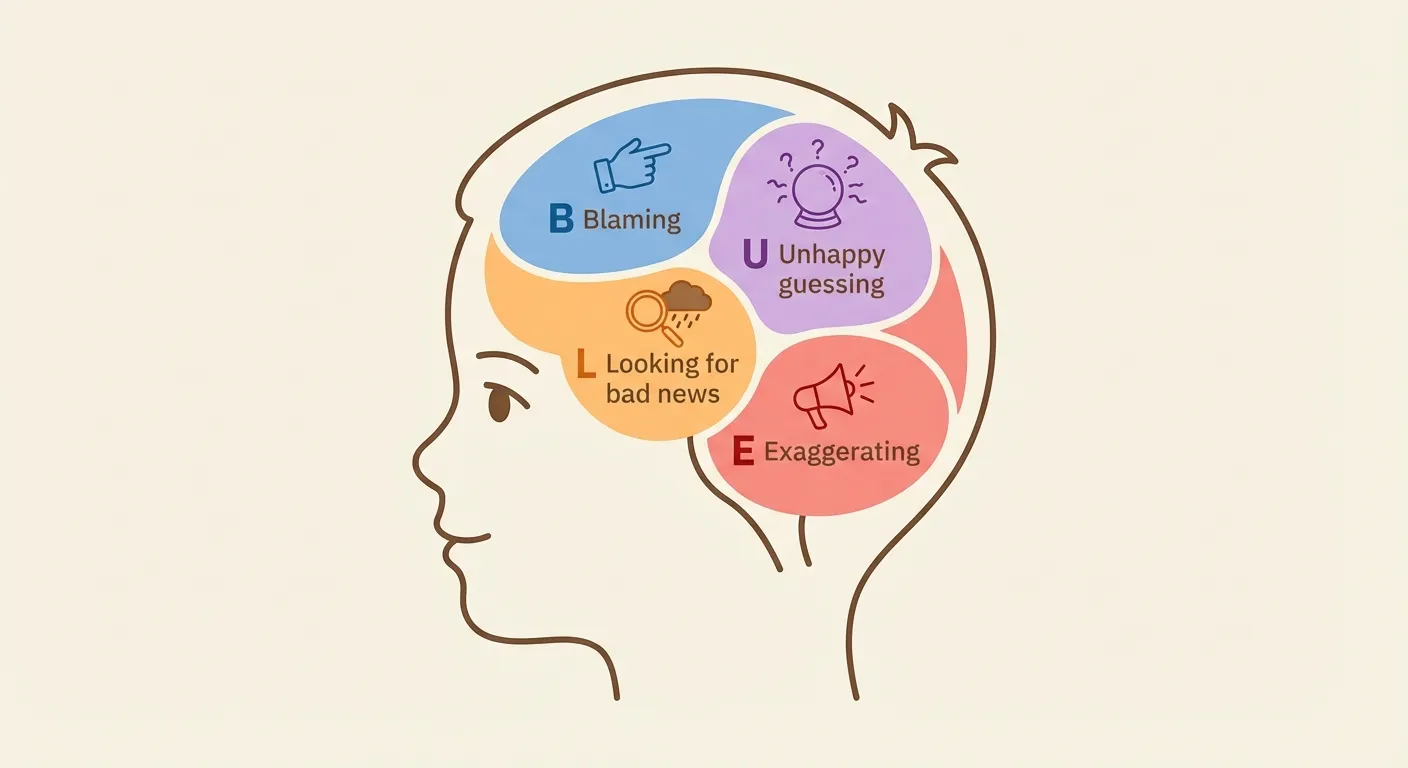
Blaming Everyone Else
100% of the responsibility lands on other people. Your child is left with zero power to change anything.
Looking for the Bad News
Everything good gets deleted. The one bad thing becomes the whole story.
Unhappy Guessing
The worst outcome is predicted as guaranteed. Helplessness kicks in before anything has even happened.
Exaggeratedly Negative
One thing gets stretched to cover everything. Watch for "always," "never," "nobody," "everyone."
The 60-Second Thought Check
Knowing the four traps is step one. Using them in the heat of the moment is where it actually matters. Here's the sequence:
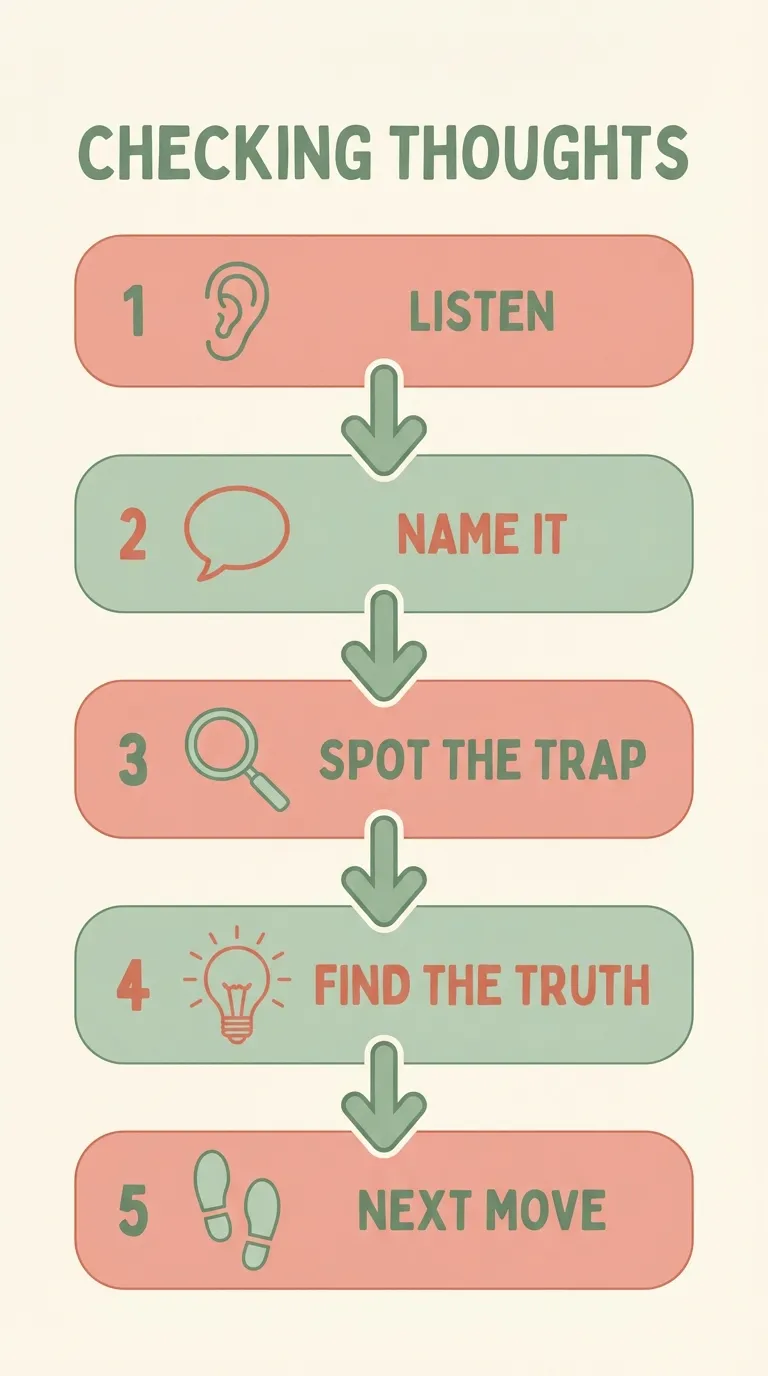
Let them vent (60 seconds)
They need to feel heard before they can think clearly. Pure listening. No problem-solving.
Name the pattern
Create a tiny gap between the thought and the belief.
Younger kids: "Is your brain being tricky, or is that really true?"
Spot which trap
Get specific. Over time, kids start naming their own traps unprompted.
Find the accurate version
Swap the distortion for what's actually, literally true. Not sugarcoated -- just precise.
Move to what's next
Once the thought is accurate, shift to action. This moves them from narrator to protagonist.
The After-School Questions That Shape Everything
The questions you ask after school train what your child's brain scans for. Lead with problems and they'll find problems. Flip it:
Trains the Negativity Filter
- "How was school?" (gets "fine" or a complaint)
- "Was anyone mean to you?"
- "Did you get in trouble?"
- "Any problems with friends?"
Trains the Strengths Filter
- "What went well today?"
- "Who did you laugh with?"
- "What's one thing you figured out on your own?"
- "Did you help anyone today?"
You're not banning complaints -- you're just not leading with them. The hard stuff still comes up. You're changing the opening act, not censoring the show.
What Builds Resilient Thinkers vs. What Doesn't
Builds Resilience
- Teaching kids to name their thinking patterns
- Asking "what can you do?" instead of "what happened to you?"
- Leading daily conversations with strength-finding questions
- Letting kids sit with disappointment before fixing it
- Celebrating when they catch their own traps
- Modeling your own corrections out loud
Reinforces Helplessness
- Agreeing with distorted thoughts to comfort them
- Rushing to solve every problem before they try
- Defaulting to "poor you" as comfort
- Labeling: "you're just a worrier" / "you're so sensitive"
- Always leading with what went wrong
- Making their excuses for them
The Long Game: Making This Stick
- Model it yourself. When you catch your own distorted thinking, say it out loud: "I'm doing the 'everything is ruined' thing. Let me find what's actually true." Kids absorb what you demonstrate far more than what you teach.
- Make it a shared vocabulary. Once your family knows the four traps, shorthand it: "Is that an 'always/never' thought?" Best as curiosity, never accusation.
- Never weaponize it. "You're just blaming again" shuts a child down. "I wonder if your brain might be trapping you" invites investigation. Tone is everything.
- Watch your own traps about your child. "She's always so dramatic" and "He never listens" are the same distortions -- from the parent side. Run the same check on yourself.