
Say Less, Teach More
Montessori discovered that the fewer words you use, the faster kids learn. Here are her three filters for every lesson.
Montessori found that fewer words produce faster learning — every time.
- Kids who learn this way absorb new concepts on the first try, stay focused longer, and start teaching themselves without being prompted.
- The move: run every lesson through three filters — concise, simple, objective — before you open your mouth.
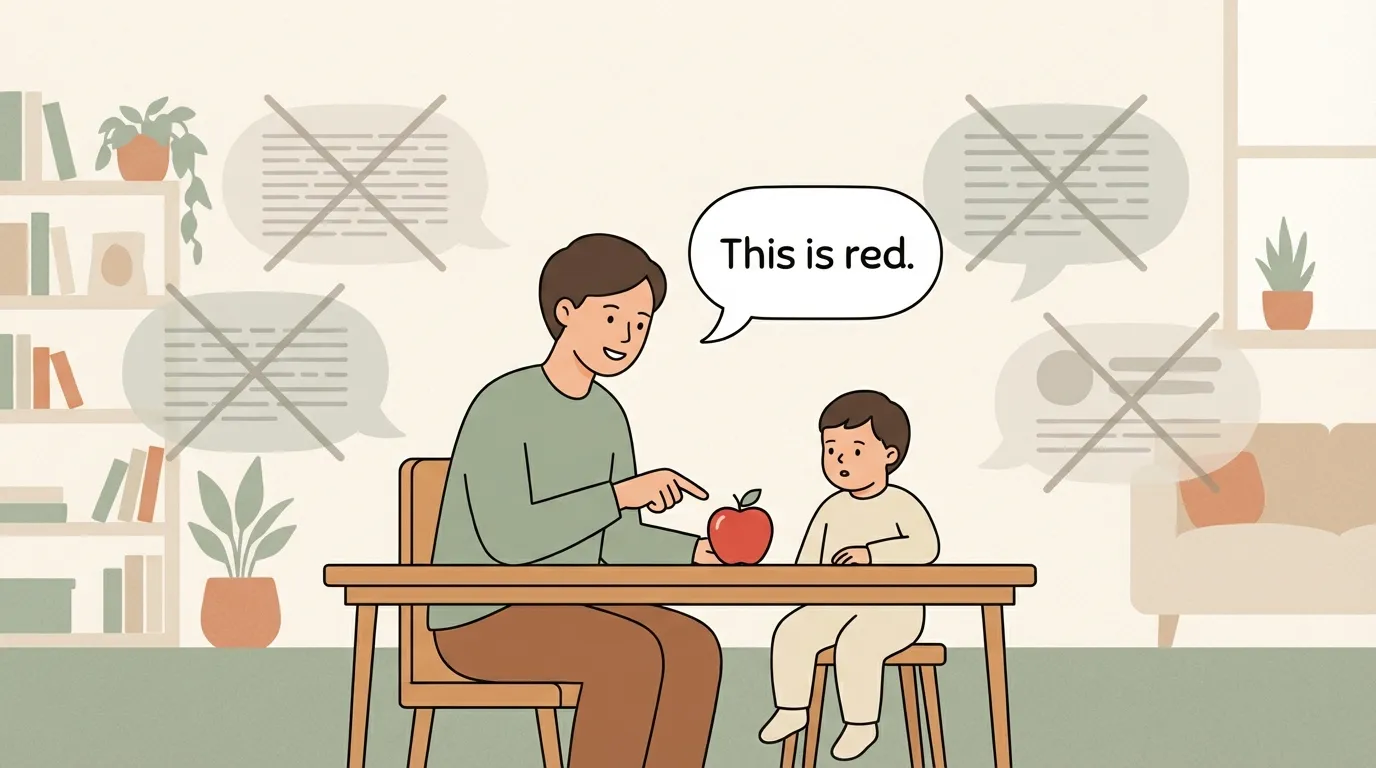
Your kid picks up a new toy. You want to teach them something about it. So you start talking. And talking. You explain what it is, where it came from, what it does, how it connects to something you saw last week, and by the time you finish your sentence, they've already walked away.
Maria Montessori noticed this over a hundred years ago. She watched teachers deliver beautiful, elaborate lessons — and watched children zone out every single time. Then she tried something radical: she stripped almost everything away.
The result? Kids learned faster. Not a little faster. Dramatically faster.
She boiled it down to three criteria. Every lesson — whether you're teaching colors, shapes, letters, or how to tie shoes — gets run through these three filters before a single word leaves your mouth.
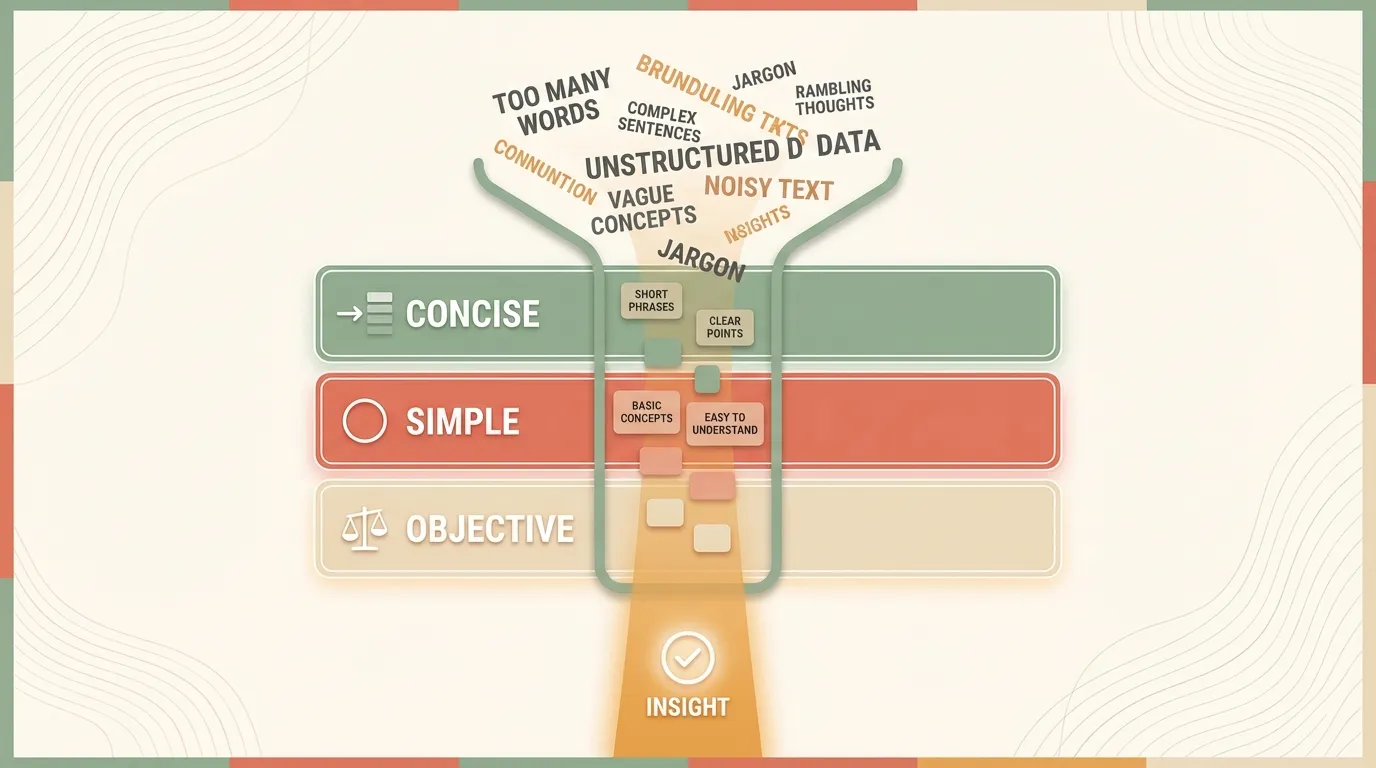
The Three Filters
Concise
Cut away every unnecessary word. Montessori quoted Dante here: "Let all thy words be counted." If you can say it in three words, don't use twelve.
Not "Now look at this, sweetie, can you see what color it is? It's a beautiful color, isn't it?" By the time you finish that sentence, the moment is gone.
Simple
State only the essential truth. No analysis, no elaboration, no building up to a conclusion. The child can absorb the whole thing directly.
Not "This is a line, and this is another line, and they make four lines, and four lines make a square." A child recognizes a square without needing to count to four. That's geometry class, not shape recognition.
Objective
Your personality disappears. You're not performing, not connecting, not riffing. Only the object you're teaching about should remain in the child's attention.
Not "Look at the sky! What color is my apron? And these cherries?" Each comparison drags in your associations, not the child's direct experience of blue.
Before and After
Here's what this looks like in practice across five everyday teaching moments:
| What most parents say | After the 3 filters |
|---|---|
| "Okay so this is called a triangle — see, it has one, two, three sides and three pointy corners..." | "This is a triangle." |
| "Feel this! Isn't it rough? Like sandpaper! Remember when Daddy was sanding the table?" | [Child touches sandpaper] "Rough." |
| "This one is biiiiig and this one is teeny tiny little! Which one do you think is bigger?" | [Place both] "This is big. This is small." |
| "Can you hear that? That's a really loud sound! Like a drum! Boom boom boom!" | [Make sound] "Loud." [Make sound] "Soft." |
| "This letter is an A — it's the first letter of the alphabet and it's in your name!" | [Trace letter] "A." |
The 3-Second Check
Before you open your mouth, run your lesson through these three questions. It takes about three seconds.
If the answer to all three is yes, speak. If not, keep trimming.
The hardest part isn't learning the filters. It's resisting the urge to be interesting. You want to connect, to elaborate, to make it a moment. Montessori's counterintuitive insight: the less of you there is in the lesson, the more space there is for the child to actually learn.
"To give a ray of light and to go on our way."Maria Montessori, on the teacher's role
Published by kungfu.family