
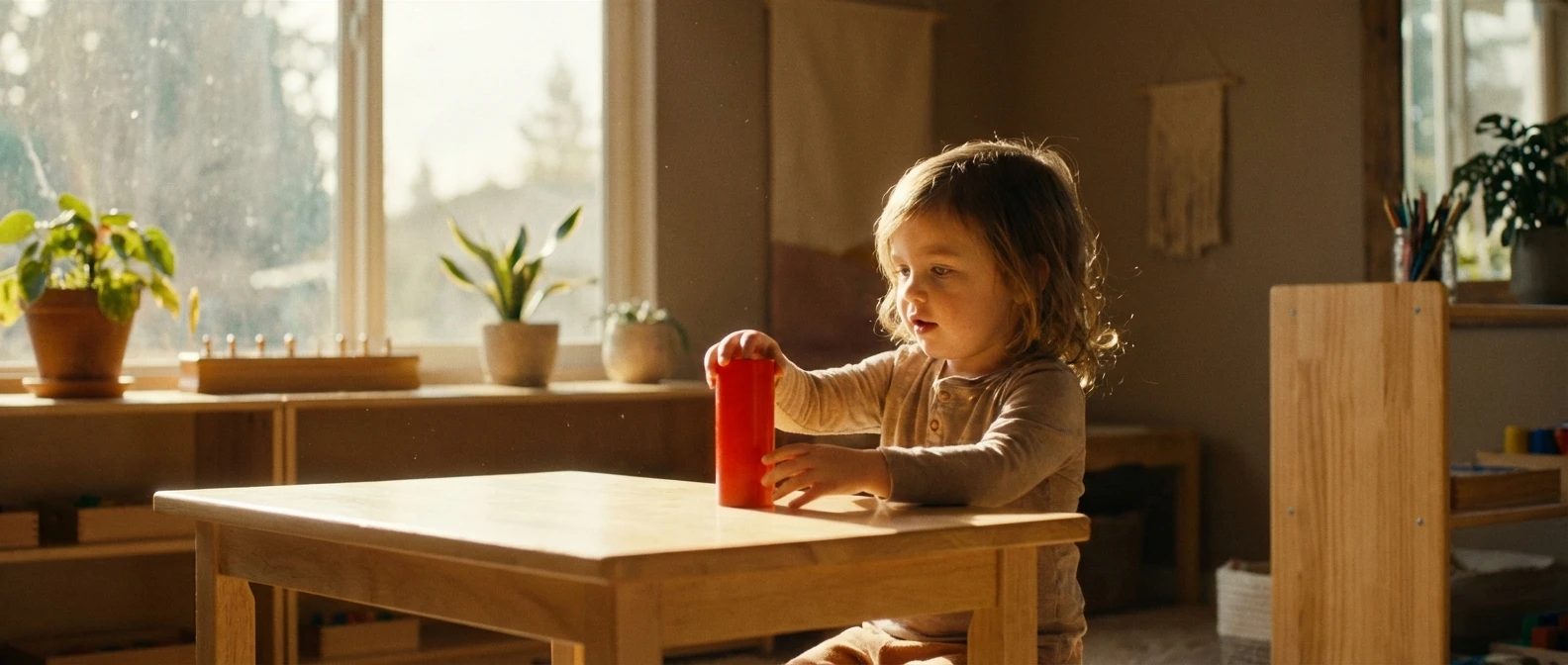
Fewer Words,
Faster Learning
Montessori's 3-step technique for teaching any concept — ages 2-6
A 3-step method that turns toddlers into kids who learn new words fast.
- Kids raised on this pick up vocabulary like sponges — colors at 2, letters at 3, reading foundations by 4. They stay focused during short lessons and retrieve words from memory on command.
- The move: strip the lesson to three bare steps — name, recognize, recall — and use almost no words at all.

The Three-Period Lesson became the backbone of Montessori education. It's been used in classrooms worldwide for over a hundred years. And the core principle is the same one Séguin discovered: the fewer words you use, the more room the child has to learn.
How does the method work?
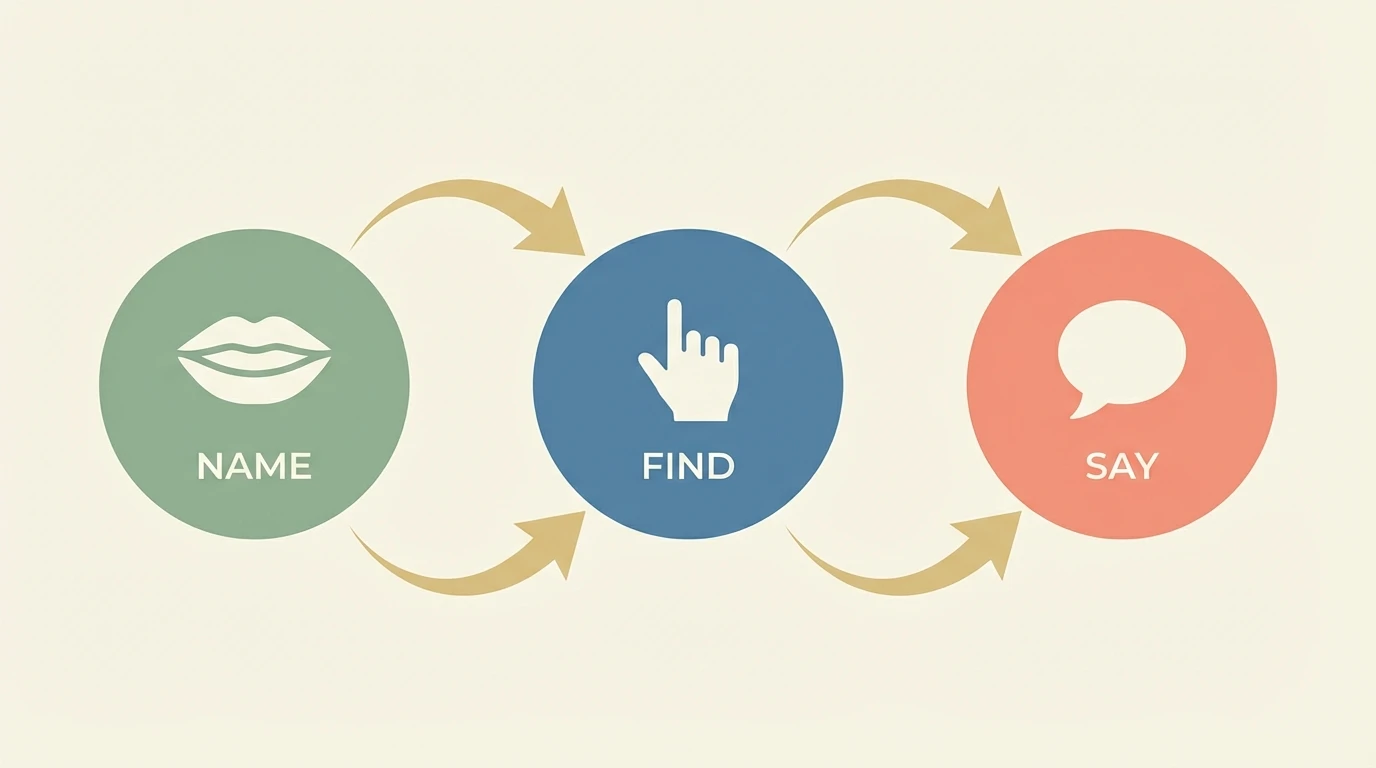
Three periods, three rules. Every lesson must be concise (count your words), simple (only absolute truth), and objective (the teacher's personality disappears). Expand each period below to see the exact technique.
1 Naming — associate the perception with the name ▶
Show two contrasting objects. Name each one. No elaboration, no analogy, no context.
[Show the other]
"This is blue."
Leave the objects in front of the child for a moment. Always present at least two contrasting items — never just one. That's the entire first period.
2 Recognition — the child identifies the named object ▶
Ask the child to show you or give you the object by name. This is where the actual learning happens. Repeat this step many times with varied requests.
"Give me the blue."
"Put the red on the table."
"Hand me the blue."
The child is connecting the name to the object through action — reaching, handing, placing. This is far more powerful than just hearing the name.
3 Recall — the child produces the name ▶
Point to the object and ask the child to name it. This is the hardest step. Only attempt it after the child succeeds consistently with Period 2.
"What is this?"
The child must retrieve the word from memory and produce it. If they can't, don't push — go back to Period 2 next time.
How do I know if my child is ready for each step?
What if the child makes a mistake?
This is where the method challenges everything you'd naturally do. The instinct is to correct, to repeat, to try one more time. Montessori says: stop.
When a child gets it wrong
The child isn't failing — they're not ready. Pushing through doesn't accelerate learning. It damages the natural state Montessori says you need to preserve.
"To give a ray of light and to go on our way."
— Maria Montessori, on the teacher's roleWhat can you teach with this method?
Anything that has a name. The method works across every sensory domain:
"Teachers ordinarily are greatly surprised at such simplicity. They often say, 'But everybody knows how to do that!' ... but the truth is that not everyone knows how to do this simple thing."
— Maria MontessoriRemember
The method that works for every concept is the same one: name it, let them find it, let them say it. Use fewer words. And when they're not ready — just smile and stop.
Explore more strategies at kungfu.family