
Your Gut Is Lying About Your Kid's Behavior
Three weeks of simple tracking gives you more clarity than a year of worrying.
- Kids benefit from parents who can say 'this strategy cut meltdowns by half' instead of 'I think things are maybe better?' -- and the data makes those wins visible to the whole family.
- The move: week one baseline, week two try something new, week three compare the numbers.
Three tantrums on Monday. One on Tuesday. But it all feels like "constant meltdowns." A 30-second daily habit fixes this -- and you'll start seeing wins you were completely missing.

Here's something wild: researchers have spent decades studying how parents perceive their kids' behavior, and the finding is consistent. We are terrible at it.
Not terrible parents. Terrible estimators. What feels like "he does this all the time" might be three times a day one week and once a day the next. Without data, your brain rounds everything up to "constant." And that distortion makes it impossible to see what's actually improving.
The fix isn't complicated. You don't need an app, a therapist, or a PhD. You need to write down what you see, when you see it, for about a week.
That's it. The pattern shows itself. And suddenly you're making moves based on evidence, not emotion.
Step One: Get Specific (This Changes Everything)
The number one mistake? Tracking something vague. "Being difficult" isn't trackable. "Slams book shut during reading time" is. The sharper your definition, the clearer your data.

Name what you can see or hear
No mind-reading. Only what a camera would catch. "Frustrated" is invisible. "Crumples paper and pushes it off the table" is footage.
Draw the line so two people agree
If you and your partner would count differently, it's too fuzzy. "Speaking loudly" = gray area. "Voice audible from the next room" = clear.
Say when context matters
Running and yelling at the park? Totally fine. During bedtime routine? That's the behavior you're tracking. Context is part of the definition.
Here's what this looks like in practice:
Pick the Right Tool for the Job
Different behaviors call for different tracking methods. You wouldn't time a tantrum the same way you'd count toys left on the floor. Here's how to pick:
Six Methods, One Cheat Sheet
Evidence Counting
Tally Tracking
Timer Tracking
Delay Tracking
Snapshot Method
Window Tracking
Your First Week: The Dead-Simple Tracker
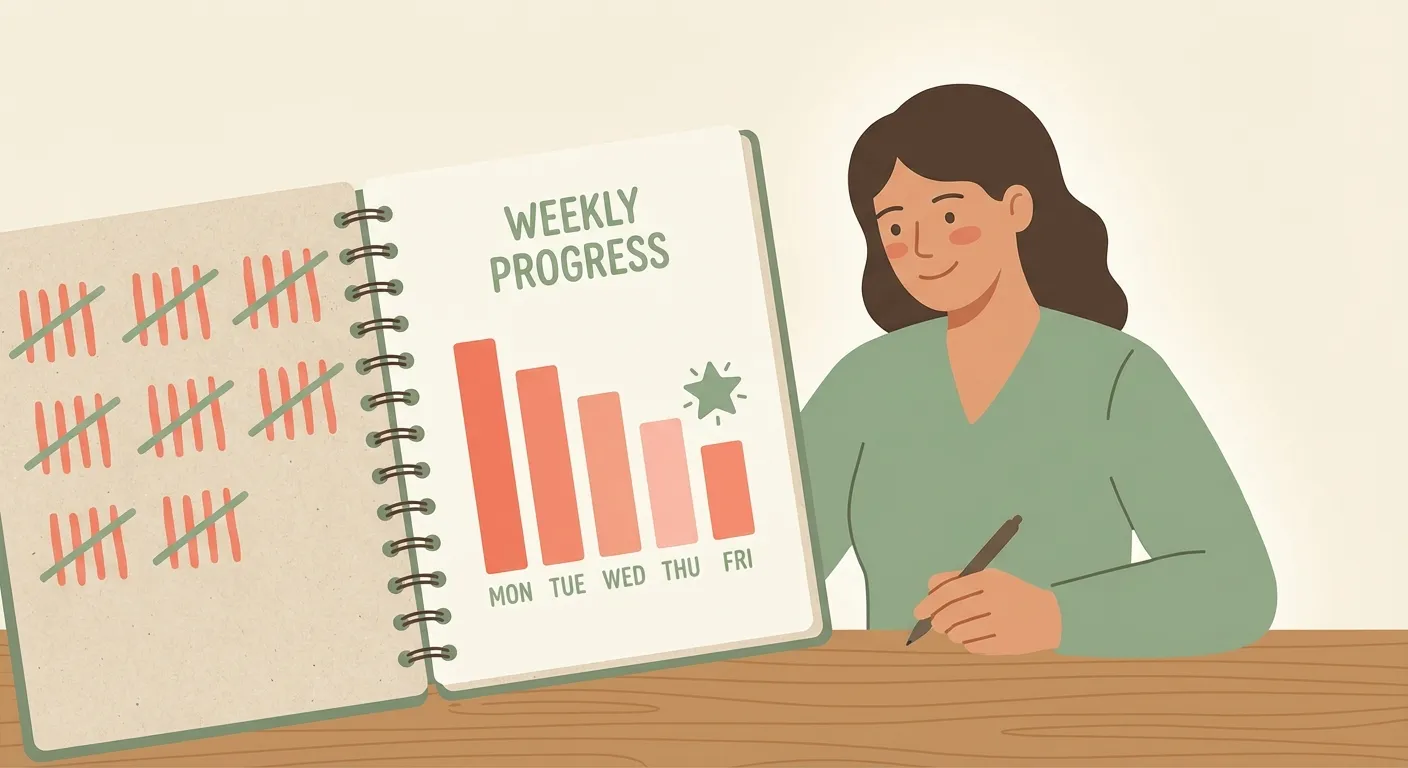
Pick one behavior. Just one. Use this format for your first week:
| Day | Morning | Afternoon | Evening | Total |
|---|---|---|---|---|
| Mon | ||||
| Tue | ||||
| Wed | ||||
| Thu | ||||
| Fri | ||||
| Sat | ||||
| Sun |
Reading Your Data (the Fun Part)
After seven days, you've got something most parents never have: actual evidence. Now scan for patterns:
Five Questions That Reveal the Pattern
The Three-Week Power Move
You don't need to track forever. Here's the play:
Week 1: Baseline
Track without changing anything. Just observe. This is your "before" data.
Week 2: Intervene
Try your new strategy. Keep tracking. Same method, same definitions.
Week 3: Confirm
Did the numbers move? If yes, you found something that works. If no, try a different approach. Either way, you know.
And when Thursday shows 3 incidents instead of the usual 7? That's not a fluke. That's evidence. Point it out to your kid: "We're getting better at this." They feel it too.
Start Tonight
Pick one behavior. Define it in one sentence. Track it for seven days.
You'll know more about what's actually happening than most parents ever will.