
The conversation you're avoiding is less scary than the story your kid is making up.
- Kids who get honest answers stop filling gaps with self-blame, process grief in healthy waves, and build trust that carries into the teenage years.
- The shift: replace protective silence with a simple, age-matched explanation — even a clumsy one counts.
Your kid heard you crying on the phone last night. You wiped your face, walked into their room, said "everything's fine," and tucked them in. They didn't push back. You thought you got away with it.
You didn't. Right now, in that small head, a story is forming: "Something bad happened and nobody will tell me what it is. Maybe it was my fault."
That story -- the one they write when you leave a gap -- is almost always worse than the truth. Developmental research backs this up: children who sense something is wrong but get no explanation experience more anxiety than children who receive a direct, honest account of what happened. The unknown isn't neutral. It's terrifying.
The good news? You don't need perfect words. You don't need a therapy degree. You need one principle and five steps.
Kids aren't scared by hard truths.
They're scared by the silence where an explanation should be.
What Happens in the Gap
Children are environmental detectives. They read tone, body language, routines, and micro-expressions before they can read books. When something shifts -- a parent's mood, a missing person at the dinner table, a hushed phone call -- they notice instantly.
Without information, their brain does two predictable things:
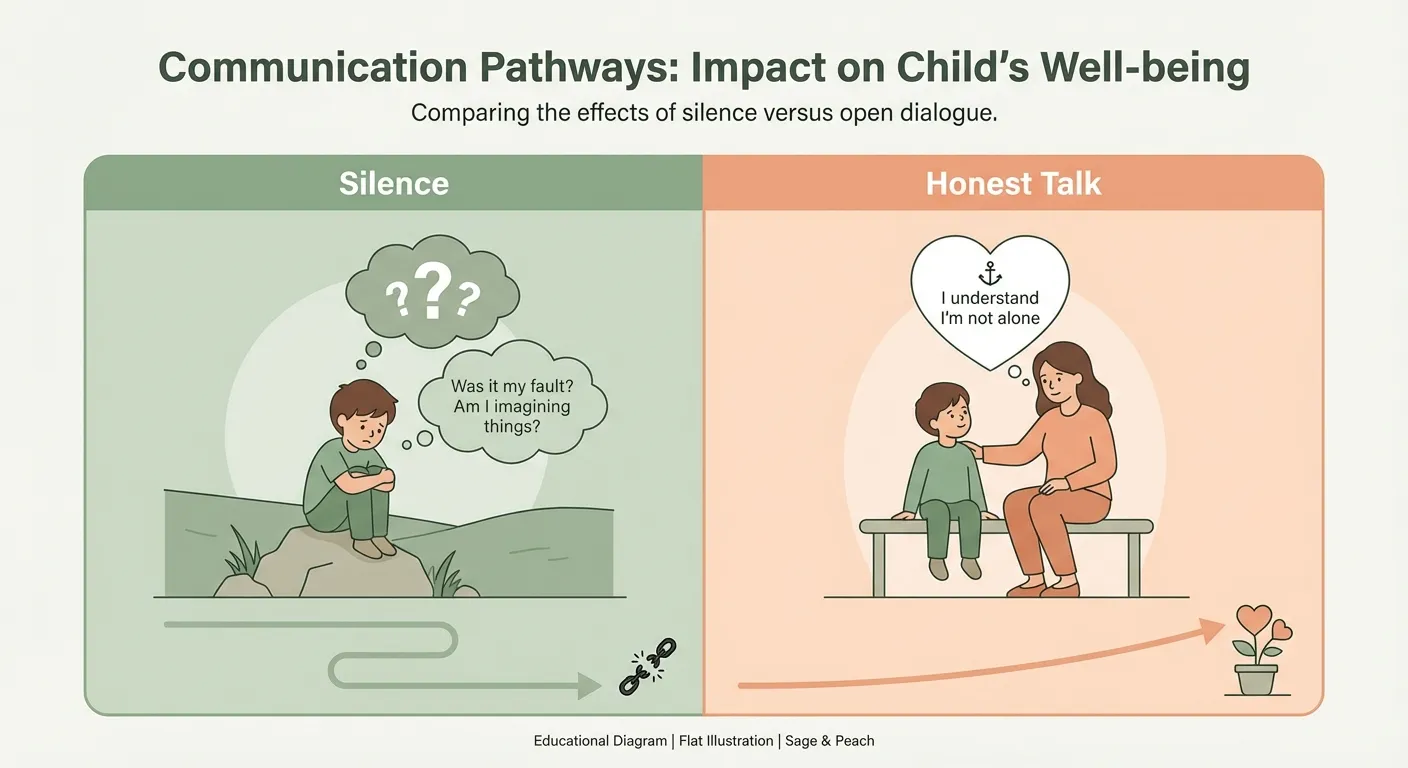
| When You Say Nothing | When You Say Something |
|---|---|
| Child senses a threat but can't name it | Child knows what happened and why it matters |
| Fear stays shapeless and unprocessable | Brain has something concrete to organize around |
| Self-blame fills the gap: "I caused this" | You close the gap: "This isn't about you" |
| Child learns big things aren't safe to discuss | Child learns you're the person who tells the truth |
This isn't about dumping adult-level detail on a four-year-old. It's about giving an honest, age-matched version rather than nothing at all.
The BRAVE Talk: Five Steps That Work Every Time
Whether it's "the goldfish died" or "Grandma is very sick," this framework scales. Each letter is a step. Do them in order.
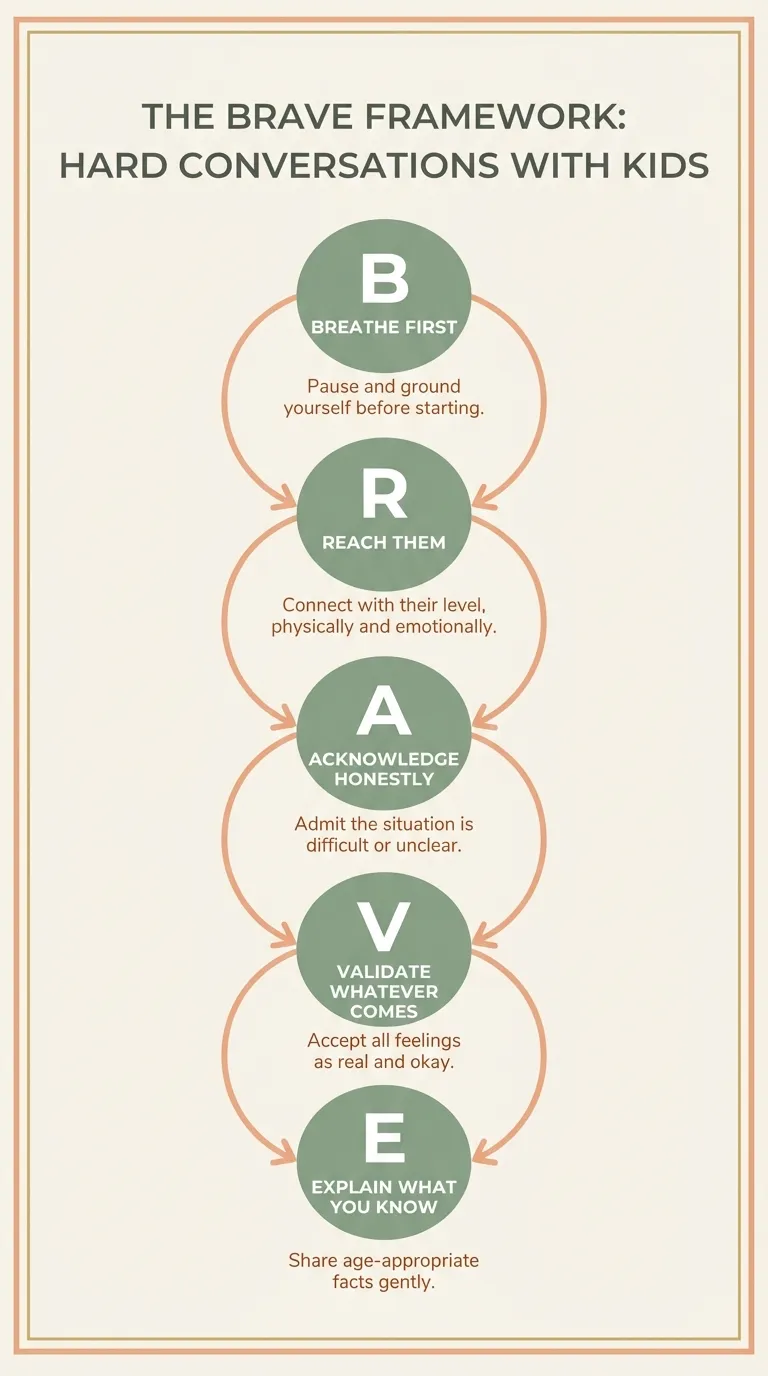
Breathe First
One slow breath before you say a word. Your child's nervous system syncs to yours. When you're regulated, they borrow that calm. When you're frantic, they absorb that too.
Reach Them
Get on their level. Sit down. Eye contact. Hand on shoulder. Signal that this matters.
Acknowledge Honestly
Use direct language. No euphemisms.
| Don't Say | Say Instead |
|---|---|
| "Passed away" | "Died" |
| "Taking a break" | "Separating" |
| "Things are changing at work" | "Lost his job" |
Euphemisms feel safer for the adult but create confusion for the child.
Validate Whatever Comes
They might cry. They might shrug and go back to playing. They might ask something that floors you. All of it is okay. Don't rush to fix.
If they go quiet, let the quiet sit. Silence after truth is healthy. Silence instead of truth is not.
Explain What You Know -- and What You Don't
Kids handle uncertainty surprisingly well when you're honest about it. Separate what's known from what isn't, then anchor to what stays the same.
When They Ask Out of Nowhere
Bedtime. The grocery store. Middle of a car ride. "Are you going to die?" "Why is that man sleeping on the street?" "How did the baby get in there?"
If they're asking, they've already been thinking about it. The question is proof they're ready for at least the beginning of an answer. You have two options:
Option A: Answer Now
Give the shortest honest answer you can. One or two sentences. Then pause and see if they want more.
Option B: Buy Time
"That's a really important question. Can we come back to this after dinner? I promise I will."
The critical part: if you pick Option B, you must actually come back to it. If you don't, your child learns that big questions get silence -- and they stop asking.
Building the Channel That Lasts Until They're 17
Every honest conversation -- even a clumsy one -- deposits trust. Every dodge or deflection withdraws it. Over years, that balance determines whether your teenager comes to you or hides from you. Here's how to start building now:
- Start small, start early. Narrate everyday disappointments honestly -- a cancelled playdate, a broken toy, a friend who was unkind. These low-stakes reps build the muscle for high-stakes conversations later.
- Let them see you have feelings too. "I'm feeling frustrated right now, so I'm going to take a few breaths." Just make clear you can handle your own emotions -- they don't need to take care of you.
- Revisit past conversations. A few days after a hard talk, casually check in: "Remember when we talked about Biscuit? How are you feeling about that now?" This signals the topic isn't off-limits.
- Trust their timeline. Kids process hard news in waves. They might seem fine for weeks, then suddenly draw a picture about it or melt down about something unrelated. That's not regression -- it's integration.
- Protect the channel. The goal isn't one perfect conversation. It's a thousand imperfect ones that prove you're the person who tells the truth.
Your steady presence is what makes hard news survivable.
Name what's real. They can handle it -- as long as they're not alone.