
Math · Ages 7–9
Division Before Addition
The counterintuitive order that makes math click for ages 7–9
Kids who start with the whole number grasp math faster than kids who build from parts.
- Kids who learn this way see patterns in numbers naturally, split quantities without counting on fingers, and treat arithmetic like a puzzle they already know how to solve.
- The move: give the whole first. Say "here are 12 apples — how can we share them?" instead of "3 + 4 = what?"
"Three plus four equals … ?"
Your seven-year-old stares at the worksheet. You wait. The seconds stretch. They start counting on their fingers — one, two, three … then four more … fumble, lose count, start again. The answer is right there, you think. It's seven. How can this be so hard?
It's hard because you're asking the question backwards.
What If the Standard Order Is Wrong?
In 1924, Rudolf Steiner stood in front of a group of teachers and told them something that contradicted everything they'd been taught about arithmetic: stop starting with the parts.
"I do not say: two and two is four. No, I say: there is a four and what I have here is divided into two and two."
Rudolf Steiner, The Kingdom of Childhood, Lecture 5 (1924)His argument was simple. Hand a child a cake and ask them to share it with friends — they understand immediately. The cake is whole. The slices are parts inside it. The child doesn't need to build the cake from slices. The cake already exists.
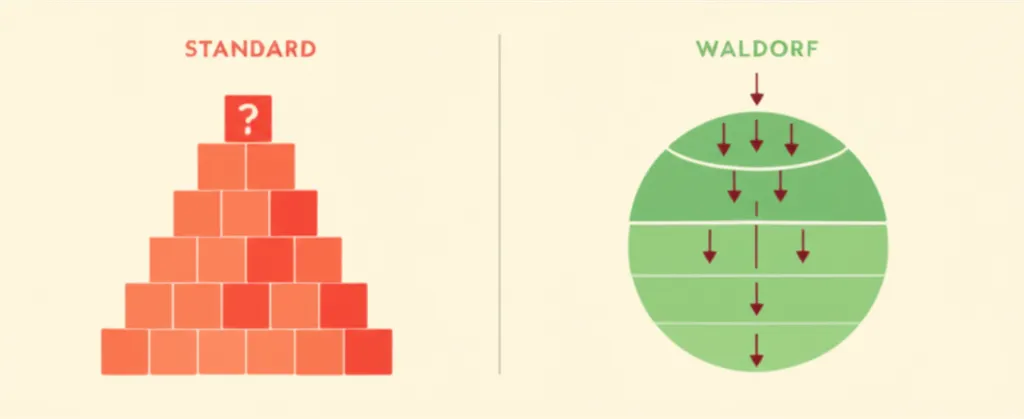
But "3 + 4 = ?" asks the child to do exactly that: take scattered pieces and construct something that doesn't yet exist. That's not how children think.
Why Does Starting With the Whole Work Better?
Think about how a child actually experiences the world. They don't see five separate fingers — they see their hand. They don't see three separate people at the dinner table — they see their family. Wholes come first. Parts are discovered inside them.
Children naturally think in wholes. A cake contains its slices. A family contains its members. Twelve contains its parts — you just have to ask the child to find them.
This is the reversal. Instead of "3 + 4 + 5 = ?", you say: "Here are 12 apples. How can we divide them among three children?" The child isn't building from nothing. They're discovering what's already inside the whole.
The difference sounds small. In practice, it changes everything.
How Do You Reverse Each Operation?
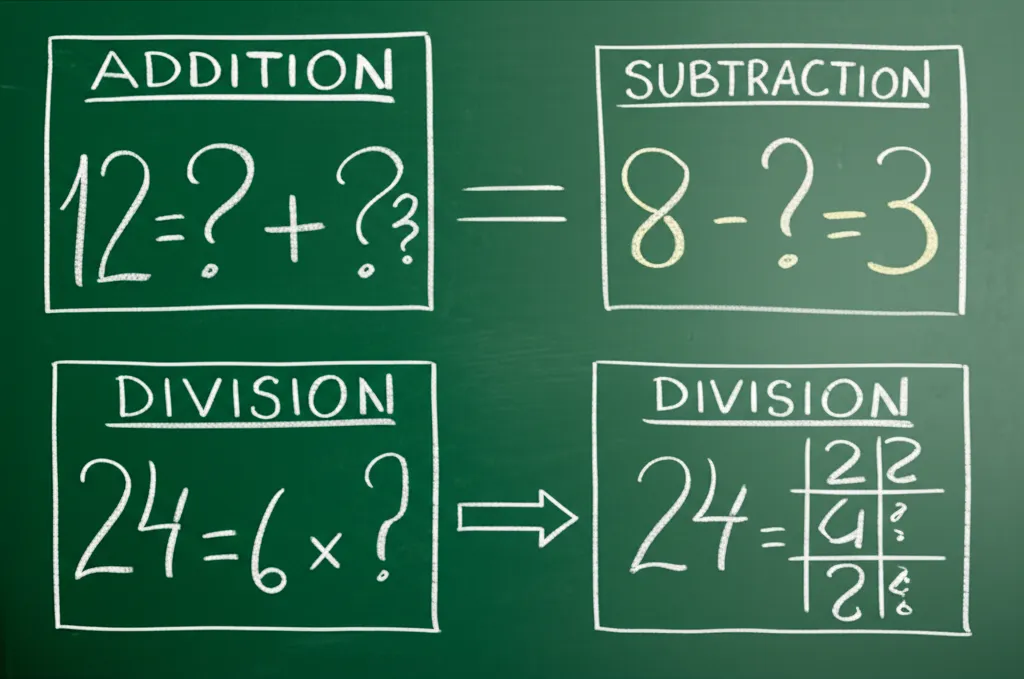
Steiner didn't just flip addition. He reversed all four operations. In each case, the same principle applies: give the whole first, then ask what's inside it.
The Four Operations Reversed
Addition: Start with the Sum
Standard: "3 + 4 + 5 = ?" — building from parts
Waldorf: "Here are 12. What parts make it?" — dividing the whole
Subtraction: Find What Was Taken
Standard: "8 − 5 = ?" — taking away a known amount
Waldorf: "8 became 3. What happened?" — finding what was lost
Multiplication: Start with the Product
Standard: "6 × 4 = ?" — multiplying to reach an unknown
Waldorf: "Here are 24 cookies, 6 per plate. How many plates?"
Division: Discover What's Contained
Standard: Introduced last, as the hardest operation
Waldorf: The most natural operation — sharing is something children already do
Notice the pattern: every question starts with what exists and asks the child to explore what's inside. The child is never building from nothing. They're always discovering.
Where Do Numbers Come From?
Before the operations, there's an even more fundamental reversal. Where do numbers come from in the first place?
Standard classrooms use abstract counters — beads, blocks, an abacus. Steiner rejected all of them. Numbers, he argued, don't come from objects you count. They come from the child's own body.
Body-Based Number Scripts
These scripts introduce numbers through the child's physical experience, not abstract counting.
One: The Child
The child itself is one — a complete, indivisible whole.
"You are one person. You cannot be cut in half and still be you. ONE is complete, whole, indivisible."
Two: Meeting
Two hands touch. Two children meet.
"Bring your hands together. See how they meet? That's TWO — things that can come together."
Three: Gathering
Three children meeting. A triangle of people.
"Stand in a triangle with two friends. That's THREE — a group, a gathering."
Five: The Hand
The Roman numeral V mirrors the shape of a spread hand.
"Hold up your hand with fingers spread. See the V shape? That's FIVE — the Romans drew it just like your hand!"
"The body is always doing mathematics, the whole of mathematics is in the body… Out of this body-mathematics the brain-mathematics must arise."
Rudolf Steiner, The Kingdom of Childhood (1924)The head, Steiner said, is just a "spectator" — it observes what the body already knows. Counting on fingers isn't primitive. It's the child connecting to the mathematics their body already contains. Abstract counters bypass this connection entirely.
What Does This Look Like in Practice?
Back to your seven-year-old at the kitchen table. Instead of handing them "3 + 4 = ?", try this:
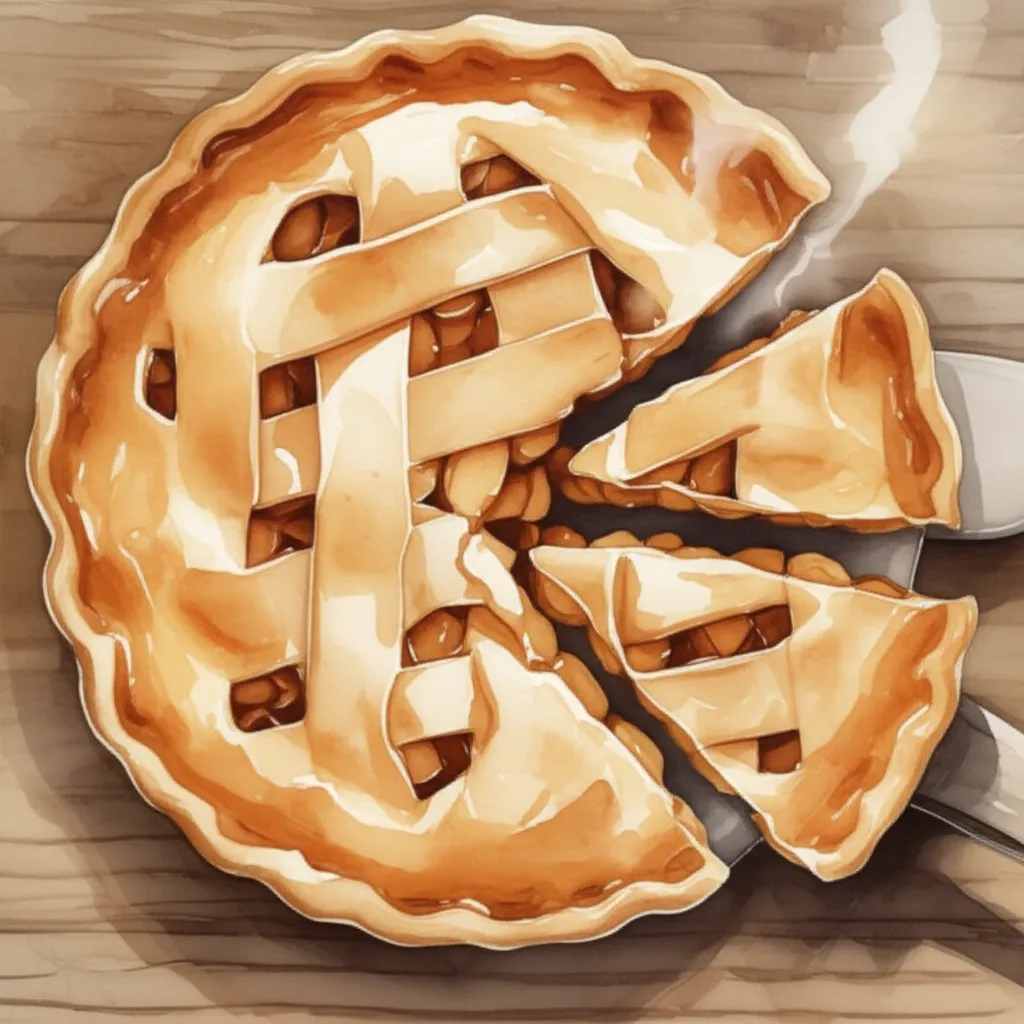
Put 12 grapes on the table. Ask: "How many ways can we share these?" Watch what happens. The child starts grouping them — 6 and 6, or 4 and 4 and 4, or 3 and 3 and 3 and 3. They're doing arithmetic, but it doesn't feel like arithmetic. It feels like play.
That's the point. The child is working with something real. The whole is right there in front of them. The parts reveal themselves naturally.
Before
"Build something from nothing."
After
"What's already inside?"
Does This Only Apply to Young Children?
Steiner applied the same principle all the way to the Pythagorean theorem. Teach it, he said, by cutting squares on the sides of a right triangle. Let children see that the two smaller squares, rearranged, fill the larger square. Let them hold the pieces in their hands.
Then let them forget it.
Let them rediscover it later, when they're ready. The wonder must remain.
"The best thing about the theorem of Pythagoras is that 'one has always known it'… We should know things in such a way that we feel that we have always known them."
Rudolf Steiner, The Kingdom of Childhood (1924)This is the deeper principle at work. Mathematics isn't something imported into the child from outside. It's something they already carry — in their body, in their intuition, in the way they naturally experience wholes before parts. The teacher's job isn't to install arithmetic. It's to help the child discover what's already there.
The Core Principle
Always start from the whole and divide into parts.
Never build from parts to reach a whole.
The child already contains the mathematics. Help them find it.
Want More Strategies Like This?
We extract actionable parenting techniques from research and books — no fluff, just what works.
Browse All Strategies