
Literacy · Ages 7–9
Writing Before Reading
Why Waldorf kids pick up a crayon before a book — ages 7–9
Kids who use their whole body to learn letters become kids who actually love writing.
- Kids taught this way grip the crayon with purpose, not dread. They see F in a fish, W in waves, S in a snake. Every letter has a story. Every story lives in their hands before it reaches their head.
- The move: replace letter worksheets with painting — let letters emerge from pictures the child draws, then practice writing before reading.
“This is the letter M. It makes the ‘mmm’ sound.”
Your six-year-old stares at the worksheet. You point at the shape. They copy it. They trace it. They forget it by Thursday. Next week, you start again.
The problem isn’t your child’s memory. The problem is that M is a stranger — an abstract shape with no connection to anything they know or care about.
“It is like showing a stranger’s portrait and expecting love.”
Paraphrased from Rudolf Steiner, The Kingdom of Childhood, Lecture 2 (1924)In 1924, Steiner proposed something that most schools still haven’t adopted: don’t start with letters at all. Start with pictures. And don’t start with reading. Start with writing.
Why Would You Teach Writing Before Reading?
This is the first reversal, and it sounds wrong until you think about it physically.
When a child writes, the whole body is engaged. The fingers grip the crayon. The arm sweeps across the page. The posture shifts. The shoulder, the wrist, the core — all active.
When a child reads, only the head is working. Eyes track. Brain decodes. The body sits still.
Standard approach
Reading first, writing second
Starts with the most abstract activity. Only the head is engaged. The body sits passive.
Waldorf approach
Writing first, reading second
Starts with the whole body. Fingers, arm, posture — all active. The head follows the body.
Writing engages the whole body. Reading engages only the head. For children aged 7–9, who are still beings of imagination and movement, starting with the body makes the learning stick.
But writing what? Not letters copied from a chart. Letters that grew from something real.
How Do Letters Come from Pictures?
This is Steiner’s second insight, and it’s rooted in history. The alphabet wasn’t invented abstract. It evolved from pictures. Ancient pictographs became hieroglyphs became Phoenician letters became the alphabet you’re reading now.
Steiner’s method lets children recapitulate that journey in weeks rather than millennia.
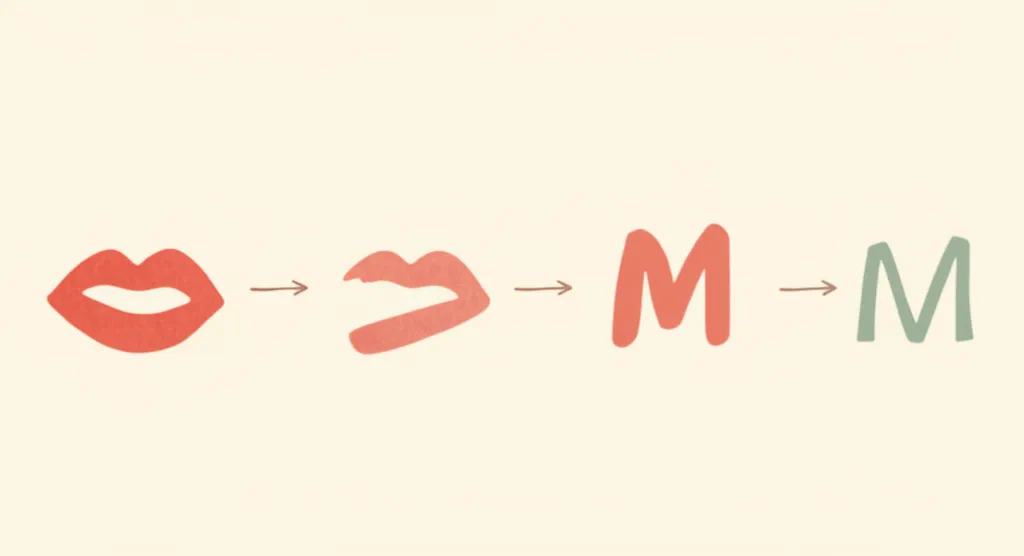
Here’s how it works with the letter M: the child paints a mouth with red color. They say the word slowly: “Mmmouth.” They isolate the first sound: “Mmmm.” Then they look at their lips in a mirror — and see two peaks pressing together. Those two peaks are the letter M.
M didn’t come from a worksheet. It came from the child’s own body.
What Does the Full Method Look Like?
The 5-Step Picture-to-Letter Method
Paint or draw a real thing
Not abstract shapes. A mouth, a fish, waves, a snake — objects the child knows and can picture. Use colors freely. The goal is expression.
Say the word, isolate the sound
Say the word slowly. Find the initial sound. “Mmmmouth” → “Mmmm.”
“Say it slowly. What sound does it start with?”
Transform the picture into the letter
Guide the child to see how the letter shape lives inside the picture. The two peaks of the upper lip become M. The winding path of a snake becomes S.
Practice writing (not reading)
Once the child understands the letter as a transformed picture, they write it. The whole body is engaged — fingers, arm, posture.
Reading comes last
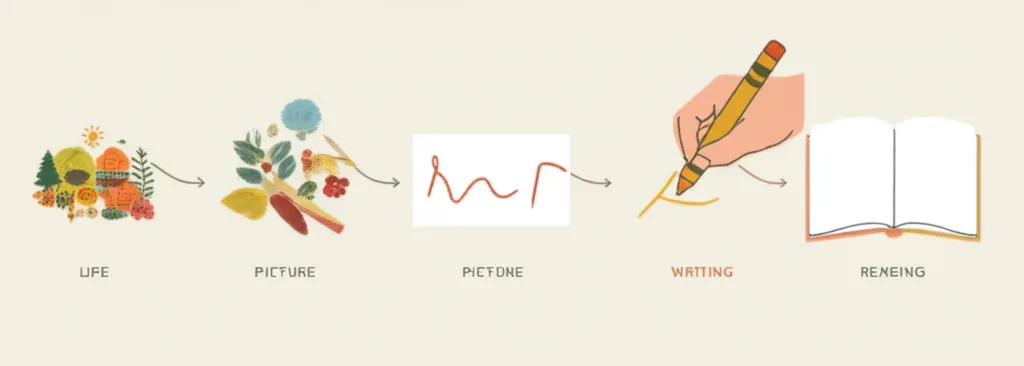
Only after children can write do you transition to reading. The sequence is always: Life → Picture → Writing → Reading.
Which Letters Come from Which Pictures?
Steiner gave several examples, but emphasized that teachers should invent their own. What matters isn’t historical accuracy — it’s that the child experiences the letter as meaningful, not arbitrary.
Consonants: From Objects
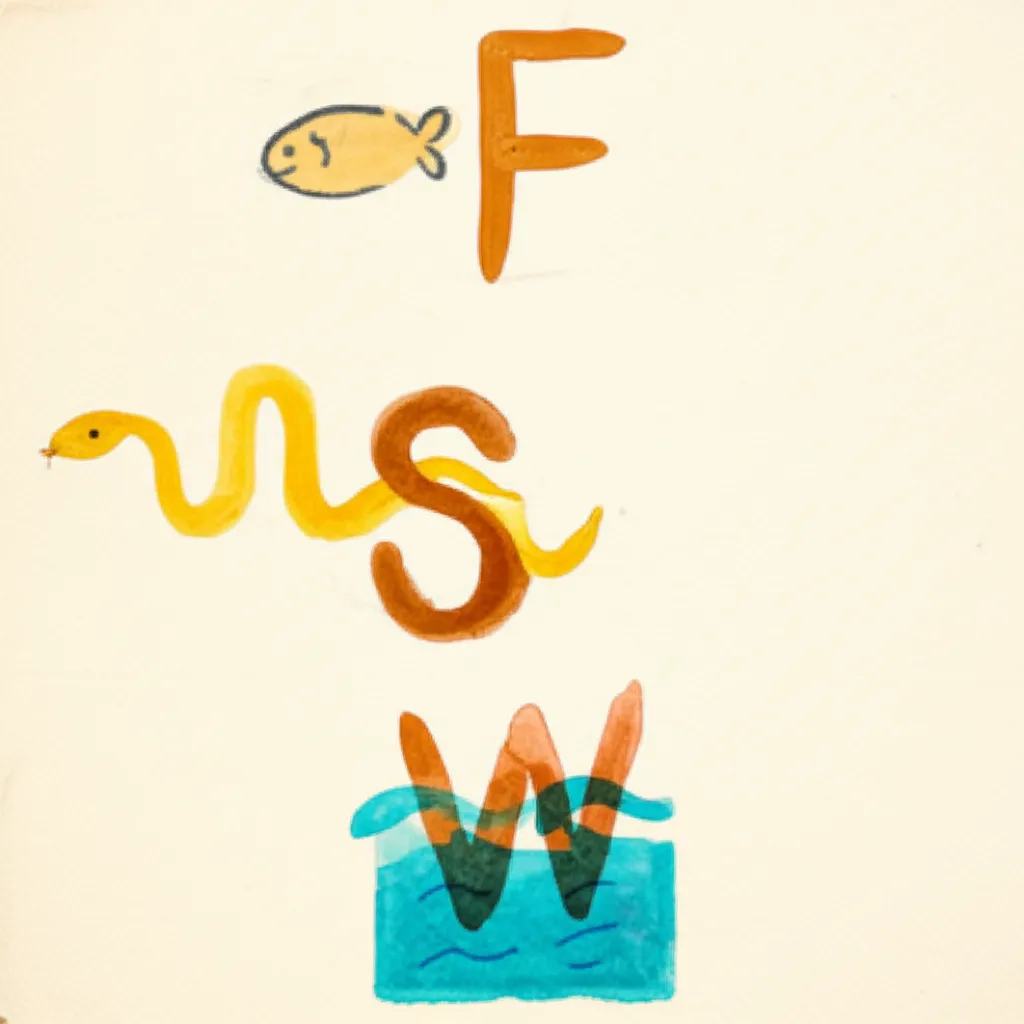
From a mouth
The two peaks of the upper lip pressing together
From a fish
The shape of a fish with fins extended
From a snake
A snake’s winding path across the ground
From waves
The up-and-down pattern of waves on water
From a bear
A bear’s round body and belly
Vowels: From Gestures
Vowels work differently. They don’t come from objects but from emotional expressions — the sounds and gestures the body makes naturally.
Vowels from the Body
A — Arms raised in wonder: “Ahhh!” The raised arms form the A shape.
O — Arms embracing with love. The circular embrace forms the O.
E — Pointing at something with surprise: “Eh?” The angular gesture mirrors the E shape.
Can You Invent Your Own Transformations?
Yes — and Steiner said you should. The picture-to-letter connection doesn’t need to follow historical etymology. What matters is that your child experiences the letter emerging from something real.
A child who loves dinosaurs might see the letter D in a dinosaur’s curved back. A child fascinated by trees might see T in a trunk with branches. The creative path is yours to find.
Be inventive. You don’t need to follow these exact examples. What matters is that the child experiences the letter as meaningful, not arbitrary. Each parent and teacher can find their own creative path.
Why Does This Matter for Ages 7–9?
Steiner’s argument was specific to this age. Children between 7 and 10 live in imagination, not intellect. They think in pictures, stories, and movement. Asking them to decode abstract symbols — which is what reading demands — asks them to skip the stage they’re in.
The picture-letter method respects where the child actually is. It lets them work with imagination (painting), with their body (writing), and with meaning (the letter grows from something they understand). Only then does abstraction enter.
“In writing, the whole human being is active. The fingers take part, the body is positioned, the whole person is engaged. In reading only the head is occupied.”
Rudolf Steiner, The Kingdom of Childhood, Lecture 2 (1924)The Sequence
Life → Picture → Writing → Reading.
Never start with the abstract. Always start with the real.
The body comes first. The head follows.
Want More Strategies Like This?
We extract actionable parenting techniques from research and books — no fluff, just what works.
Browse All Strategies